

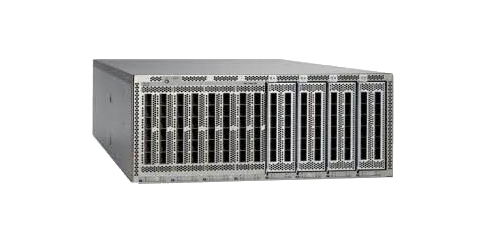
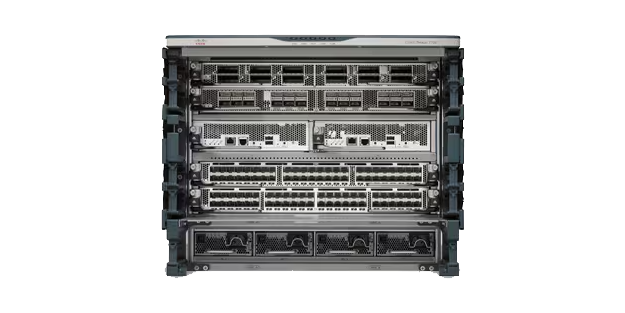
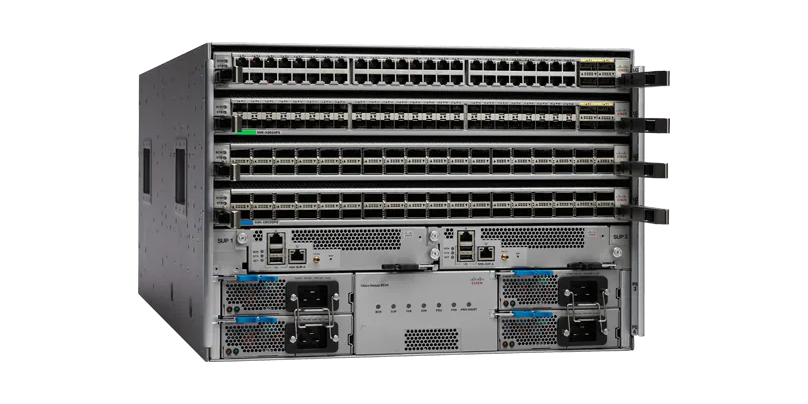
The Cisco Nexus License defines how Cisco Nexus data center switches enable the required NX-OS software capabilities, fabric features, telemetry, routing, switching, automation, and data center networking subscriptions. Licensing is usually planned around the Nexus platform family, switch model, NX-OS release, Essentials / Advantage / Premier tier, deployment architecture, add-on features, Smart Licensing method, and support or subscription term.
Key Benefits
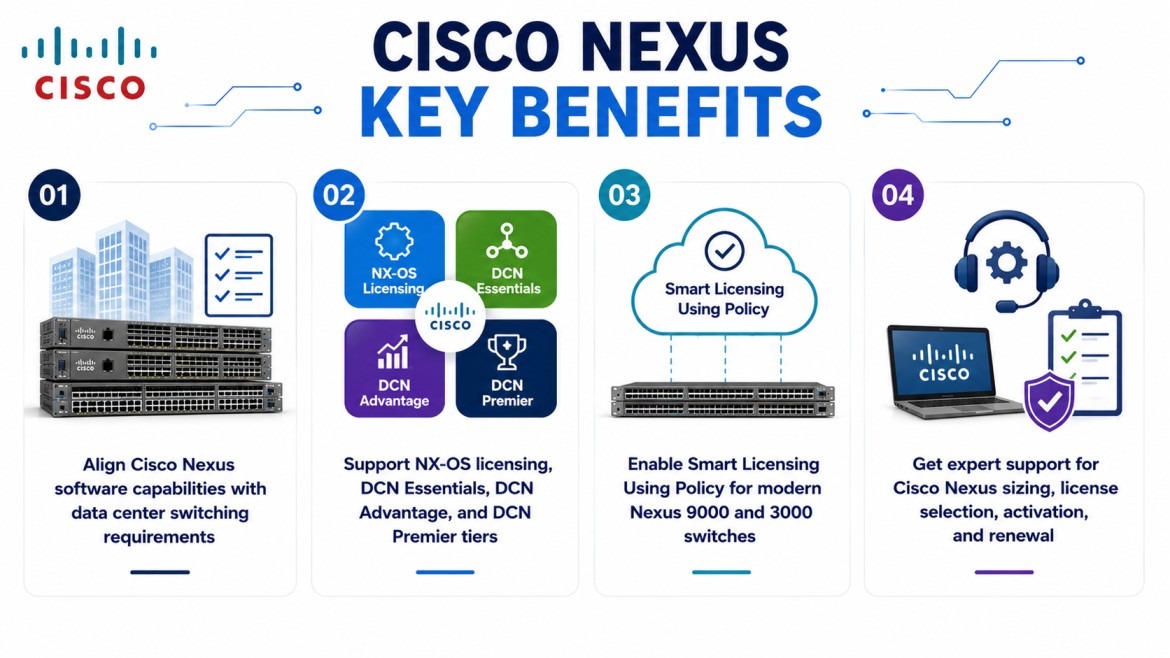
- Align Cisco Nexus software capabilities with data center switching requirements
- Support NX-OS licensing, DCN Essentials, DCN Advantage, and DCN Premier tiers
- Enable Smart Licensing Using Policy for modern Nexus 9000 and 3000 switches
- Get expert support for Cisco Nexus sizing, license selection, activation, and renewal
Cisco Nexus License At a glance
What it does : Cisco Nexus licensing enables NX-OS software features and data center networking capabilities across Cisco Nexus switching platforms, including data center fabric operations, routing, switching, VXLAN EVPN, telemetry, and advanced operational visibility.
License type : Product-dependent. Cisco documentation states that NX-OS licensing covers feature and module-based licensing options for Cisco Nexus switches running NX-OS software, and that tier-based licensing is available for some Cisco Nexus 3000 and 9000 Series switches.
Typical term : Cisco Nexus tier-based licenses may be available as subscription or perpetual consumption models. Cisco’s NX-OS licensing guide states that subscription term-based licenses are available in 3-year, 5-year, and 7-year terms.
Activation method : Smart Licensing Using Policy for supported Nexus platforms, with usage reporting through Cisco Smart Software Manager, Smart Software Manager On-Prem, Cisco Smart Licensing Utility, or disconnected workflows depending on the deployment. Cisco states that beginning with NX-OS Release 10.2(1)F, Smart Licensing Using Policy is enabled by default on all Nexus devices.
Who needs it : Organizations deploying Cisco Nexus switches for data center switching, spine-leaf networks, VXLAN EVPN fabrics, ACI or NX-OS standalone architectures, storage-adjacent networking, telemetry, and high-scale enterprise data center operations.
License Overview
Cisco Nexus licensing depends on the switch family, NX-OS release, feature requirements, deployment architecture, and whether the environment uses standalone NX-OS, ACI, or broader Cisco Data Center Networking subscriptions.
The Cisco Nexus License may be structured around tier-based licenses, feature-based licenses, module-based licenses, or platform-specific licensing depending on the device and software release. Cisco’s NX-OS licensing guide explains that licensing allows access to specified premium features after installing the appropriate license, and it lists licensing support across Nexus 5000, 7000, 3000, and 9000 Series platforms.
For many modern Nexus 3000 and 9000 deployments, tier-based licensing is especially important. Cisco states that tier-based licensing applies to both Cisco ACI and NX-OS standalone architectures where supported Nexus switches are deployed, and that DCN tiers include Essentials, Advantage, and Premier.
Because Nexus environments can include fixed switches, modular chassis, spine-leaf fabrics, high-speed data center interconnect, VXLAN EVPN, telemetry, and automation features, licensing should be planned around the actual network role and feature requirements rather than only the hardware model.
A properly aligned licensing model helps organizations avoid feature gaps, support data center growth, maintain entitlement compliance, and keep Cisco Nexus capabilities aligned with the intended data center architecture.
Product Overview
Cisco Nexus switches are commonly used in enterprise data centers where performance, fabric scalability, low-latency switching, and operational visibility are important.
A basic Nexus deployment may only require standard NX-OS switching and routing capabilities. A larger data center environment may require VXLAN EVPN, ACI fabric capabilities, multi-site connectivity, telemetry, segmentation, advanced operations, or Nexus Dashboard-related visibility.
Cisco Nexus licensing is designed to align these software capabilities with the real deployment model. This allows organizations to select a license tier or add-on scope based on whether the switch is used as a top-of-rack switch, spine switch, leaf switch, aggregation device, or part of a broader data center fabric.
One of the main operational advantages is structured data center feature planning. Instead of treating every Nexus switch as the same, teams can license each platform based on its role, feature requirements, and long-term fabric strategy.
For organizations standardizing on Cisco Nexus switching, this approach supports more predictable deployment planning, cleaner lifecycle management, and stronger control over data center network capabilities.
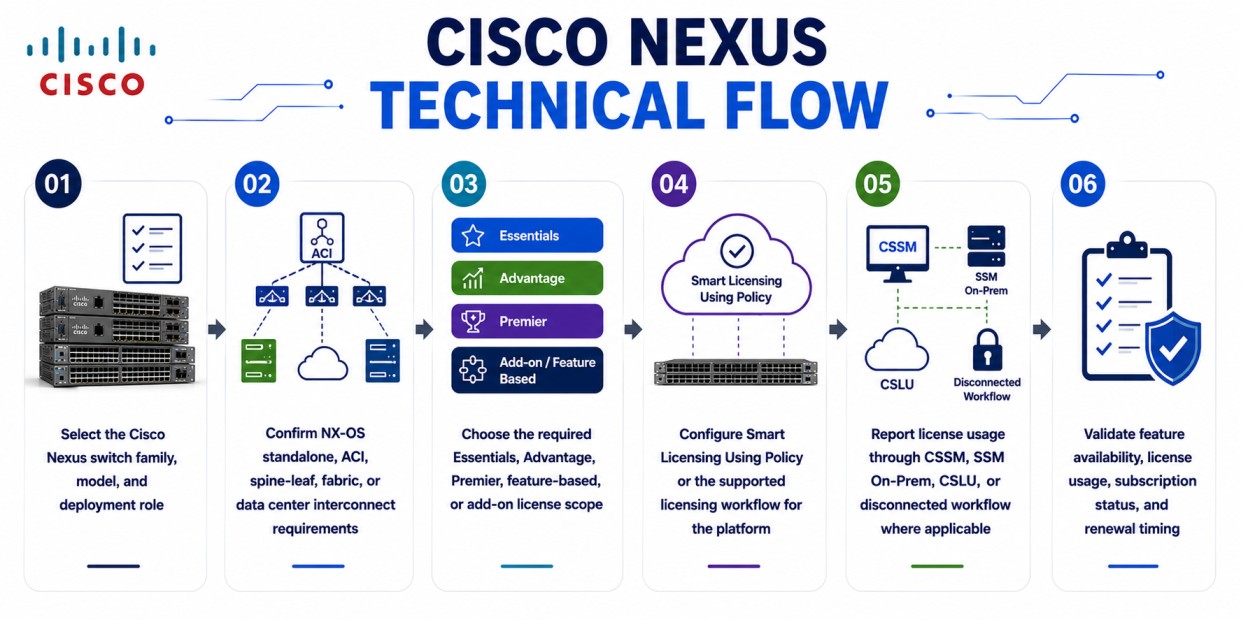
Core technical flow
- Select the Cisco Nexus switch family, model, and deployment role
- Confirm NX-OS standalone, ACI, spine-leaf, fabric, or data center interconnect requirements
- Choose the required Essentials, Advantage, Premier, feature-based, or add-on license scope
- Configure Smart Licensing Using Policy or the supported licensing workflow for the platform
- Report license usage through CSSM, SSM On-Prem, CSLU, or disconnected workflow where applicable
- Validate feature availability, license usage, subscription status, and renewal timing
Options & Tiers
| Licensing Model | Best for | Typical Scope | What affects pricing |
|---|---|---|---|
| DCN Essentials | Foundational Nexus data center switching | Routing, switching, fabric services, telemetry, and basic data center functions | Switch model and platform tier |
| DCN Advantage | Advanced data center fabrics | Adds advanced fabric, DCI overlay, VXLAN EVPN Multi-Site, and related capabilities | Feature depth and fabric scale |
| DCN Premier | Operations and advanced assurance | Includes Advantage and Essentials plus Network Assurance / Insights capabilities | Operational visibility needs |
| Feature-based licenses | Specific NX-OS premium features | Platform or release-specific feature enablement | Feature requirement |
| Module-based licenses | Modular Nexus platforms | Features enabled per physical module | Module count and chassis design |
| Smart Licensing Using Policy | Modern Nexus 3000/9000 deployments | Usage reporting and compliance workflow | NX-OS release and transport model |
Features & Benefits
As data center networks expand across virtualization, cloud connectivity, high-speed storage traffic, distributed applications, and multi-site fabrics, Nexus licensing becomes important for keeping software capabilities aligned with the actual architecture. A well-planned Cisco Nexus License allows teams to enable the right level of data center networking functionality, whether the environment needs foundational switching, VXLAN EVPN, advanced fabric operations, telemetry, or deeper operational assurance.
One major benefit is scalability. Nexus tiered licensing gives organizations a clearer way to align license levels with fabric size, feature needs, and operational maturity. Another important benefit is visibility and operational control. Cisco describes Data Center Networking subscriptions as tiered licensing that can help simplify data center operations, scale access to innovations, and support flexible licensing choices. Over time, this helps organizations reduce licensing confusion, improve data center planning, and keep Nexus software capabilities matched with both current and future network requirements.
System Requirements
Common environments
- Cisco Nexus data center switching environments
- Nexus 3000, 7000, 9000, and modular data center platforms
- NX-OS standalone architectures
- ACI and data center fabric environments
- VXLAN EVPN, spine-leaf, DCI, and high-speed data center networks
Technical requirements
- Supported Cisco Nexus switch model and NX-OS release
- Cisco Smart Account and Virtual Account access where applicable
- Correct DCN / NX-OS license tier or add-on license
- CSSM, SSM On-Prem, CSLU, or disconnected reporting workflow depending on deployment
- Feature validation based on platform support and software release
How activation works
Activating a Cisco Nexus License usually starts with confirming the switch model, NX-OS release, license tier, and Smart Account where the entitlement is available. For supported Nexus 9000 and 3000 switches, Cisco uses Smart Licensing Using Policy. Cisco describes SLP as an enhanced Smart Licensing model that supports license usage reporting for compliance and management without disrupting network operations.
In connected environments, license usage can be reported to Cisco Smart Software Manager. In controlled environments, organizations may use SSM On-Prem or Cisco Smart Licensing Utility. For offline or air-gapped deployments, Cisco’s SLP comparison table lists disconnected workflows where transport mode is off as an available model.
After the licensing workflow is configured, administrators should validate the active license tier, feature availability, usage reporting status, RUM report handling, and renewal dates. Cisco’s SLP documentation notes that license usage is reported through Resource Utilization Measurement reports and that reporting policies define acknowledgment and reporting requirements.
After activation, organizations should periodically review switch inventory, tier usage, feature enablement, Smart Account alignment, and subscription renewal timing to keep the Cisco Nexus environment compliant and operationally aligned.
Pricing factors + quote process
Pricing for Cisco Nexus licensing usually depends on switch model, platform family, license tier, deployment architecture, subscription term, add-on features, and support coverage.
A basic NX-OS standalone deployment may require a different license scope than a large VXLAN EVPN fabric, ACI deployment, modular chassis environment, or multi-site data center network. Cisco’s NX-OS licensing guide notes that tier-based licenses are available as subscription and perpetual consumption models, with subscription options in 3-, 5-, and 7-year terms.
Additional considerations such as fixed versus modular platforms, port speed, fabric role, Nexus Dashboard features, telemetry requirements, operational assurance, SSM On-Prem needs, renewal timing, and Cisco support coverage can also influence the final quote.
During the quote process, Nexus inventory, architecture design, feature requirements, license tier, and activation model are reviewed first so the licensing approach can match the organization’s data center networking strategy more accurately.
After you request a quote
- We review your Cisco Nexus models and data center architecture
- Recommend the suitable Essentials, Advantage, Premier, or add-on licensing scope
- Provide official pricing and delivery details
- Share Smart Licensing and activation guidance
Cisco Nexus pricing depends on your router series, license type, deployment model and support requirements.