

Splunk licensing helps you collect, search, and make sense of machine data at scale, so security, IT, and observability teams can turn logs into useful insights and act faster.
Quick benefits
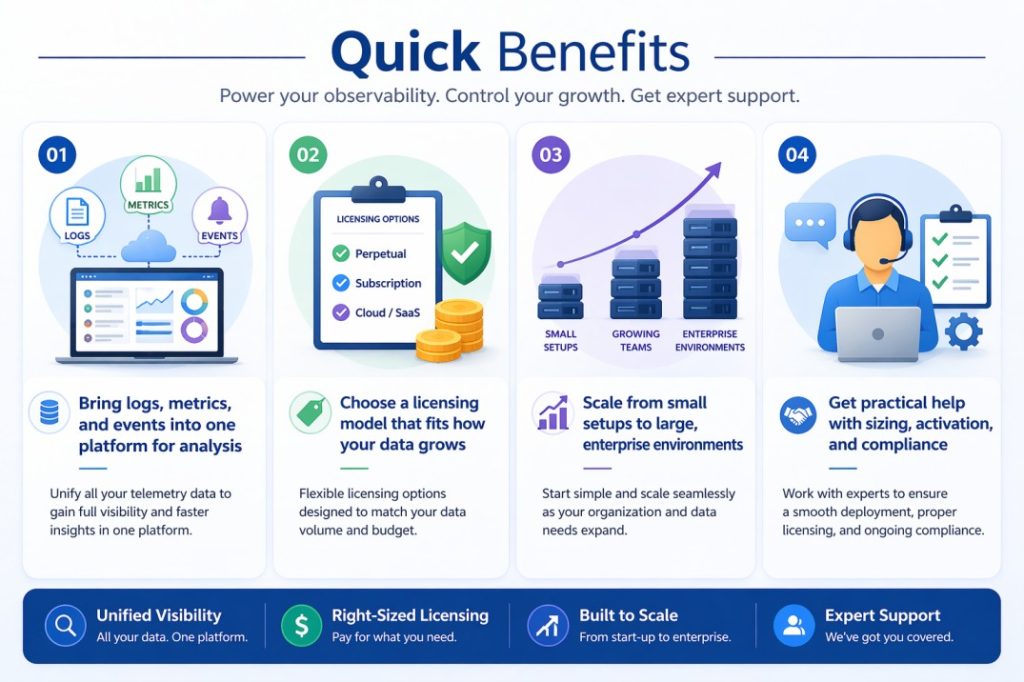
- Bring logs, metrics, and events into one platform for analysis
- Choose a licensing model that fits how your data grows
- Scale from small setups to large, enterprise environments
- Get practical help with sizing, activation, and compliance
Splunk License At a glance
What it does : Controls how much data you can bring into Splunk and analyze, along with access to its features and apps.
License type : Subscription (for most modern deployments)
Typical term : 1 year · 3 years · 5 years
Activation method : License key applied in Splunk Enterprise or entitlement applied in Splunk Cloud
Who needs it : Security, IT operations, and observability teams dealing with large volumes of logs and machine data
License Overview
The Splunk license determines how much data your organization can ingest, store, and analyze within the platform during a given subscription period. Unlike traditional licensing models that are based on users or devices, Splunk is typically licensed based on data usage, most often measured as the amount of data ingested per day. This approach makes the license closely tied to how the platform is actually used in real environments.
In day-to-day operations, this means that as your infrastructure grows, whether through more applications, servers, integrations, or users, the volume of data increases as well. As a result, your licensing needs naturally scale with your environment. Splunk supports this by offering flexible licensing options across both self-managed deployments (Splunk Enterprise) and cloud-based environments (Splunk Cloud). Activation usually involves applying a license key or entitlement, which defines your allowed data ingestion capacity and keeps the platform running within those limits.
Because data volume is the main factor, getting the sizing right is important. If the estimate is too low, you may run into limits or warnings. If it’s too high, you may end up paying for capacity you don’t use. A well-sized license helps keep things predictable, avoids interruptions, and makes renewals easier as your data continues to grow.
Options & Tiers
| Plan / Model | Best for | Key inclusions | What affects price |
|---|---|---|---|
| Ingest-based licensing | Most common deployments | Daily data ingestion capacity | GB/day volume, term |
| Infrastructure-based licensing | Large, predictable environments | Resource-based usage model | Infrastructure size, term |
| Splunk Cloud subscription | SaaS deployments | Managed platform + ingestion | Data volume, cloud scope |
| Splunk Enterprise | On-prem deployments | Full control and flexibility | Data volume, infrastructure |
Features & Benefits
Splunk is designed around one core idea: turning raw machine data into something useful. Its licensing model reflects that by scaling with the amount of data you bring in, rather than limiting you by users or devices. For most teams, this feels more natural, since data volume is what actually grows as systems and applications expand.
Another advantage is flexibility in how you deploy it. Some teams prefer running Splunk in their own environment for full control, while others go with the cloud version to reduce operational overhead. Either way, the way you interact with the platform stays consistent. Once data is in, you can search, analyze, and build reports quickly, which helps with troubleshooting, security investigations, and day-to-day monitoring.
Compatibility & Requirements
Common environments
- Security operations (SIEM)
- IT operations and monitoring
- Observability and analytics platforms
Typical prerequisites
- A clear estimate of daily data ingestion
- Defined data sources (logs, metrics, events)
- A decision on deployment (cloud vs on-prem)
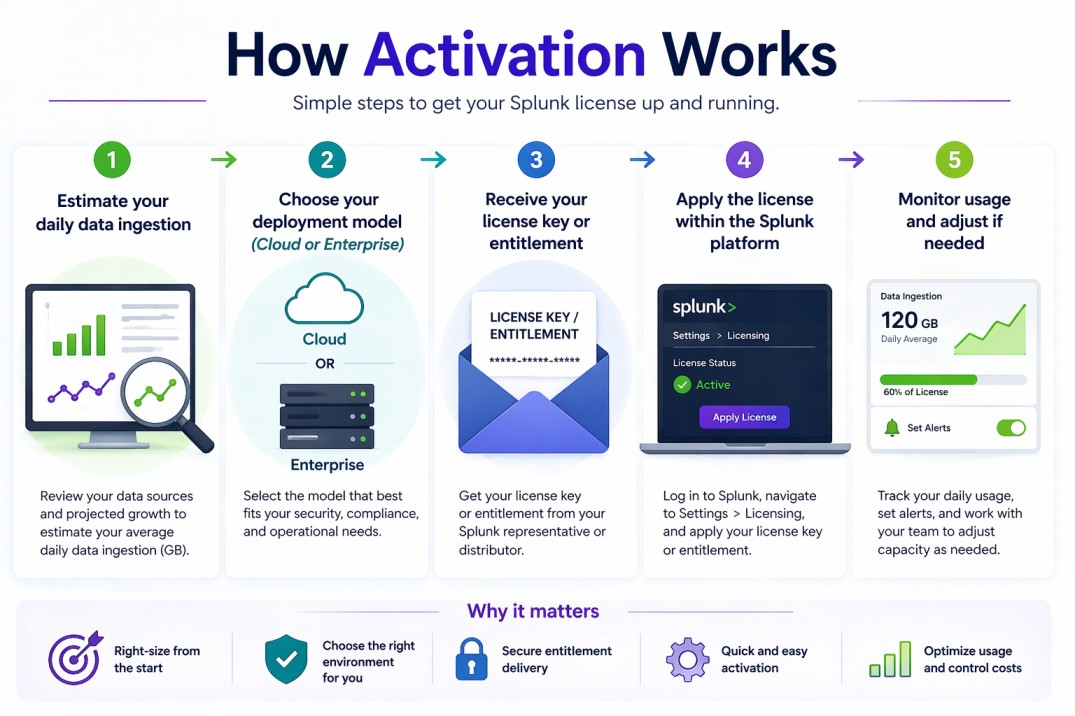
How activation works
- Estimate your daily data ingestion
- Choose your deployment model (Cloud or Enterprise)
- Receive your license key or entitlement
- Apply the license within the Splunk platform
- Monitor usage and adjust if needed
Pricing factors + quote process
Splunk pricing mainly depends on how much data you ingest into the system each day. The more logs, metrics, and events you collect, the more capacity you need. Deployment type also matters—cloud deployments usually include infrastructure and management, while on-prem setups depend more on your own environment. The subscription term can also affect pricing, with longer terms often offering better overall value.
After you request a quote
- We review your data volume and use case
- Recommend the most suitable licensing model
- Provide official pricing and delivery details
- Share guidance for activation and deployment
Splunk Pricing depends on your license edition, quantity, term, and deployment needs.