

Cisco NCS 2000 Series is a Cisco optical transport platform family designed for DWDM networks, ROADM-based optical transport, coherent wavelength services, metro and long-haul connectivity, transponding, muxponding, and high-capacity optical infrastructure. Unlike packet routers or branch network devices, Cisco NCS 2000 platforms are mainly selected when the network needs flexible wavelength routing, optical service expansion, fiber efficiency, and carrier-grade transport performance. This page helps buyers understand Cisco NCS 2000 ordering considerations, review licensing and part-number requirements, and move to the related Cisco NCS 2000 part numbers for accurate quote planning.
Series Highlights
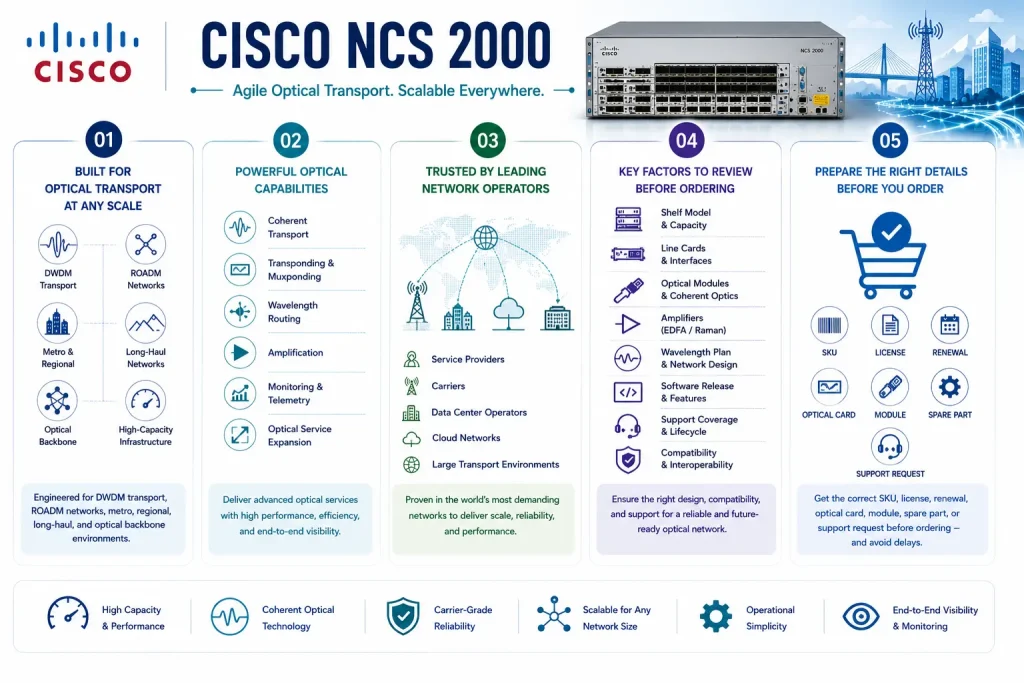
- Suitable for DWDM transport, ROADM networks, metro, regional, long-haul, and optical backbone environments
- Supports coherent transport, wavelength routing, amplification, and optical service expansion
- Commonly used by service providers, carriers, data center operators, cloud networks, and large transport environments
- Requires careful review of shelf model, line cards, optical modules, amplifiers, wavelength plan, software release, support, and compatibility
- Helps buyers prepare the correct SKU, license, renewal, optical card, module, spare part, or support request before ordering
Review Cisco NCS 2000 Price List and request a quote tailored to your licensing needs.
Cisco NCS 2000 At a glance
What it is : Cisco NCS 2000 Series is an optical transport and DWDM platform family within the Cisco Network Convergence System portfolio.
Product family : Cisco NCS License
Typical use : DWDM transport, ROADM optical networking, metro transport, regional transport, long-haul connectivity, coherent wavelength services, transponding, muxponding, and optical backbone expansion.
License or ordering scope : Shelf model, line cards, optical service cards, coherent modules, amplifiers, mux/demux components, software release, support renewal, software entitlement, and activation method where applicable.
Who needs it : Service providers, cloud operators, carriers, data center teams, and large enterprises that need the correct Cisco NCS 2000 part number, optical component, software entitlement, support option, or renewal.
Series Overview
Cisco NCS 2000 Series is built for optical networks where capacity, wavelength flexibility, reach, and service continuity are critical. It is commonly used when operators need to transport high-speed services across metro, regional, long-haul, or backbone fiber infrastructure.
In a typical deployment, Cisco NCS 2000 may be used as a DWDM platform with ROADM capabilities, coherent transport cards, transponder and muxponder functions, amplifiers, passive modules, and optical monitoring components. These environments often require careful wavelength planning, fiber-path design, optical power validation, and compatibility checks between shelves, cards, optics, and software versions.
The value of Cisco NCS 2000 is that it helps operators scale optical transport while keeping wavelength provisioning and service expansion more flexible. Compared with the packet-routing platforms covered by the broader Cisco Router License category, Cisco NCS 2000 ordering requires more detailed optical design and compatibility checks. The correct part number depends on the optical role, card type, wavelength requirement, supported rate, fiber distance, line-system design, and support coverage.
Licensing and Part Number Guidance
Choosing the correct part number for Cisco NCS 2000 depends on the exact shelf model, optical role, line card requirement, wavelength plan, software release, coherent optics, amplification design, support term, and activation method.
Some requests may involve transponder or muxponder cards for carrying client services over DWDM. Others may require ROADM line cards, contentionless add/drop components, amplifiers, passive patch panels, mux/demux modules, controller cards, power supplies, fan units, optics, or support renewals.
Cisco NCS 2000 ordering should not be treated like a simple license request. Optical compatibility is a major part of the process. Fiber distance, channel spacing, optical power, line-system design, card generation, software version, and supported service rate can all affect the final SKU. For existing deployments, the current platform inventory should be reviewed before ordering. This helps avoid mismatched cards, unsupported optics, incorrect service modules, software incompatibility, or support coverage gaps.
Common Use Cases
| Use case | Why it matters |
|---|---|
| DWDM transport expansion | Helps increase wavelength capacity across metro, regional, and long-haul optical networks |
| ROADM-based optical networking | Supports flexible wavelength routing and optical service provisioning without constant manual fiber changes |
| Coherent wavelength services | Enables high-speed optical transport for data center, carrier, cloud, and backbone traffic |
| Transponding and muxponding | Helps transport multiple client services efficiently across DWDM infrastructure |
| Amplifier and line-system planning | Supports optical reach, signal quality, and service continuity across fiber paths |
| Card, module, or renewal planning | Helps validate shelf, card, optics, software, license, and support requirements before ordering |
Models, Licenses, and Ordering Scope
| Area to check | What to confirm |
|---|---|
| Platform model | Exact Cisco NCS 2000 shelf, chassis, or system configuration requirement |
| Optical role | DWDM transport, ROADM node, transponder, muxponder, amplification, add/drop, or line-system expansion |
| Card requirement | Line cards, service cards, coherent cards, ROADM cards, controller cards, or passive modules |
| Interface requirement | Client ports, trunk ports, optical rates, wavelength plan, coherent optics, and fiber design |
| Software version | Supported platform software release, feature compatibility, and operational requirements |
| License type | Software entitlement, feature license, support renewal, Smart License where applicable, or product-specific licensing |
| Hardware scope | Shelf, line card, amplifier, mux/demux, patch panel, optics, fan, power supply, or spare component |
| Quantity | Number of shelves, optical cards, wavelengths, optics, line-system parts, spare units, or renewal targets |
| Term | 1-year, 3-year, 5-year, renewal, subscription, or support coverage period |
| Activation method | Smart License, SLP, Classic License review, PLR License, SLR License, or Cisco-supported workflow where applicable |
| Part number | Correct Cisco NCS 2000 hardware SKU and related license, optic, module, renewal, or support item |
What to Check Before Requesting a Quote
Before requesting a quote for Cisco NCS 2000, confirm the exact shelf or chassis model, installed cards, optical design, required wavelengths, client interface type, line rate, software version, support term, and activation method. You should also define whether the request is for a new DWDM deployment, ROADM expansion, coherent service card, transponder, muxponder, amplifier, spare component, software entitlement, support renewal, or replacement project. Each use case can change the required SKU and compatibility checks.
For existing optical networks, prepare the current inventory first. This should include platform model, serial number, installed cards, optics, software release, fiber path, license status, and support coverage. This step is important because optical transport projects depend heavily on design compatibility and power-budget planning.
Activation and Delivery Notes
After the correct Cisco NCS 2000 part number is selected, activation and delivery depend on the platform model, software release, entitlement type, hardware component, and optical design. Some requests may involve product-specific software entitlement, Smart Licensing where applicable, support renewal, or software feature validation. Other requests may be mainly hardware-focused, such as optical cards, coherent modules, amplifiers, mux/demux components, passive modules, fans, or power supplies.
For hardware delivery, compatibility should be checked before shipment. Optical cards, coherent optics, amplifier modules, ROADM cards, controller cards, passive patch panels, fans, and power supplies must match the selected NCS 2000 platform and software release. For renewal, replacement, or optical expansion projects, the current license and support status should be reviewed first. This helps prevent delivery delays and keeps the ordered SKU aligned with the real optical transport requirement.
Cisco NCS Series pricing depends on your router series, license type, deployment model and support requirements.