

Cisco CSR is commonly used to refer to Cisco Cloud Services Router environments, especially the Cisco CSR 1000V virtual router used for cloud edge routing, VPN, WAN services, and virtual network connectivity. Licensing is usually planned around feature package, throughput level, Smart Licensing method, support status, and whether the environment should remain on Cisco CSR 1000V or migrate to Cisco Catalyst 8000V.
Key Benefits
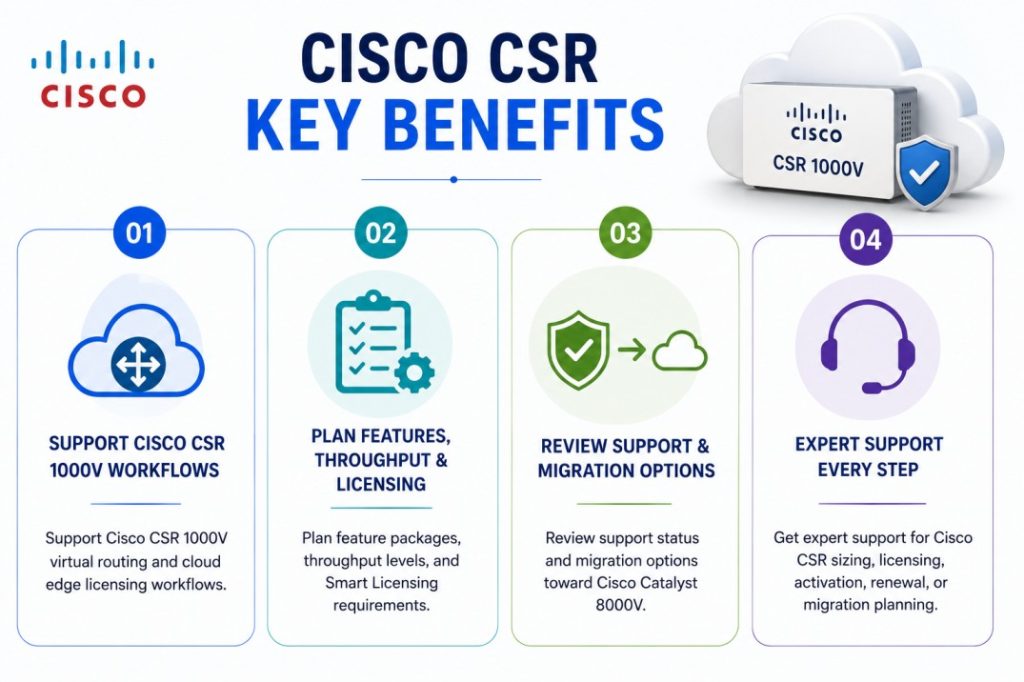
- Support Cisco CSR 1000V virtual routing and cloud edge licensing workflows
- Plan feature packages, throughput levels, and Smart Licensing requirements
- Review support status and migration options toward Cisco Catalyst 8000V
- Get expert support for Cisco CSR sizing, licensing, activation, renewal, or migration planning
Cisco CSR At a glance
What it does : Cisco CSR 1000V, officially Cisco Cloud Services Router 1000V, provides virtual routing, WAN gateway, VPN, cloud networking, and enterprise network services in virtualized or cloud-hosted environments. Cisco describes the CSR 1000V as a virtual router that delivers WAN gateway and network services functions into virtual and cloud environments.
License type : Cisco CSR 1000V licensing is commonly tied to feature package and throughput level. Cisco documentation states that the CSR 1000V supports throughput licenses and that the requested Smart License must match the configured technology package level and throughput level.
Typical term : Historically, CSR 1000V licenses were available in perpetual and term subscription models, with throughput levels such as 10 Mbps, 50 Mbps, 100 Mbps, 250 Mbps, 500 Mbps, 1 Gbps, 2.5 Gbps, 5 Gbps, and 10 Gbps depending on release and licensing model.
Activation method : Cisco Smart Licensing, throughput license request, or Permanent License Reservation for selected restricted environments. Cisco documentation also describes CSR 1000V Smart Licensing support and PLR-related workflows.
Who needs it : Organizations maintaining existing Cisco CSR 1000V deployments, renewing legacy virtual router licensing, validating throughput entitlement, or planning migration from Cisco CSR to Cisco Catalyst 8000V.
License Overview
Cisco CSR licensing is mainly associated with the Cisco CSR 1000V virtual router. The license determines which feature package and throughput level can be used by the virtual router, making it important for cloud edge, VPN, virtual WAN, and network services deployments.
The key licensing factor is throughput. Cisco’s CSR 1000V FAQ explains that IOS XE software on CSR 1000V supports up to 10 Gbps of throughput, but performance is rate-limited based on the license purchased. After activation, the CSR 1000V limits aggregate bidirectional throughput according to the licensed level.
Historically, Cisco CSR also used technology package levels such as Standard, Advanced, and Premium, depending on required routing and network services. Older Cisco CSR documentation describes package-based licensing with different feature levels and server resource requirements based on throughput.
Because Cisco CSR 1000V is now an end-of-support product, licensing should be handled carefully. Cisco’s support page states that the CSR 1000V Series is no longer supported and that customers are advised to migrate to Cisco Catalyst 8000V Edge Software going forward.
A properly planned Cisco CSR license approach helps organizations validate existing entitlement, avoid throughput mismatch, understand support limitations, and decide whether renewal, replacement, or migration is the better path.
Product Overview
Cisco CSR was designed for organizations that needed Cisco routing capabilities in virtual or cloud environments instead of physical router hardware.
In practice, Cisco CSR 1000V can provide virtual WAN routing, VPN termination, network services, and cloud edge connectivity using Cisco IOS XE software. This made it useful for service providers, enterprise cloud environments, hosted data centers, and hybrid WAN designs.
The selected license controls how the router performs and what features are available. A low-throughput virtual router may be suitable for testing or small cloud workloads, while larger production deployments may require higher throughput and broader feature capabilities.
However, Cisco CSR should now be treated as a legacy platform. For new deployments, Cisco’s guidance points toward Cisco Catalyst 8000V Edge Software as the migration path from CSR 1000V. Cisco also notes in current IOS XE documentation that CSR 1000V is no longer supported from Cisco IOS XE Bengaluru 17.4.1a onward and that users should upgrade to Catalyst 8000V.
For existing environments, the main value of Cisco CSR content is helping users understand licensing, activation, throughput validation, and migration planning.
Core technical flow
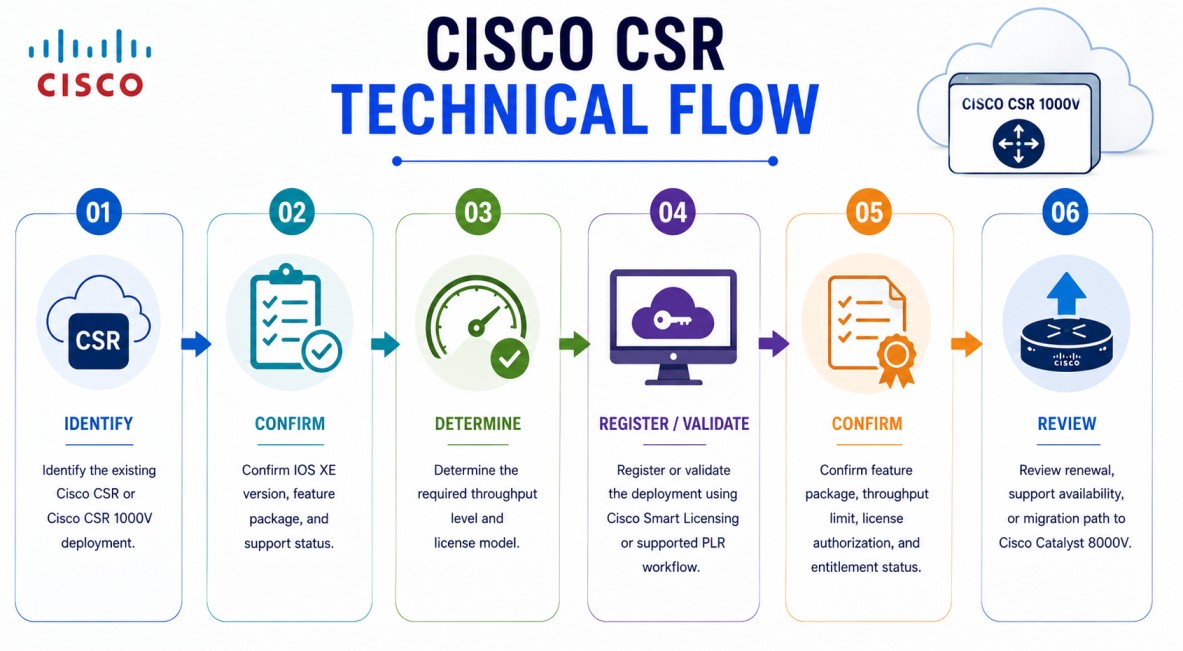
- Identify the existing Cisco CSR or Cisco CSR 1000V deployment
- Confirm IOS XE version, feature package, and support status
- Determine the required throughput level and license model
- Register or validate the deployment using Cisco Smart Licensing or supported PLR workflow
- Confirm feature package, throughput limit, license authorization, and entitlement status
- Review renewal, support availability, or migration path to Cisco Catalyst 8000V
Options & Tiers
| Licensing Model | Best for | Typical Scope | What affects pricing |
|---|---|---|---|
| Throughput license | CSR 1000V performance control | Licensed bandwidth such as 100M, 250M, 1G, or higher | Required throughput |
| Technology package | Feature-based CSR deployments | Standard, Advanced, or Premium-style capability scope | Required features |
| Smart Licensing | Connected Cisco licensing workflow | Registration and entitlement management | Smart Account and license availability |
| Permanent License Reservation | Restricted environments | Offline or controlled license reservation | Security and connectivity model |
| Migration planning | Existing CSR customers | Move from CSR 1000V to Catalyst 8000V | Support status and replacement design |
Features & Benefits
Cisco CSR licensing gives teams control over virtual router capability, throughput, and deployment scope. One major benefit is throughput alignment. Since Cisco CSR 1000V performance is rate-limited by license, teams can match the virtual router’s capacity to the expected traffic profile rather than over-sizing or under-sizing the deployment.
Another benefit is cloud routing flexibility. Cisco CSR was built to extend WAN services into provider-hosted cloud and virtual environments, allowing organizations to use familiar Cisco IOS XE routing capabilities in non-physical deployments.
For existing deployments, the most important benefit is license and migration clarity. Since Cisco CSR 1000V is no longer supported, organizations need to understand their current license position and whether continued use, renewal review, or Catalyst 8000V migration is the correct operational path. Over time, this helps reduce licensing uncertainty, avoid performance surprises, and support cleaner virtual routing lifecycle planning.
System Requirements
Common environments
- Existing Cisco CSR 1000V deployments
- Virtual routing and cloud edge environments
- VPN, WAN gateway, and hosted network services
- Legacy IOS XE virtual router environments
- Migration projects toward Cisco Catalyst 8000V
Technical requirements
- Supported Cisco CSR 1000V image and IOS XE release
- Correct feature package and throughput license
- Cisco Smart Account and Virtual Account access where applicable
- Smart Licensing, PLR, or supported entitlement workflow
- Migration review if the environment is moving to Catalyst 8000V
How activation works
Activating Cisco CSR 1000V licensing usually starts after the virtual router is deployed and the required feature package and throughput level are selected.
For Smart Licensing workflows, the device must be registered with the Smart License server before requesting the required throughput-level license. Cisco’s CSR 1000V licensing documentation states that the requested license should correspond to the configured technology package level and throughput level.
In restricted environments, Cisco CSR could also use Permanent License Reservation workflows. Cisco’s PLR guidance for CSR 1000V notes that the default trial throughput is throttled at 1 Mbps and explains PLR-related handling for environments where normal connectivity or file transfer may be limited.
After activation, administrators should validate the configured package, throughput limit, Smart Licensing status, authorization status, and operational performance. This is important because the router enforces the purchased throughput level after license activation. For current planning, activation should also include a support-status review. Since Cisco CSR 1000V is no longer supported, organizations should confirm whether continued use is acceptable or whether migration to Cisco Catalyst 8000V is required.
Pricing factors + quote process
Pricing for Cisco CSR licensing is usually influenced by the requested throughput level, feature package, term model, existing entitlement status, and whether the request is for legacy renewal or migration planning.
A small test or development environment may only require low throughput, while a production cloud edge router may require higher throughput and stronger feature coverage. Cisco CSR 1000V release notes list supported throughput license levels up to 10 Gbps depending on release and model.
Additional considerations include Smart Licensing availability, PLR requirements, support status, EOL limitations, existing Cisco Smart Account entitlements, and whether Cisco Catalyst 8000V should replace the current CSR design.
During the quote process, the current Cisco CSR deployment, throughput requirement, software version, licensing status, and migration requirement are reviewed first so the licensing approach can match the customer’s real virtual routing environment.
After you request a quote
- We review your Cisco CSR or Cisco CSR 1000V deployment
- Validate throughput, feature package, and license requirement
- Check support, renewal, and migration considerations
- Provide official pricing, delivery details, and activation guidance