

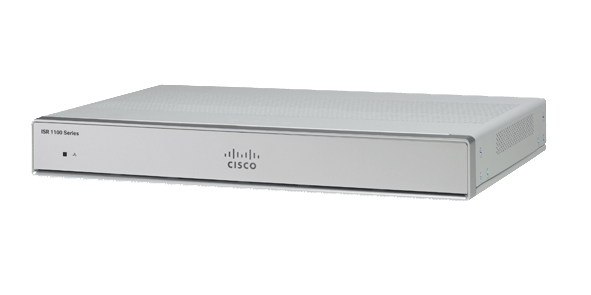


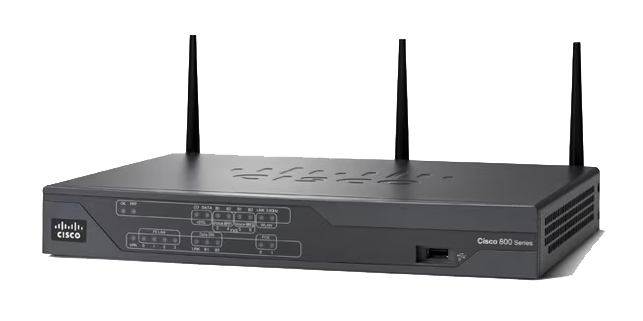
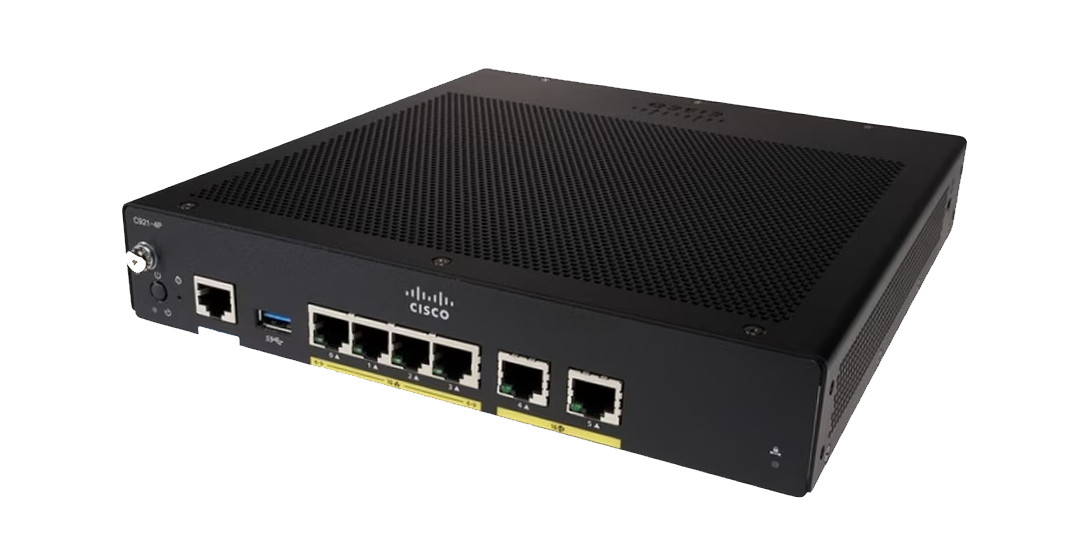
The Cisco ISR License defines how Cisco Integrated Services Router platforms enable routing, WAN, SD-WAN, security, application visibility, voice, throughput, and branch connectivity features across enterprise networks. Licensing is usually planned around the ISR platform family, IOS XE release, required feature tier, Cisco DNA or routing subscription, throughput needs, security requirements, Smart Licensing model, and support or renewal term.
Key Benefits
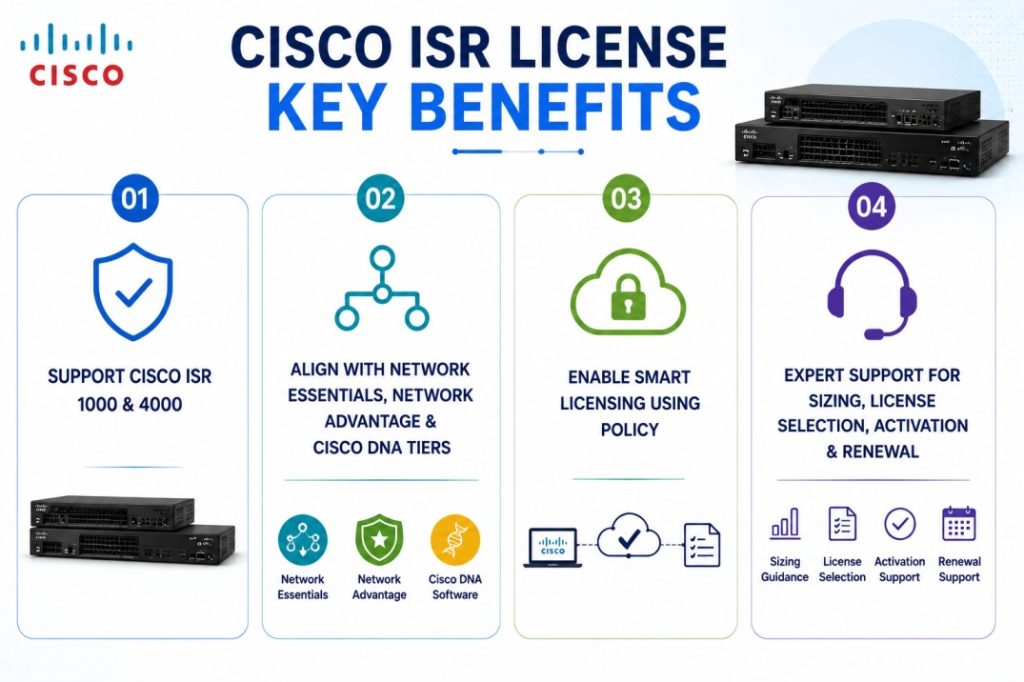
- Support Cisco ISR 1000 and ISR 4000 routing environments
- Align licensing with Network Essentials, Network Advantage, and Cisco DNA software tiers
- Enable Smart Licensing Using Policy for modern IOS XE ISR deployments
- Get expert support for Cisco ISR sizing, license selection, activation, and renewal
Cisco ISR License At a glance
What it does : Cisco ISR licensing enables software features and routing capabilities for Cisco Integrated Services Routers, including branch routing, WAN connectivity, SD-WAN, VPN, security, application visibility, voice services, and enterprise network services.
License type : Product and release dependent. Cisco’s SD-WAN and Routing ordering guide notes that Cisco 1000 and 4000 Series ISRs include Network Essentials or Network Advantage, depending on the purchased tier. Cisco DNA Essentials includes Network Essentials as the perpetual element, while Cisco DNA Advantage includes Network Advantage as the perpetual element.
Typical term : Cisco DNA subscription software for SD-WAN and Routing is commonly available in 3-, 5-, and 7-year terms for Essentials and Advantage offers.
Activation method : Modern Cisco ISR deployments commonly use Smart Licensing or Smart Licensing Using Policy on supported Cisco IOS XE releases. Cisco lists Cisco 1000 Series Integrated Services Routers under IOS XE enterprise routing products supported by Smart Licensing Using Policy.
Who needs it : Organizations deploying Cisco ISR routers for branch connectivity, WAN edge routing, SD-WAN, VPN, voice, security services, application-aware routing, and secure enterprise access.
License Overview
Cisco ISR licensing depends on the router family, IOS XE version, deployment role, software tier, and required services. A small branch router may need only foundational routing and security features, while a larger ISR deployment may require SD-WAN, advanced security, application visibility, voice, higher throughput, or cloud-managed routing capabilities.
The Cisco ISR License is commonly structured around a Network Essentials or Network Advantage software tier, often paired with a Cisco DNA subscription where SD-WAN, routing management, or advanced software capabilities are required. Cisco’s routing subscription guidance explains that ISR 1000 and ISR 4000 platforms include Network Essentials or Network Advantage depending on the tier purchased.
For Cisco ISR 4000 environments, licensing may also involve performance and security-related considerations. Cisco’s ISR 4000 software configuration documentation describes Smart Licensing as a flexible model for purchasing and managing Cisco software across an organization.
Because ISR deployments can include branch sites, VPN hubs, voice gateways, SD-WAN edges, secure internet breakout, and application-aware services, licensing should be planned around the actual branch and WAN role rather than only the hardware model.
A properly aligned Cisco ISR License helps organizations avoid feature gaps, throughput limitations, incorrect tier selection, and licensing compliance issues as branch networks evolve.
Product Overview
Cisco ISR routers are widely used in enterprise branch and WAN environments where connectivity, security, application performance, and service integration need to work together on a single routing platform.
In a basic deployment, an ISR may provide routing, WAN access, NAT, VPN, and site connectivity. In a more advanced environment, it may also support SD-WAN, application visibility, voice services, security functions, cloud connectivity, and centralized management.
Cisco ISR licensing helps determine which of these capabilities are available and how the router fits into the broader network architecture. This makes license planning important before purchasing, upgrading, or renewing ISR platforms.
One of the main operational advantages is deployment flexibility. The same ISR family may support different branch roles depending on software tier, throughput requirement, security need, and management model.
For organizations standardizing branch routing around Cisco ISR platforms, this approach supports cleaner design, easier lifecycle planning, and better control over routing and SD-WAN capabilities.
Core technical flow
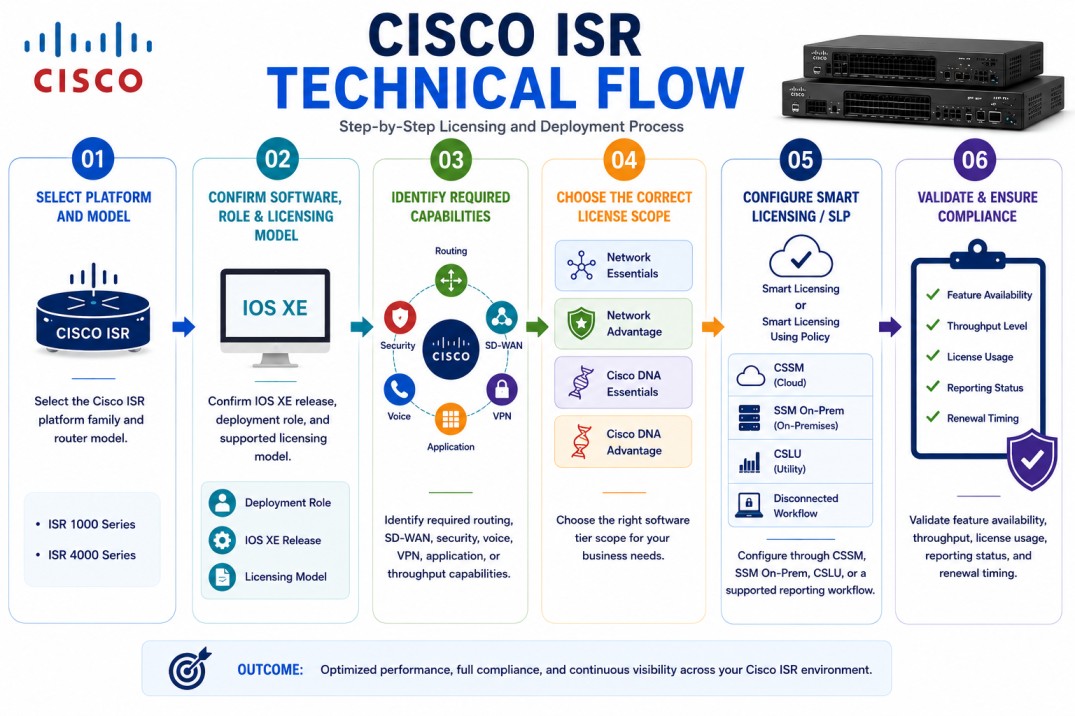
- Select the Cisco ISR platform family and router model
- Confirm IOS XE release, deployment role, and supported licensing model
- Identify required routing, SD-WAN, security, voice, VPN, application, or throughput capabilities
- Choose the correct Network Essentials, Network Advantage, Cisco DNA Essentials, or Cisco DNA Advantage scope
- Configure Smart Licensing or Smart Licensing Using Policy through CSSM, SSM On-Prem, CSLU, or a supported reporting workflow
- Validate feature availability, throughput level, license usage, reporting status, and renewal timing
Options & Tiers
| Licensing Model | Best for | Typical Scope | What affects pricing |
|---|---|---|---|
| Network Essentials | Standard branch routing | Foundational routing and network services | ISR model and required features |
| Network Advantage | Advanced routing environments | Broader routing, security, voice, and application capabilities | Feature depth and branch role |
| Cisco DNA Essentials | Core SD-WAN and routing subscription needs | Term-based management and SD-WAN-related capabilities | Subscription term and platform tier |
| Cisco DNA Advantage | Advanced SD-WAN and routing deployments | Expanded management, policy, analytics, and advanced routing capabilities | Feature requirements and scale |
| Performance / throughput licensing | ISR 4000 performance-sensitive deployments | Higher throughput or platform performance needs | Throughput requirement |
| Smart Licensing Using Policy | Modern IOS XE ISR deployments | Usage reporting and compliance workflow | IOS XE version and transport model |
Features & Benefits
As branch networks grow across remote offices, cloud services, internet breakout, VPN users, and SD-WAN fabrics, ISR licensing becomes important for keeping software capabilities aligned with real operational needs. A well-planned Cisco ISR License allows teams to enable the correct routing, security, voice, SD-WAN, and application-aware capabilities for each branch or WAN edge location.
One major benefit is controlled scalability. Smaller branches can use a simpler software scope, while larger branches or regional sites can be licensed for broader routing, security, and application visibility. Another benefit is improved license governance. Smart Licensing Using Policy provides a modern usage-reporting model for supported IOS XE routing platforms, and Cisco notes that after migration to a release where Smart Licensing Using Policy is supported, it becomes the supported licensing model for that product instance. Over time, this helps organizations reduce renewal confusion, simplify ISR lifecycle planning, and maintain better control over branch routing capabilities.
System Requirements
Common environments
- Cisco ISR 1000 branch routing environments
- Cisco ISR 4000 enterprise branch and WAN deployments
- Traditional routing, SD-WAN, VPN, and secure internet edge use cases
- Voice gateway, application visibility, and branch service environments
Technical requirements
- Supported Cisco ISR model and IOS XE release
- Cisco Smart Account and Virtual Account access where applicable
- Correct Network and Cisco DNA software tier
- CSSM connectivity, SSM On-Prem, CSLU, or supported reporting workflow
- Feature and throughput validation based on the router model
How activation works
Activating Cisco ISR licensing usually starts with confirming the ISR model, IOS XE version, selected feature tier, Smart Account, and the licensing model supported by the software release.
For modern Cisco IOS XE routers, Smart Licensing Using Policy is commonly used. Cisco provides specific configuration guidance for Smart Licensing Using Policy on IOS XE routers, including registration and reporting workflows.
In connected environments, license usage can be reported to Cisco Smart Software Manager. In controlled environments, organizations may use Smart Software Manager On-Prem, Cisco Smart Licensing Utility, or another supported reporting workflow instead of direct internet communication.
For ISR 4000 deployments, activation may also involve validating feature levels, performance licensing, or security-related entitlements depending on the model and software version. Cisco’s ISR 4000 documentation includes Smart Licensing guidance for IOS XE 17-based deployments.
After activation or reporting configuration, administrators should review license summary, usage reporting status, feature availability, throughput configuration, subscription term, and Smart Account alignment to ensure the Cisco ISR License remains compliant and operationally aligned.
Pricing factors + quote process
Pricing for Cisco ISR licensing usually depends on the ISR model, deployment role, selected software tier, throughput requirement, SD-WAN needs, support coverage, and subscription term.
A basic branch router may require a different license scope than an ISR used for SD-WAN, voice gateway services, VPN aggregation, application visibility, or higher-performance security workloads. Cisco’s SD-WAN and Routing FAQ confirms that Cisco DNA Essentials and Cisco DNA Advantage offers are available for SD-WAN and Routing subscriptions in 3-, 5-, and 7-year terms.
Additional considerations such as Network Essentials versus Network Advantage, Cisco DNA Essentials versus Advantage, HSEC or crypto-related requirements, throughput licensing, Smart Licensing method, renewal timing, and support coverage can also influence the final quote.
During the quote process, ISR inventory, branch design, feature requirements, throughput needs, and activation model are reviewed first so the licensing approach can match the organization’s routing strategy more accurately.
After you request a quote
- We review your Cisco ISR model and deployment role
- Identify the correct Network and Cisco DNA licensing scope
- Validate feature, throughput, security, and activation requirements
- Provide official pricing, delivery details, and renewal guidance