

Tenable Identity Exposure helps organizations identify identity-related risks across Active Directory and hybrid identity environments, improving visibility into misconfigurations, privilege exposure, and attack paths.
Quick benefits
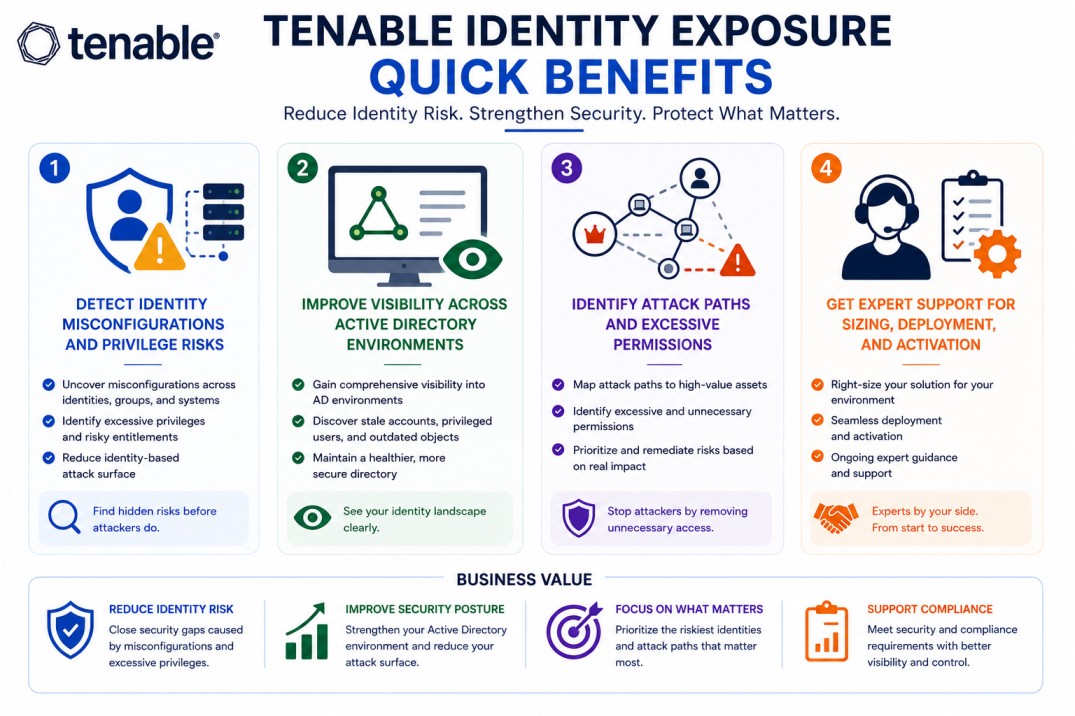
- Detect identity misconfigurations and privilege risks
- Improve visibility across Active Directory environments
- Identify attack paths and excessive permissions
- Get expert support for sizing, deployment, and activation
Tenable Identity Exposure At a glance
What it does : Tenable Identity Exposure analyzes identity infrastructure to identify privilege risks, configuration weaknesses, and potential attack paths.
License type : Subscription-based (user/identity-based)
Typical term : 1 year · 3 years · 5 years
Activation method : Cloud-managed or hybrid activation via Tenable platform
Who needs it : Organizations that want visibility into identity-related risks across Active Directory and hybrid identity environments

License Overview
The Tenable Identity Exposure license is generally aligned with the number of identities or directory objects being monitored within the environment. In most deployments, this includes users, groups, privileged accounts, and identity-related infrastructure components. Because identity environments evolve continuously, licensing should reflect the actual scope of monitored identities rather than static infrastructure assumptions. Organizations with large or distributed Active Directory environments typically require broader visibility into permissions and privilege relationships.
Tenable Identity Exposure is designed to work across on-prem and hybrid identity infrastructures, helping teams analyze identity posture without relying solely on traditional vulnerability scanning. A properly sized license helps ensure that identity relationships, permissions, and attack paths remain visible across the environment without creating unnecessary licensing overhead.
Product Overview
Tenable Identity Exposure is built to help organizations understand how identity weaknesses can create security exposure inside the environment.
In practice, the platform analyzes identity infrastructure, especially Active Directory, to identify issues such as excessive permissions, stale privileges, misconfigurations, and risky trust relationships.
One of the key strengths of the platform is attack path visibility. Instead of viewing identity risks individually, teams can understand how multiple weaknesses may combine to create privilege escalation opportunities.
The platform also helps improve operational awareness around identity hygiene. Security teams can identify outdated configurations and privilege sprawl before they become larger security problems.
For hybrid environments, Tenable Identity Exposure provides centralized visibility into identity-related risks across both on-prem and connected identity systems.
Core technical flow
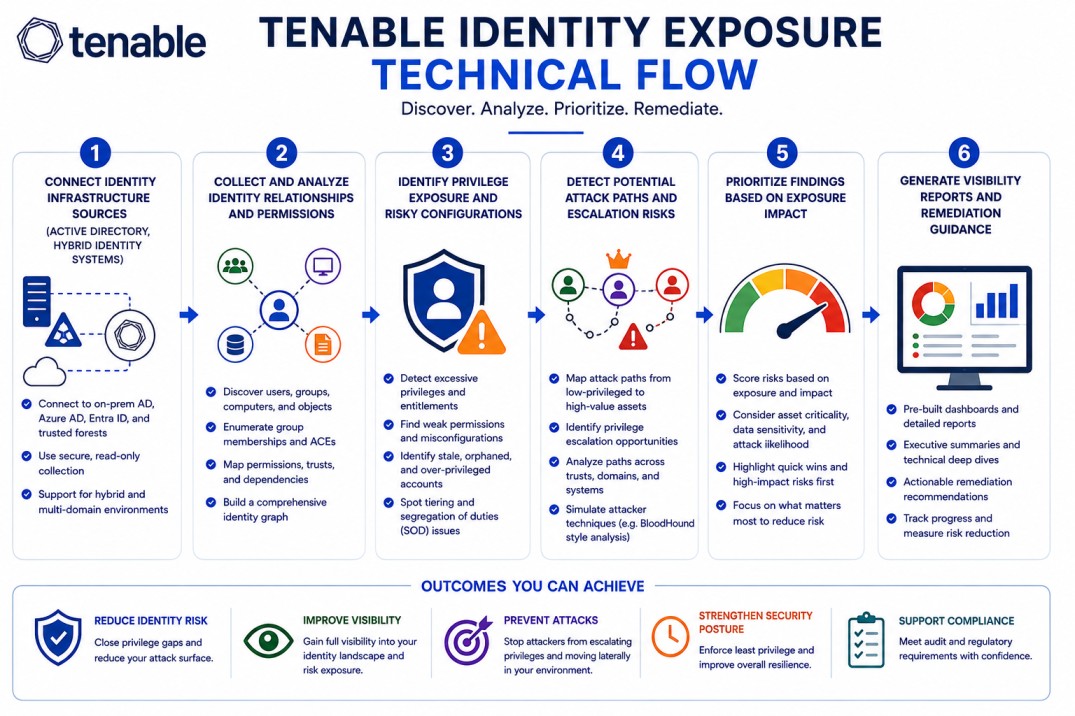
- Connect identity infrastructure sources (Active Directory, hybrid identity systems)
- Collect and analyze identity relationships and permissions
- Identify privilege exposure and risky configurations
- Detect potential attack paths and escalation risks
- Prioritize findings based on exposure impact
- Generate visibility reports and remediation guidance
Options & Tiers
| Plan / Model | Best for | Key inclusions | What affects price |
|---|---|---|---|
| Standard identity visibility | Most organizations | Identity exposure analysis + reporting | Identity count, term |
| Hybrid identity deployment | Mixed environments | On-prem + hybrid visibility | Integration scope |
| Enterprise deployment | Large infrastructures | Scalable identity analysis | Directory size |
| Advanced risk visibility | Security-focused teams | Attack path analysis + privilege insights | Environment complexity |
Features & Benefits
Tenable Identity Exposure helps organizations improve visibility into identity-related risks that are often difficult to detect through traditional vulnerability management alone. One of the main advantages is attack path analysis. Instead of reviewing permissions separately, teams can understand how identity relationships may be chained together to create escalation opportunities. It also improves identity hygiene by helping administrators identify stale permissions, excessive privileges, and risky configurations across directory environments. Over time, this leads to better control over identity exposure and a clearer understanding of privilege-related security risks.
Compatibility & Requirements
Supported Environments
- Active Directory infrastructures
- Hybrid identity environments
- Enterprise identity management ecosystems
System Requirements
- Access to identity infrastructure sources
- Connectivity to Active Directory or hybrid identity systems
- Appropriate privileges for identity analysis
How activation works
Activating Tenable Identity Exposure typically starts with provisioning the platform within your Tenable environment and applying the appropriate subscription license. Once the tenant is active, administrators configure connectivity to identity infrastructure sources such as Active Directory or hybrid identity systems. The platform then begins collecting identity relationships, permissions, and configuration data for analysis. Depending on the deployment model, activation may involve configuring connectors, service accounts, and communication paths between the platform and identity infrastructure.
Because the service is designed to analyze identity exposure continuously, visibility improves as the platform builds a more complete understanding of privilege relationships and attack paths across the environment. After activation, organizations should verify that all required identity sources are included within the licensed scope to maintain consistent exposure visibility.
Pricing factors + quote process
Pricing for Tenable Identity Exposure is usually influenced by the number of identities being analyzed and the overall complexity of the identity infrastructure. Organizations with hybrid identity environments, multiple domains, or complex privilege structures may require broader visibility and integration scope.
Other factors, such as deployment architecture, reporting requirements, and subscription term, can also affect licensing scope. The quote process starts with reviewing your identity environment, directory structure, and visibility requirements. From there, the appropriate licensing and deployment approach can be recommended.
After you request a quote
- We review your identity infrastructure and scope
- Recommend the most suitable licensing model
- Provide official pricing and delivery details
- Share activation and deployment guidance
Tenable Pricing depends on your license edition, quantity, term, and deployment needs.