

Tenable OT Security helps organizations monitor and protect operational technology environments by improving visibility into industrial assets, vulnerabilities, and exposure risks across OT (Operational Technology) networks.
Quick benefits
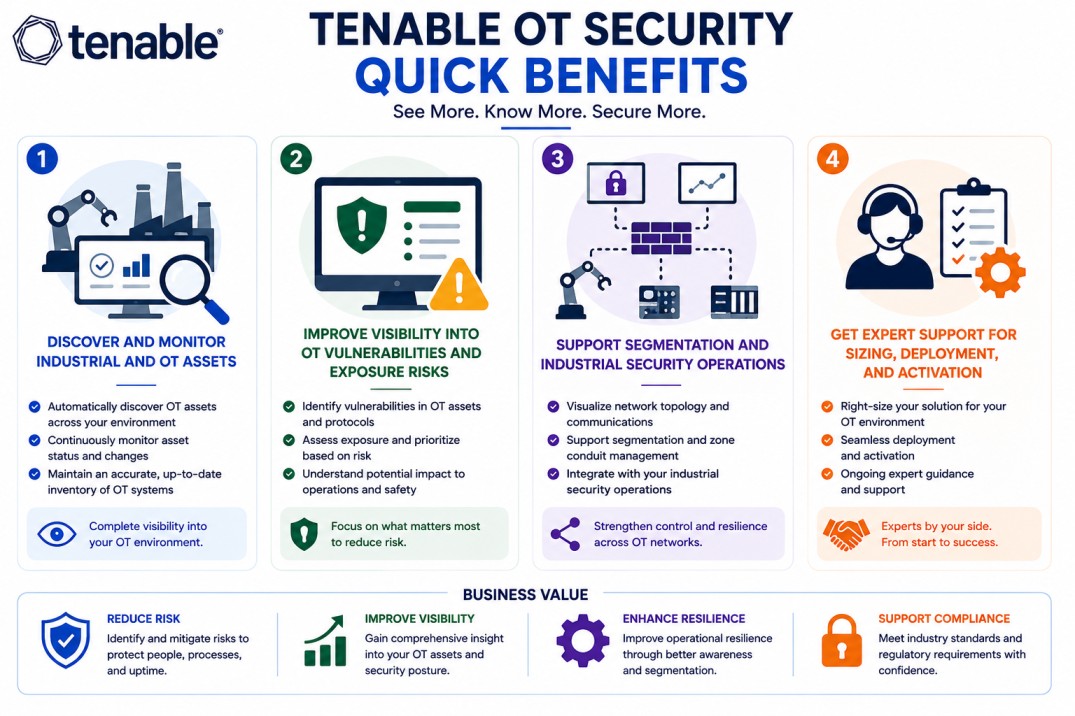
- Discover and monitor industrial and OT assets
- Improve visibility into OT vulnerabilities and exposure risks
- Support segmentation and industrial security operations
- Get expert support for sizing, deployment, and activation
Tenable OT Security At a glance
What it does : Tenable OT Security provides visibility into operational technology environments by identifying industrial assets, vulnerabilities, and security risks.
License type : Subscription-based (asset/device-based)
Typical term : 1 year · 3 years · 5 years
Activation method : On-prem or hybrid activation via Tenable platform
Who needs it : Organizations operating industrial systems, manufacturing environments, utilities, or critical infrastructure networks

License Overview
The Tenable OT Security license is generally aligned with the number of industrial assets and OT devices being monitored across the environment. This can include controllers, industrial endpoints, engineering workstations, and other operational technology systems. Because OT infrastructures are often distributed across multiple sites and operational zones, licensing should reflect the actual scope of industrial visibility requirements rather than only traditional IT asset counts.
Tenable OT Security is commonly deployed in environments where operational continuity and visibility are critical. Many organizations use it to improve awareness of vulnerabilities and unmanaged devices inside industrial networks while maintaining stricter operational controls. A properly sized license helps ensure that industrial assets, communication paths, and exposure risks remain visible across OT environments without leaving unmanaged segments outside the monitoring scope.
Product Overview
Tenable OT Security is designed to provide visibility into industrial environments where traditional IT security tools often have limited coverage.
In practice, the platform analyzes industrial traffic, identifies connected OT assets, and evaluates vulnerabilities and exposure risks across operational networks. This helps organizations understand what devices exist in the environment and how they communicate.
One of the key strengths of the platform is its ability to improve asset awareness in operational environments where unmanaged or legacy systems are common.
The platform also supports security operations by helping teams identify risky communication patterns, vulnerable devices, and segmentation gaps that may increase operational exposure.
For organizations operating critical infrastructure or industrial systems, this visibility can help improve both security posture and operational resilience.
Core technical flow
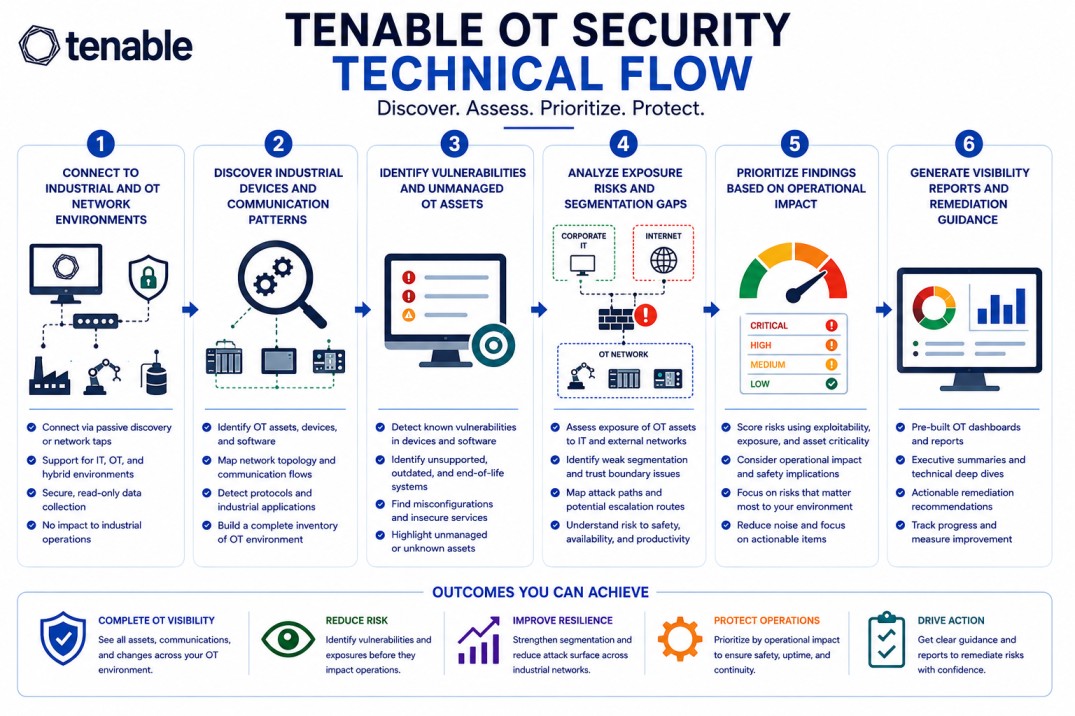
- Connect to industrial and OT network environments
- Discover industrial devices and communication patterns
- Identify vulnerabilities and unmanaged OT assets
- Analyze exposure risks and segmentation gaps
- Prioritize findings based on operational impact
- Generate visibility reports and remediation guidance
Options & Tiers
| Plan / Model | Best for | Key inclusions | What affects price |
|---|---|---|---|
| Standard OT visibility | Most organizations | Industrial asset discovery + monitoring | Device count, term |
| Multi-site deployment | Distributed operations | Centralized OT visibility | Site scale |
| Hybrid deployment | Mixed IT/OT environments | Cross-environment monitoring | Integration scope |
| Enterprise deployment | Critical infrastructure | Scalable industrial security visibility | Architecture complexity |
Features & Benefits
Tenable OT Security helps organizations improve operational visibility across industrial environments where unmanaged devices and legacy systems are often difficult to track. One of the key operational advantages is centralized OT asset awareness. Security teams can identify industrial devices, communication behaviors, and vulnerabilities from a unified platform. It also supports industrial security initiatives by helping organizations identify segmentation weaknesses and exposure risks that may affect operational continuity. Over time, this helps improve visibility across operational environments while supporting more consistent OT security operations.
Compatibility & Requirements
Supported Environments
- Manufacturing environments
- Utilities and energy infrastructure
- Industrial control system (ICS) networks
- Critical infrastructure environments
System Requirements
- Access to OT network segments
- Visibility into industrial communication traffic
- Deployment infrastructure for monitoring components
How activation works
Activating Tenable OT Security usually begins with deploying the platform within the OT or hybrid environment and applying the appropriate subscription license. Once the system is active, administrators configure visibility into industrial network segments and communication traffic. Depending on the deployment architecture, this may involve connecting monitoring components to mirrored network traffic or designated OT monitoring points.
As industrial assets and communication flows are discovered, they are evaluated against the licensed monitoring scope. The platform then begins identifying vulnerabilities, unmanaged devices, and exposure risks across the operational environment. Because OT deployments often require controlled rollout procedures, activation is commonly performed gradually across industrial zones and operational sites to minimize disruption.
After activation, organizations should verify that all required OT segments and industrial assets are included within the licensed visibility scope.
Pricing factors + quote process
Pricing for Tenable OT Security is usually influenced by the number of industrial assets, operational sites, and monitored OT network segments within the environment.
Organizations operating distributed industrial environments or critical infrastructure often require broader visibility coverage and more complex deployment architectures.
Other factors, such as segmentation requirements, integration scope, deployment model, and subscription term, can also affect licensing scope.
The quote process typically starts with reviewing your OT infrastructure, industrial asset visibility requirements, and operational environment structure. From there, the appropriate licensing and deployment approach can be recommended.
After you request a quote
- We review your OT environment and monitoring scope
- Recommend the most suitable deployment model
- Provide official pricing and delivery details
- Share activation and deployment guidance
Tenable Pricing depends on your license edition, quantity, term, and deployment needs.