

Tenable Vulnerability Management helps organizations continuously discover assets and identify vulnerabilities, giving security teams clear visibility and prioritization across modern environments.
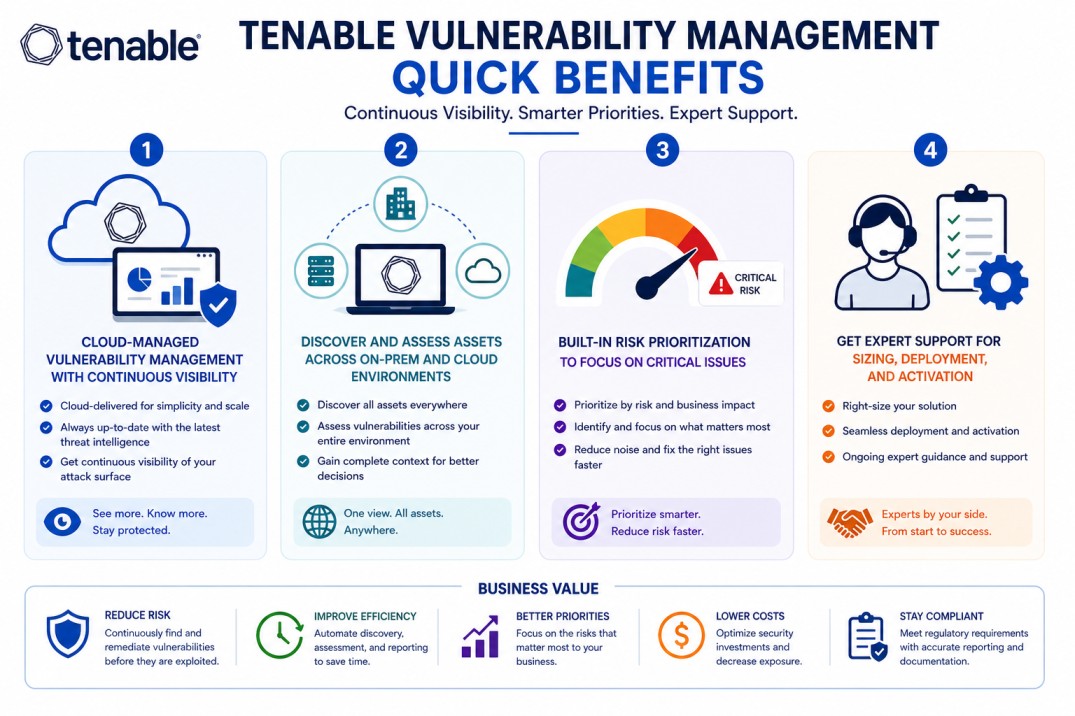
Quick benefits
- Cloud-managed vulnerability management with continuous visibility
- Discover and assess assets across on-prem and cloud environments
- Built-in risk prioritization to focus on critical issues
- Get expert support for sizing, deployment, and activation
Tenable Vulnerability Management At a glance
What it does : Tenable Vulnerability Management is a cloud-based platform that discovers assets and continuously assesses them for vulnerabilities.
License type : Subscription-based (asset-based)
Typical term : 1 year · 3 years · 5 years
Activation method : Cloud activation via Tenable platform
Who needs it : Organizations that want scalable, cloud-managed vulnerability management across hybrid and distributed environments
License Overview
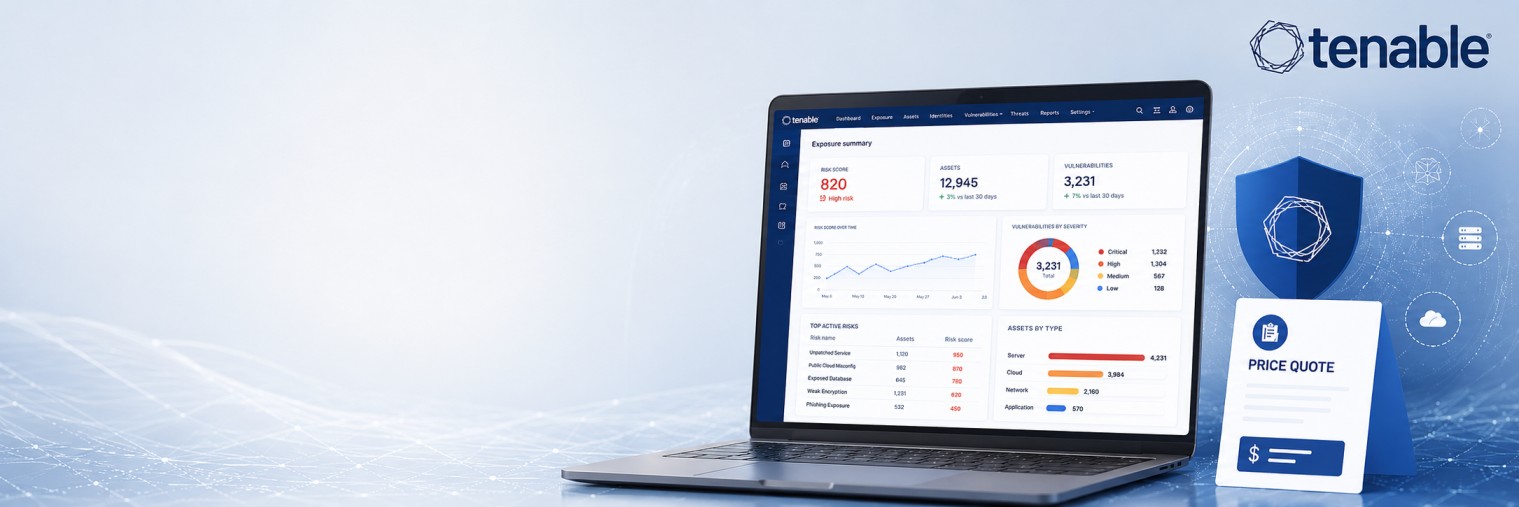
The Tenable Vulnerability Management license is based on the number of assets you need to monitor. Instead of relying on IP-based counting, it focuses on unique systems such as servers, endpoints, and cloud workloads. In most environments, assets are discovered dynamically as scanners and agents identify systems across networks and cloud platforms. This makes the licensing model more flexible and better aligned with modern infrastructure.
Because Tenable Vulnerability Management is delivered as a cloud service, there is no need to manage core infrastructure. The platform handles asset tracking, vulnerability assessment, and data processing centrally. Sizing the license correctly is important. Too few assets can leave gaps in coverage, while too many may increase cost unnecessarily. A balanced approach ensures full visibility without overprovisioning.
Product Overview
Tenable Vulnerability Management is designed to give continuous visibility into your security posture without the complexity of managing on-prem infrastructure.
In practice, the platform continuously discovers assets and evaluates them for vulnerabilities. This includes traditional systems as well as cloud workloads and dynamic environments.
One of the key advantages is its always-on approach. Instead of periodic scans, it provides ongoing assessment, helping teams identify risks as they emerge.
It also simplifies operations. With a cloud-managed model, updates, scalability, and performance are handled by the platform, allowing teams to focus on remediation rather than maintenance.
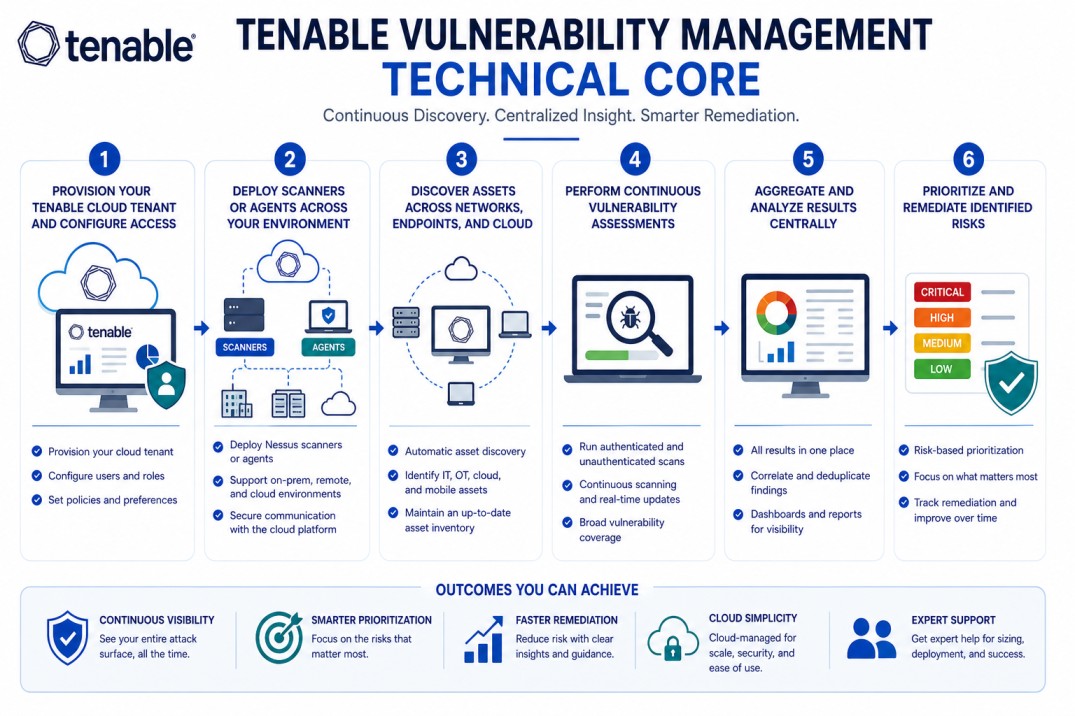
Core technical flow
- Provision your Tenable cloud tenant and configure access
- Deploy scanners or agents across your environment
- Discover assets across networks, endpoints, and cloud
- Perform continuous vulnerability assessments
- Aggregate and analyze results centrally
- Prioritize and remediate identified risks
Options & Tiers
| Plan / Model | Best for | Key inclusions | What affects price |
|---|---|---|---|
| Standard cloud VM | Most organizations | Continuous scanning + asset discovery | Asset count, term |
| Agent-based deployment | Distributed environments | Endpoint visibility | Agent coverage |
| Hybrid deployment | Mixed environments | Network + cloud visibility | Scope, integrations |
| Enterprise deployment | Large infrastructures | Scalable vulnerability management | Architecture size |
Features & Benefits
Tenable Vulnerability Management helps organizations maintain continuous visibility into vulnerabilities across their environment. Instead of relying on scheduled scans, it keeps tracking risks as systems change. A key benefit is improved prioritization. By analyzing vulnerabilities in context, the platform helps teams focus on the most critical issues. It also supports flexibility. Whether your infrastructure is on-prem, cloud, or hybrid, the same platform can manage all assets in one place. Over time, this leads to a more consistent and proactive vulnerability management process.
Compatibility & Requirements
Supported Environments
- Cloud and hybrid infrastructures
- Enterprise IT environments
- Dynamic and scalable systems
Technical requirements
- Network scanners or endpoint agents
- Access to target systems
- Internet connectivity for cloud platform
How activation works
Activating Tenable Vulnerability Management starts with provisioning your cloud environment. Once your subscription is applied, your tenant becomes active and ready for configuration. From there, you set up users and roles, then deploy scanners or agents depending on your architecture. These components connect securely to the Tenable platform and begin discovering assets.
As assets are identified, they are counted against your licensed capacity. The platform immediately starts assessing them for vulnerabilities and collecting data. Because it is cloud-managed, most of the heavy lifting, such as updates, processing, and scaling, is handled automatically. This allows teams to focus on analysis and remediation rather than infrastructure management. It’s important to monitor asset usage after activation to ensure it stays aligned with your license and provides full coverage.
Price Factors and Quotation Process
Tenable Vulnerability Management pricing is mainly based on the number of assets being monitored. As your environment grows, the license scope adjusts accordingly.
Other factors, such as deployment type, agent usage, and integration needs, can also influence pricing.
Subscription length plays a role as well, with longer terms typically offering better value.
The most accurate pricing comes from aligning the platform with your actual asset inventory and operational requirements.
After you request a quote
- We review your asset inventory and environment
- Recommend the most suitable deployment approach
- Provide official pricing and delivery details
- Share activation and deployment guidance
Tenable Pricing depends on your license edition, quantity, term, and deployment needs.