


VIPRION License provides the software entitlements required to operate F5 VIPRION platforms and use the BIG-IP application delivery and security services provisioned on VIPRION chassis and blades. VIPRION is F5’s high-performance modular platform for running BIG-IP services, allowing organizations to scale application delivery, traffic management, and security capabilities by using a chassis-and-blade architecture.
F5 documentation confirms that a valid BIG-IP license is required before a VIPRION system can process traffic, and licensing is activated using a base registration key with additional keys where required for specific modules.
Quick Benefits
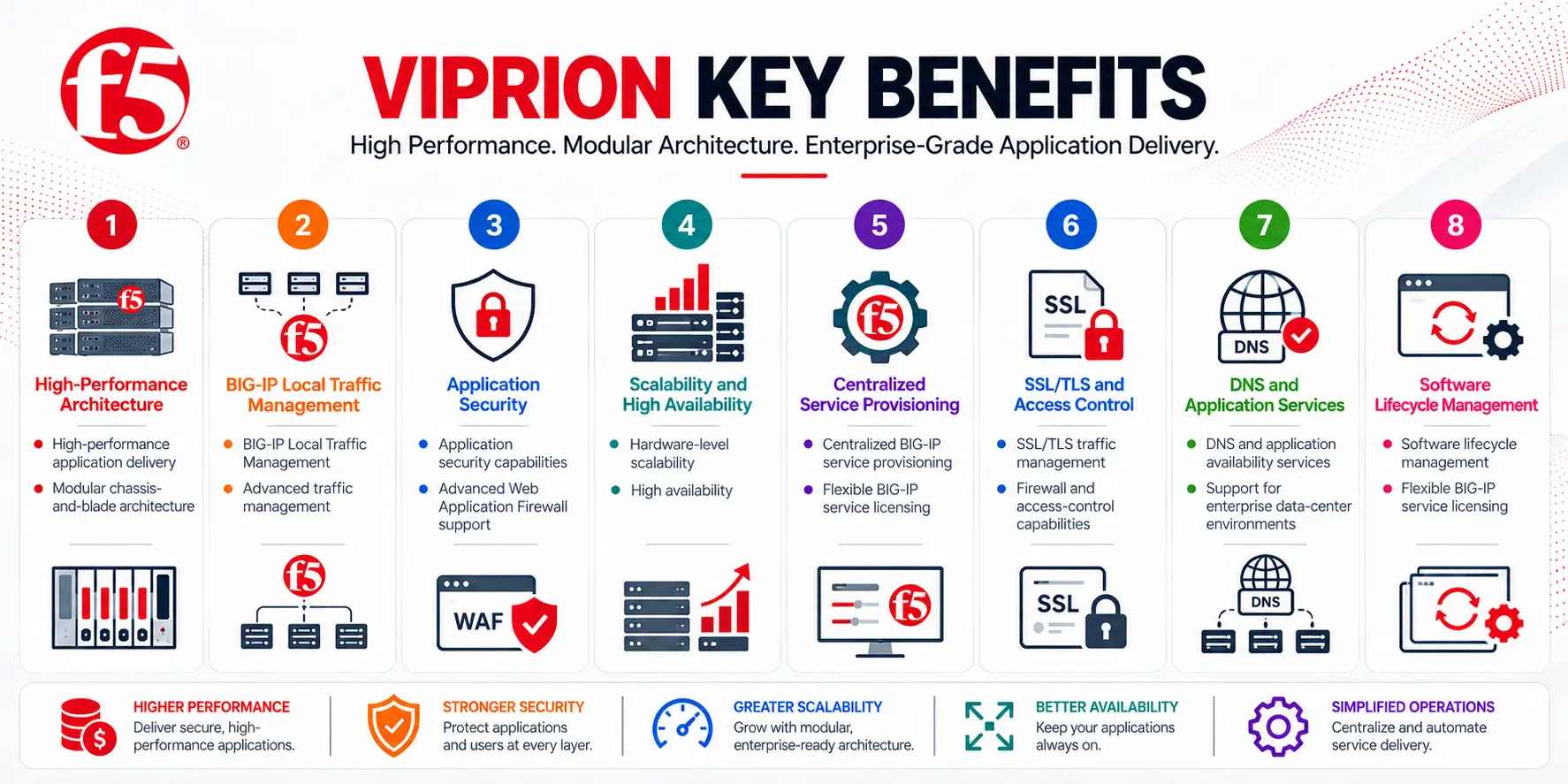
- High-performance application delivery
- Modular chassis-and-blade architecture
- BIG-IP Local Traffic Management
- Application security capabilities
- Advanced traffic management
- High availability
- Hardware-level scalability
- Centralized BIG-IP service provisioning
- SSL/TLS traffic management
- Firewall and access-control capabilities
- Advanced Web Application Firewall support
- DNS and application availability services
- Software lifecycle management
- Support for enterprise data-center environments
- Flexible BIG-IP service licensing
VIPRION License At a Glance
What it is: F5 modular hardware platform running BIG-IP application delivery and security services
Vendor: F5 License
Platform: F5 VIPRION chassis and blades
Software: F5 BIG-IP / TMOS
Primary role: High-performance application delivery, traffic management, and security
Architecture: Modular chassis with interchangeable processing blades
Core platform: BIG-IP TMOS
Main services: LTM, Advanced WAF, AFM, APM, DNS, SSL Orchestrator, and other supported BIG-IP modules
License model: BIG-IP base license with applicable add-on or subscription entitlements
Activation: Base registration key and applicable add-on registration keys
License Overview
A VIPRION License is not simply a license for the physical chassis. VIPRION systems run the BIG-IP software platform, and the software services available on the system are controlled through BIG-IP licensing.
The base registration key identifies the F5 products the customer is entitled to license. Additional registration keys can be used for applicable modules. F5’s current BIG-IP documentation states that a valid license must be activated before the system can be used for traffic processing.
This means that the licensing process should distinguish between:
- VIPRION hardware
- BIG-IP software entitlement
- Base BIG-IP services
- Additional BIG-IP modules
- Subscription or perpetual entitlement
- Support and maintenance
- Blade and chassis capacity
The selected BIG-IP services determine much of the functional scope of the deployment.
How VIPRION Licensing Works
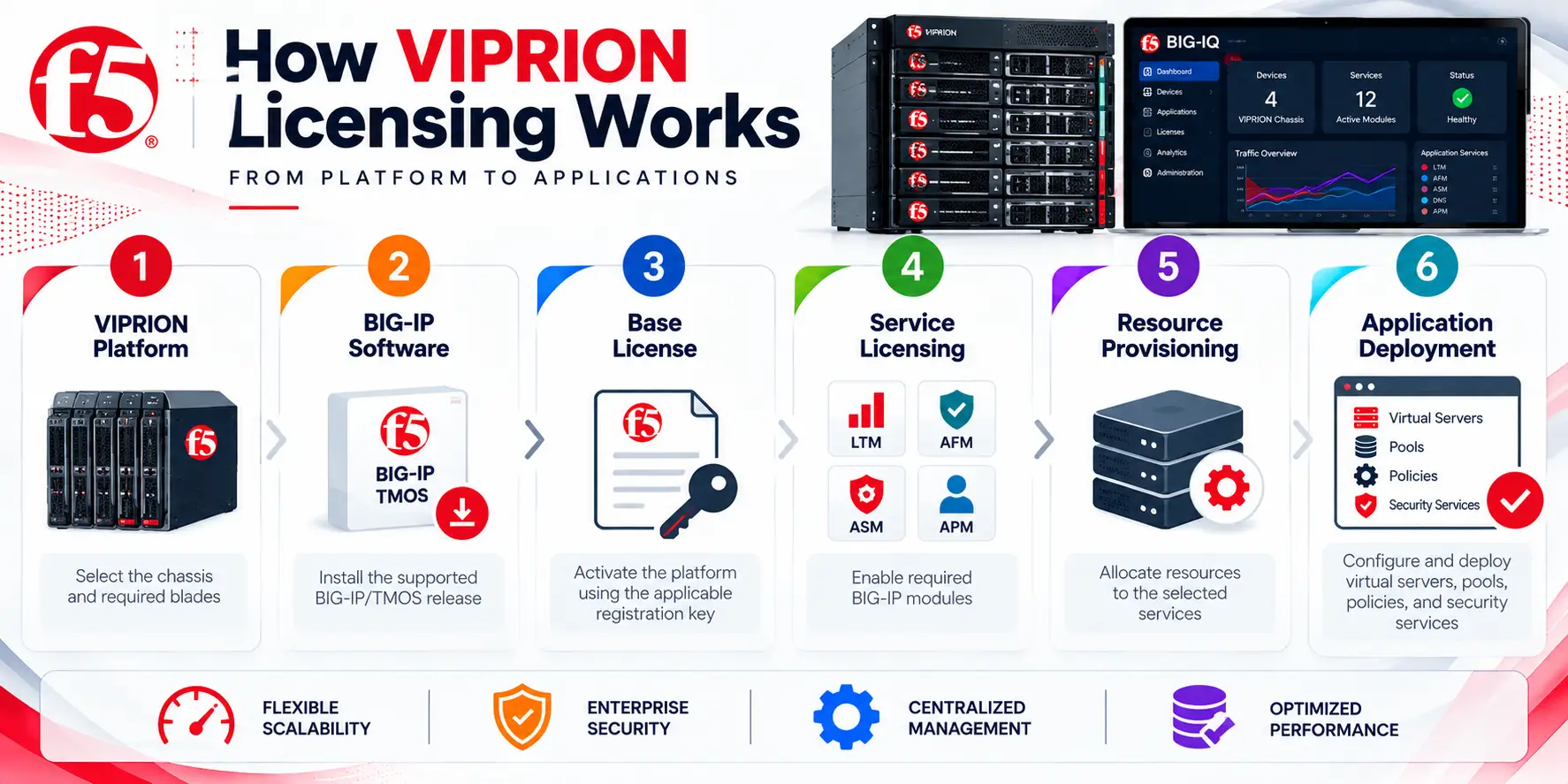
VIPRION licensing can be understood as a combination of platform capacity and software functionality.
A typical implementation follows:
VIPRION Platform
→ Select the chassis and required blades
BIG-IP Software
→ Install the supported BIG-IP/TMOS release
Base License
→ Activate the BIG-IP platform using the applicable registration key
Service Licensing
→ Enable required BIG-IP modules
Resource Provisioning
→ Allocate resources to the selected services
Application Deployment
→ Configure virtual servers, pools, policies, and security services
F5 also notes that when an add-on module is licensed, the appropriate resources must be provisioned for that module.
VIPRION Platform and BIG-IP Services
| Capability | Primary Purpose |
|---|---|
| BIG-IP LTM | Local traffic management and application load balancing |
| Advanced WAF | Protection against web application attacks |
| Advanced Firewall Manager (AFM) | Network firewall and traffic security |
| Access Policy Manager (APM) | Identity-aware access control and application access |
| BIG-IP DNS | Global server load balancing and DNS-based application availability |
| SSL Orchestrator | Visibility and policy enforcement for encrypted traffic |
| Advanced Routing | Advanced routing capabilities for supported deployments |
| Application Analytics | Visibility into application traffic and performance |
| iRules | Programmable traffic-management and application policies |
| High Availability | Resiliency and service continuity |
| Centralized Management | Management through BIG-IQ where supported |
F5 identifies VIPRION as one of its hardware platforms for BIG-IP application delivery services, alongside iSeries and other BIG-IP platforms.
Licensing Options and Models
| Licensing Option | Description | Suitable For |
|---|---|---|
| BIG-IP Base License | Base software entitlement required to operate BIG-IP on the VIPRION platform | All BIG-IP/VIPRION deployments |
| LTM License | Application load balancing and local traffic management | Enterprise application delivery |
| Advanced WAF License | Web application security and vulnerability protection | Public-facing and business-critical applications |
| AFM License | Network firewall and traffic-security capabilities | Data-center and perimeter security |
| APM License | Identity-based application access and authentication | Remote and application access environments |
| DNS License | DNS and global application traffic management | Multi-site and global application deployments |
| SSL Orchestrator License | Security-service chaining and encrypted-traffic visibility | Encrypted traffic inspection environments |
| Advanced Routing License | Advanced routing functionality for supported deployments | Complex enterprise and service-provider networks |
| Subscription License | Time-based access to selected BIG-IP services | Organizations using subscription licensing |
| Perpetual License | Long-term software entitlement for applicable F5 products | Existing perpetual-license environments |
| Support and Maintenance | Technical support and software-update entitlement according to the agreement | Mission-critical deployments |
Features and Benefits
Modular Performance
One of the main characteristics of VIPRION is its modular architecture.
Instead of relying on a single fixed hardware configuration, organizations can deploy supported blades within a VIPRION chassis and scale processing capacity according to the platform configuration.
This architecture is useful for environments where application traffic can grow significantly over time.
BIG-IP Local Traffic Management
BIG-IP LTM is commonly associated with VIPRION deployments.
LTM can distribute application traffic across backend resources while providing capabilities such as:
- Load balancing
- Health monitoring
- Application traffic management
- SSL termination
- Persistence
- Connection management
- Traffic policies
This allows VIPRION to operate as a high-performance application delivery platform.
Web Application Security
VIPRION can run supported BIG-IP application-security modules, including Advanced WAF.
Advanced WAF can provide protection for applications against attacks such as:
- SQL injection
- Cross-site scripting
- Automated attacks
- Malicious HTTP requests
- Application-layer abuse
The applicable security capabilities depend on the licensed BIG-IP modules.
Compatibility and Requirements
Before selecting a VIPRION License, organizations should evaluate:
- VIPRION chassis model
- Blade model and quantity
- BIG-IP/TMOS version
- Application throughput
- SSL/TLS traffic volume
- Concurrent connections
- New connections per second
- Required BIG-IP modules
- Number of applications
- LTM requirements
- WAF requirements
- Firewall requirements
- DNS requirements
- SSL inspection requirements
The exact software and module compatibility should always be checked against the selected VIPRION hardware and BIG-IP release. F5’s current certification documentation, for example, lists VIPRION platforms among systems supporting specific BIG-IP TMOS releases, demonstrating that platform and software-version compatibility needs to be checked when planning a deployment.
Activation and Deployment
A typical VIPRION licensing process includes:
- Identify the VIPRION chassis and blades
- Confirm the supported BIG-IP/TMOS version
- Determine required BIG-IP services
- Obtain the applicable base registration key
- Install or initialize BIG-IP
- Activate the base license
- Apply required add-on registration keys
- Provision resources for licensed modules
- Configure networking and high availability
F5 supports both automatic and manual license activation. Manual activation is useful when the BIG-IP system does not have a path to the Internet. The process uses a device dossier and F5’s licensing service to generate the required license text. This is particularly relevant for isolated enterprise or security-sensitive data-center environments.
Pricing and Quote Process
Pricing for VIPRION License depends on both the hardware platform and the BIG-IP software services required. A quotation should separate the physical infrastructure from software licensing.
Before requesting a quote, prepare:
- VIPRION chassis model
- Blade model
- Number of blades
- BIG-IP version
- Expected throughput
- SSL/TLS traffic
- Concurrent sessions
- Application count
- LTM requirements
- WAF requirements
- Firewall requirements
- APM requirements
For example, a VIPRION deployment used primarily for LTM and application delivery will have a different licensing scope from one running LTM, Advanced WAF, AFM, APM, and DNS simultaneously. The required modules should therefore be identified before requesting a final quotation.
F5 Viprion pricing depends on your product edition, license type, deployment model, traffic needs, term, and support requirements.