






F5 License covers the software entitlements used to deliver application traffic management, load balancing, access control, DNS services, web application security, network firewalling, and centralized BIG-IP management. It is not a single license key or one fixed bundle. The right configuration depends on the F5 platform, required application services, deployment model, performance level, and whether the environment uses physical appliances, virtual editions, or a mix of both.
For most buyers, the first decision is not simply “which F5 license do I need?” It is which BIG-IP services the application actually requires. A basic load-balancing environment has a very different licensing scope from a deployment that also needs Advanced WAF, DNS, access management, or network firewall capabilities. F5 currently supports perpetual and subscription purchasing models, with packaging varying by platform and deployment type.
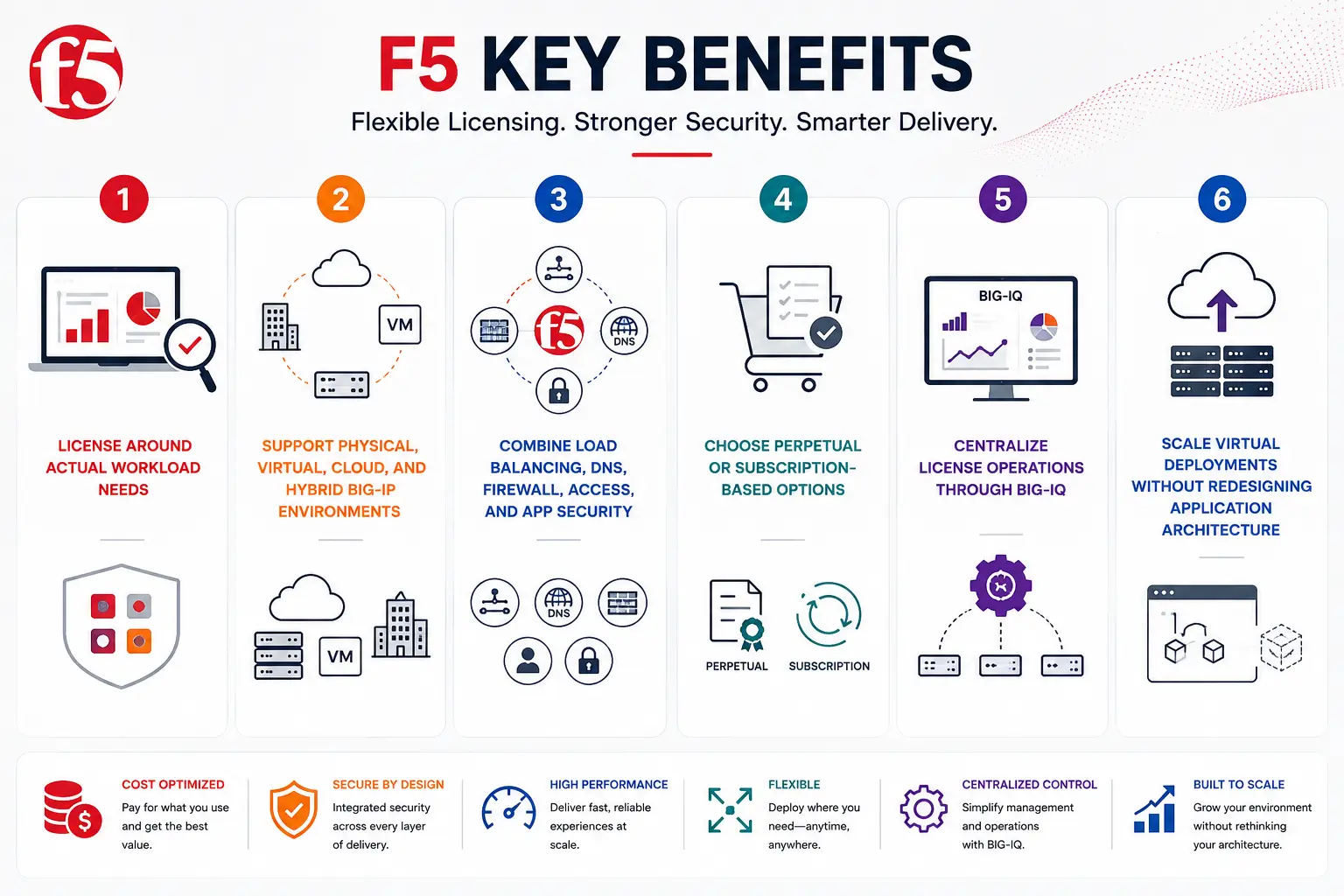
Key Benefits
- License application delivery and security around actual workload needs
- Support physical, virtual, cloud, and hybrid BIG-IP environments
- Combine load balancing, DNS, firewall, access, and application security
- Choose perpetual or subscription-based purchasing options
- Centralize selected license operations through BIG-IQ
- Scale virtual deployments without redesigning the entire application architecture
F5 License At a Glance
What it does: Activates F5 application delivery, traffic management, security, access, and management capabilities
Deployment options: Physical appliance, virtual edition, public cloud, private cloud, and hybrid
Common platforms: F5 rSeries, BIG-IP Virtual Edition, BIG-IQ, plus existing iSeries, VIPRION, and BIG-IP Standard series
Licensing approaches: Perpetual, subscription, enterprise agreements, and supported consumption models
Activation: F5 registration key with online or manual activation workflows
Who needs it: Organizations running application delivery, load balancing, web security, remote access, DNS, or multi-cloud BIG-IP services
F5 License Overview
F5 licensing is built around the application services enabled on the platform. BIG-IP Local Traffic Manager (LTM) handles local application traffic management and load balancing, while additional services can extend the environment with DNS, Advanced Firewall Manager, Advanced WAF, and access-management capabilities.
The way those services are packaged depends on how F5 is purchased. BIG-IP Virtual Edition subscriptions, for example, are offered in renewable one-, two-, and three-year terms and can be packaged in Good, Better, and Best configurations or ordered with selected standalone modules. F5 also continues to offer perpetual licensing, where entitlements extend for the life of the product and can be purchased through service bundles.
Hardware matters as well. F5 rSeries is the current next-generation appliance platform and was designed as the migration path from iSeries. Existing organizations may still operate iSeries, VIPRION, or older systems, so a license request should always identify the exact appliance or virtual platform rather than assuming licenses move freely between generations.
How F5 License Works
Most BIG-IP systems are activated using a base registration key. Additional services can be associated through add-on keys or included through the purchased bundle. The device contacts the F5 licensing service during automatic activation; environments without internet access can use a manual dossier-based workflow.
On newer rSeries systems, licensing is handled at the F5OS platform layer. BIG-IP tenants running on that appliance inherit licensing from the base system rather than each tenant requiring an independent platform license. This is particularly useful where several BIG-IP tenants share one physical appliance.
A practical licensing review therefore starts with:
Platform → Required BIG-IP services → Capacity → Deployment model → License package → Activation
Options & Licensing Models
| Licensing option | Best suited for | Main consideration |
|---|---|---|
| Perpetual license | Stable long-term deployments | Platform, bundle, services, support |
| VE subscription | Virtual and cloud environments | Instance count, term, service package |
| BIG-IP Virtual Edition | Private/public cloud or virtual data center | Throughput and application services |
| rSeries | Current physical BIG-IP deployments | Appliance model, bundle, tenant design |
| BIG-IQ | Centralized BIG-IP management | Managed devices and licensing scope |
| Legacy F5 platforms | Existing infrastructure | Entitlement, support, migration compatibility |
F5 Virtual Edition subscriptions allow organizations to increase or decrease licensed instances during the subscription period, which can suit environments where application capacity changes more frequently than physical infrastructure.
Features & Benefits
The main value of F5 licensing is the ability to add application services without treating every requirement as a separate network appliance. A BIG-IP deployment can start with traffic management and later incorporate DNS, application security, firewalling, or access functions when the architecture requires them.
This matters in real environments. An application team may only need LTM for availability today, while an internet-facing service may also require Advanced WAF and DNS resilience. Licensing those functions around the workload avoids buying features simply because they appear in the largest bundle.
BIG-IQ can also help larger environments centralize BIG-IP lifecycle tasks, licensing, certificates, configuration, backups, and operational visibility.
Compatibility & Requirements
Before selecting an F5 License, confirm:
- Exact BIG-IP hardware or Virtual Edition platform
- Required application services and security modules
- Software version and platform compatibility
- Expected application and SSL traffic
- Number of physical or virtual instances
- High-availability or tenant architecture
- Existing registration and add-on keys
- Current support contract and upgrade requirements
For rSeries, the appliance is licensed at the platform level. Older platforms and BIG-IP VE deployments can follow different licensing rules, so existing keys should be reviewed before a migration or hardware refresh.
How F5 License Activation Works
Connected systems can activate directly against the F5 licensing service using the registration key. Offline environments can generate a dossier, transfer it to the F5 licensing portal, obtain the resulting license text, and apply it manually.
BIG-IQ follows the same general registration-key concept and supports both automatic and manual activation. It can also manage license assignment for supported BIG-IP VE environments.
F5 License Pricing and Quote Process
F5 License pricing depends mainly on the platform, required BIG-IP services, purchasing model, capacity, number of instances, and support requirement. A physical rSeries deployment will not be quoted the same way as a group of subscription-based BIG-IP Virtual Editions.
For pricing, submit F5 as the brand and the required F5 product or license as the product name. Existing registration keys, license inventories, appliance information, or technical specifications can be attached to the quote request. Details such as Better/Best packaging, individual modules, throughput, HA quantities, renewal, or migration requirements can then be reviewed against the actual environment.
F5 pricing depends on your product edition, license type, deployment model, traffic needs, term, and support requirements.