



Imagicle License provides access to a portfolio of unified communications and collaboration applications designed to improve business communication, voice management, customer interaction, and operational visibility. Imagicle solutions integrate with modern collaboration platforms to help organizations manage communication workflows more efficiently.
Quick Benefits
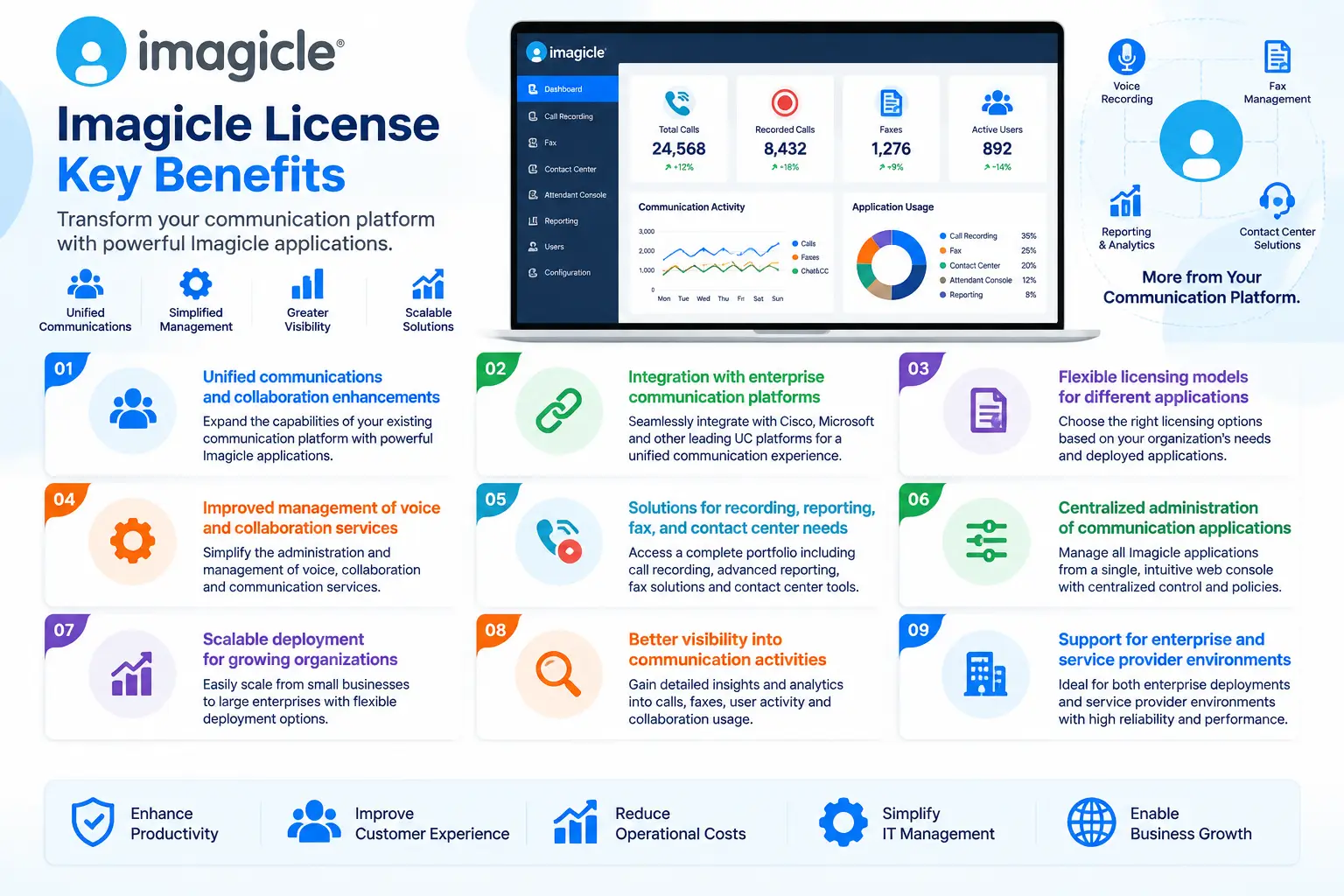
- Unified communications and collaboration enhancements
- Integration with enterprise communication platforms
- Flexible licensing models for different applications
- Improved management of voice and collaboration services
- Solutions for recording, reporting, fax, and contact center needs
- Centralized administration of communication applications
- Scalable deployment for growing organizations
- Better visibility into communication activities
- Support for enterprise and service provider environments
Imagicle License At a Glance
Vendor: Imagicle
Category: Unified Communications and Collaboration Software Licensing
Primary focus: Business communication applications and collaboration enhancements
Main solutions: Call recording, attendant console, contact center, fax, analytics, reporting, and UC applications
Integration platforms: Cisco Unified Communications Manager, Cisco Webex, Microsoft Teams, and other supported collaboration environments
Main users: Enterprises, IT administrators, communication teams, and service providers
Licensing factors: Users, extensions, applications, modules, features, and subscription duration

License Overview
An Imagicle License is designed around the specific communication applications an organization requires rather than following a single licensing model across the entire portfolio. Since Imagicle provides different solutions for voice recording, operator management, contact center capabilities, fax communication, and analytics, each product may have different licensing considerations.
Depending on the selected application, licensing can be influenced by factors such as users, extensions, agents, operators, enabled modules, recording requirements, or subscription duration. For example, a call recording solution may depend on the number of users or extensions being recorded, while an attendant console solution may focus on operator accounts and supported features.
Organizations should evaluate their existing collaboration environment, required communication capabilities, number of users, and future growth plans before selecting an Imagicle License. Correct sizing helps businesses activate the required functionality without purchasing unnecessary capacity.
Imagicle Product Portfolio Overview
| Product Family | Main Purpose | Licensing Considerations |
|---|---|---|
| Imagicle UC Suite | Unified communications applications combined into a single platform | Users, selected applications, enabled modules |
| Imagicle Call Recording | Voice recording and compliance management | Users, extensions, recording requirements, storage needs |
| Imagicle Attendant Console | Operator and receptionist call management | Operators, users, extensions, workflow requirements |
| Imagicle Contact Center | Customer interaction and queue management | Agents, queues, users, communication features |
| Imagicle Fax | Digital fax communication and document exchange | Users, fax requirements, communication volume |
| Imagicle Analytics | Communication reporting and visibility | Users, data sources, reporting requirements |
Imagicle allows organizations to select the applications that match their communication requirements instead of adopting unnecessary functionality. This application-based approach makes licensing more adaptable for different business environments.
How Imagicle Licensing Works
Imagicle licensing works according to the communication needs of the organization and the applications selected for deployment. Instead of using one fixed licensing structure for every solution, Imagicle evaluates the resources involved in each application area. Some solutions are based on users or extensions, while others depend on operators, agents, modules, or specific communication capabilities. Organizations using Cisco collaboration platforms, Webex environments, or other supported systems should consider how many users require access, which applications are needed, and how the communication environment may expand in the future. A clear understanding of these requirements helps businesses select an appropriate license model and avoid limitations after deployment.
Options and Licensing Models
| Licensing Model | Description | Common Usage |
|---|---|---|
| User-Based Licensing | Licensing according to users requiring access to communication applications | UC applications, collaboration tools, and reporting solutions |
| Extension-Based Licensing | Based on voice extensions or communication endpoints | Voice recording and telephony-focused solutions |
| Agent / Operator Licensing | Licensing according to active support staff or operators | Contact center and attendant console environments |
| Module-Based Licensing | Additional capabilities activated according to business requirements | Advanced communication features |
| Subscription Licensing | Time-based access including updates and support options | Cloud and modern deployments |
| Enterprise Licensing | Broader access for organizations requiring multiple capabilities | Large-scale communication environments |
Features and Benefits
Imagicle helps organizations improve the way they manage business communication by adding practical applications on top of existing collaboration platforms. Instead of replacing communication infrastructure, Imagicle solutions extend its capabilities with features such as call recording, operator management, analytics, fax services, and customer interaction tools. One of the main advantages of the Imagicle portfolio is integration with existing enterprise communication environments. Organizations can enhance their current collaboration investments while maintaining familiar workflows for users and administrators.
The platform also improves operational visibility. Communication data can be analyzed through reporting and analytics capabilities, helping businesses understand usage patterns, improve service quality, and make better decisions about communication processes. For organizations with complex communication requirements, Imagicle provides a flexible approach where individual applications can be selected according to business needs rather than forcing a one-size-fits-all deployment.
Compatibility and Requirements
Before selecting an Imagicle License, organizations should evaluate their existing communication infrastructure and application requirements.
Important considerations include:
- Current collaboration platform
- Number of users and extensions
- Required Imagicle applications
- Deployment architecture
- Integration requirements
- Storage and reporting needs
- Security and compliance requirements
Imagicle solutions are commonly deployed alongside enterprise communication platforms such as Cisco Unified Communications Manager and Cisco Webex. Depending on the selected application, additional requirements may apply for voice infrastructure, virtualization, cloud connectivity, or user synchronization. A technical review before deployment helps ensure that the selected applications integrate correctly with the existing environment.
Activation and Deployment
Imagicle deployment begins with activating the purchased license and preparing the required communication environment.
Typical deployment steps include:
- License registration and activation
- Installing or configuring Imagicle applications
- Connecting to the collaboration platform
- Assigning users, extensions, or roles
- Enabling required features and policies
Pricing and Quote Process
Pricing for an Imagicle License depends on the selected applications, licensing model, number of users or extensions, enabled features, deployment method, and subscription requirements.
Before requesting a quote, organizations should define:
- Required Imagicle applications
- Number of users, extensions, agents, or operators
- Existing collaboration platform
- Required modules and features
- Deployment model
- Support and subscription requirements
Providing accurate information allows the appropriate license capacity to be selected and prevents purchasing unnecessary functionality. Organizations should also consider future communication growth, especially when adding users, expanding locations, or introducing additional collaboration services.
Imagicle pricing depends on your selected applications, licensing model, deployment environment, subscription term, and support needs.