

Imagicle Voice Analytics is a voice intelligence solution designed to help organizations analyze recorded conversations, identify communication trends, and gain deeper insights from customer interactions. An Imagicle Voice Analytics License enables businesses to transform voice data into actionable information for quality improvement, compliance monitoring, and communication optimization.
Quick Benefits
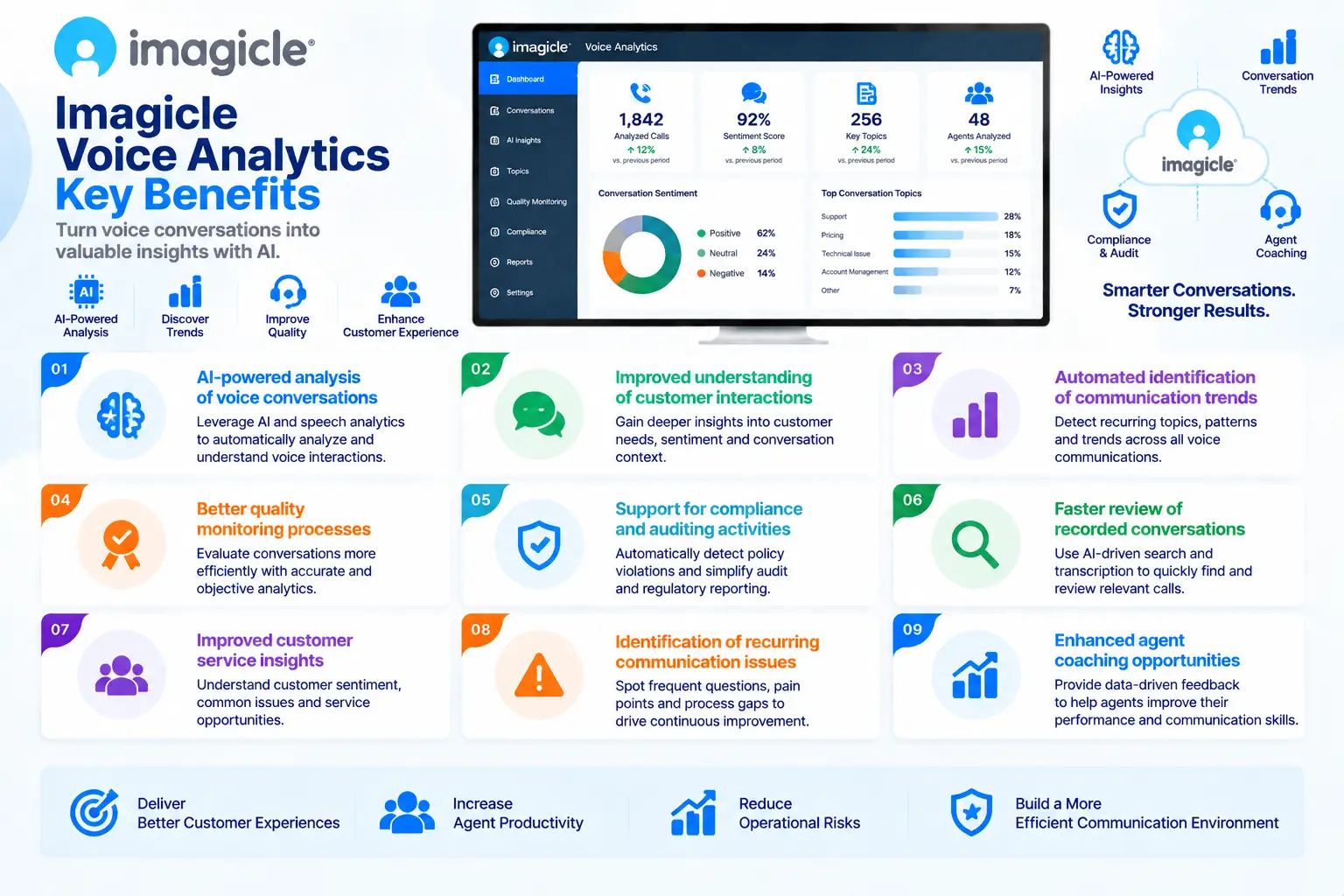
- AI-powered analysis of voice conversations
- Improved understanding of customer interactions
- Automated identification of communication trends
- Better quality monitoring processes
- Support for compliance and auditing activities
- Faster review of recorded conversations
- Improved customer service insights
- Identification of recurring communication issues
- Enhanced agent coaching opportunities
Imagicle Voice Analytics At a Glance
What it is: Voice intelligence and conversation analytics solution
Vendor: Imagicle
Parent category: Imagicle License
Primary role: Analyze voice conversations and extract business insights
Main users: Contact centers, customer experience teams, quality managers, compliance teams, and communication administrators
Core capabilities: Speech analysis, conversation insights, quality monitoring, reporting, and interaction analysis
Integration platforms: Imagicle Call Recording, Cisco Unified Communications Manager, Cisco Webex, and supported collaboration environments
Deployment: Cloud, hybrid, and on-premises models depending on environment
License Overview
An Imagicle Voice Analytics License is generally determined by the amount of communication data that needs to be analyzed and the number of users or interactions included in the analytics environment.
Because voice analytics works on recorded conversations, licensing considerations are closely connected to existing recording infrastructure, the number of monitored users, call volume, retention requirements, and the level of analysis required.
Organizations should evaluate whether they need analytics across all recorded conversations or only selected departments. A customer service organization may focus on agent performance and customer satisfaction, while regulated businesses may prioritize compliance monitoring and communication review.
The required licensing model can also depend on additional capabilities such as automated analysis, reporting, search functionality, quality evaluation, and integration with existing call recording platforms.
When selecting an Imagicle Voice Analytics License, organizations should define their business objectives first, whether the goal is improving service quality, identifying operational patterns, supporting compliance, or gaining better visibility into customer interactions.
Product Overview
Voice Data Intelligence and Conversation Analysis
Traditional call recording provides organizations with stored conversations, but reviewing every interaction manually can be time-consuming and inefficient.
Imagicle Voice Analytics extends recorded communication by analyzing voice data and helping organizations identify meaningful patterns within conversations.
Instead of relying only on manual review, businesses can use analytics capabilities to understand customer interactions at scale and focus attention on the conversations that require further investigation.
AI-Based Interaction Insights
Customer conversations contain valuable information about service quality, customer expectations, and operational challenges.
Imagicle Voice Analytics helps organizations extract insights from recorded interactions by analyzing communication patterns and identifying important trends.
This allows managers to better understand customer needs and evaluate how effectively communication teams handle interactions.
For organizations with large numbers of recorded calls, automated analysis reduces the effort required to discover useful information.
Quality Monitoring and Agent Improvement
Maintaining consistent service quality across customer-facing teams can be challenging, especially in large contact center environments.
Imagicle Voice Analytics supports quality monitoring by helping supervisors review interactions more efficiently and identify areas where employees may need additional guidance.
Instead of selecting calls randomly or manually reviewing large recording archives, teams can use analytical insights to focus on specific communication scenarios.
This improves coaching processes and supports continuous improvement.
Core Technical Flow
Customer Voice Interaction
→ Call Recording Platform
→ Recorded Conversation Storage
→ Imagicle Voice Analytics Processing
→ Speech and Interaction Analysis
→ Reports, Insights, and Quality Improvements
The platform analyzes recorded conversations and provides information that helps organizations improve communication performance.
Options and Licensing Models
| Licensing Factor | Description | Suitable For |
|---|---|---|
| Analyzed Users / Agents | Number of employees whose conversations are analyzed | Contact centers and support teams |
| Recorded Interactions | Volume of conversations processed by analytics | Organizations with different call volumes |
| Recording Integration | Connection with existing call recording systems | Businesses already using voice recording |
| Analytics Features | Level of intelligence and reporting capabilities required | Organizations needing advanced insights |
| Storage and Retention | Amount of communication data maintained | Compliance-focused environments |
| Support and Subscription | Updates, maintenance, and assistance options | Long-term production deployments |
The correct licensing approach depends on the number of interactions analyzed, business objectives, recording environment, and required analytics capabilities.
Features and Benefits
Imagicle Voice Analytics helps organizations move beyond simple call storage and gain practical intelligence from business conversations. By analyzing recorded interactions, companies can better understand communication quality, customer expectations, and operational performance.
A major benefit is improved efficiency in quality management. Supervisors no longer need to depend only on manual review processes and can use analytical insights to identify important interactions more effectively. The solution also supports better decision-making by revealing patterns that may not be visible through individual call reviews. Organizations can identify recurring customer concerns, evaluate service performance, and improve communication strategies. For contact centers and customer-facing teams, voice analytics provides a foundation for continuous improvement by connecting communication data with business objectives.
Compatibility and Requirements
Before deploying Imagicle Voice Analytics, organizations should evaluate their communication infrastructure and analytics requirements.
Important considerations include:
- Existing call recording platform
- Number of recorded users
- Expected interaction volume
- Required analytics capabilities
- Storage and retention policies
- Compliance requirements
- User access permissions
Imagicle Voice Analytics is typically used alongside Imagicle Call Recording and enterprise communication platforms such as Cisco Unified Communications Manager and Cisco Webex environments. Organizations should ensure that recording data is available and properly managed before implementing analytics capabilities.
Activation and Deployment
Imagicle Voice Analytics deployment begins with activating the purchased license and preparing the required communication environment.
Typical deployment steps include:
- License registration and activation
- Connecting recording data sources
- Configuring analytics policies
- Setting user permissions
- Testing reports and insights
Organizations usually begin by analyzing selected departments or interaction types before expanding analytics coverage across the wider communication environment.
Pricing and Quote Process
Pricing for an Imagicle Voice Analytics License depends mainly on the number of analyzed users, interaction volume, required analytics capabilities, recording environment, and deployment requirements.
Before requesting a quote, organizations should define:
- Number of users or agents to analyze
- Existing recording infrastructure
- Expected conversation volume
- Required analytics features
- Storage and retention requirements
- Support and subscription needs
Accurate planning helps organizations select the appropriate analytics capacity without unnecessary costs. Organizations should also consider future growth because increasing customer interactions, additional departments, and expanded recording coverage can affect licensing requirements.
Imagicle pricing depends on your selected applications, licensing model, deployment environment, subscription term, and support needs.