

Cisco Secure Email Appliance protects business email against phishing, spam, ransomware, malicious attachments, harmful URLs, Business Email Compromise (BEC), and data leakage. Cisco now refers to the platform as Cisco Secure Email Gateway; it was formerly known as Cisco Email Security Appliance (ESA), or simply Cisco ESA.
The platform sits in the email path and inspects inbound and outbound messages before they reach users or leave the organization. It combines Cisco Talos threat intelligence with reputation filtering, malware analysis, URL protection, content controls, and optional data-protection features. Deployment can be cloud-based, virtual, or hybrid depending on the organization’s infrastructure and security requirements.
Cisco Secure Email Appliance Highlights
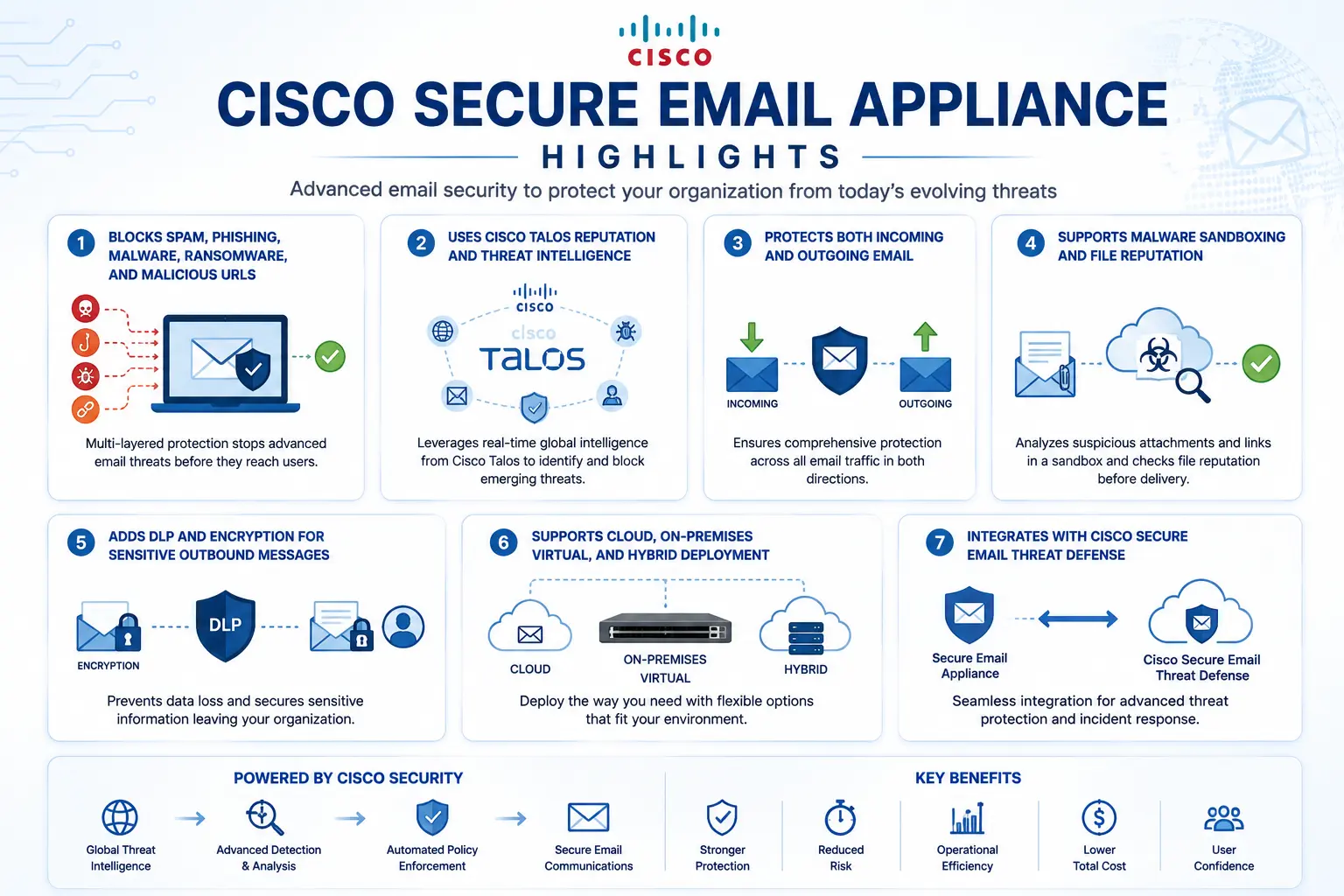
- Blocks spam, phishing, malware, ransomware, and malicious URLs
- Uses Cisco Talos reputation and threat intelligence
- Protects both incoming and outgoing email
- Supports malware sandboxing and file reputation
- Adds DLP and encryption for sensitive outbound messages
- Supports cloud, on-premises virtual, and hybrid deployment
- Integrates with Cisco Secure Email Threat Defense
Cisco Secure Email Appliance At a Glance
Former name: Cisco Email Security Appliance (Cisco ESA)
Product category : Cisco Security
Primary role: Inbound and outbound email inspection and policy enforcement
License measurement: Per user / mailbox
Main bundles: Secure Email Essentials and Secure Email Advantage
Deployment options: Cloud, on-premises virtual appliance, or hybrid
Typical terms: 1 year, 3 years, or 5 years
Cisco Secure Email Appliance Product Overview
Cisco Secure Email Appliance operates as a security gateway within the broader Cisco License ecosystem, positioned between an organization’s mail environment and external email systems.Incoming messages are checked before delivery, while outbound messages can be inspected for sensitive information, policy violations, or content that requires encryption.
Email Threat Protection
Sender reputation, domain reputation, anti-spam engines, antivirus scanning, and Outbreak Filters help stop unwanted or suspicious messages early in the mail flow. URL filtering evaluates links contained in messages and attachments, while click-time protection can respond when a previously safe destination later becomes malicious.
Malware and Attachment Analysis
Cisco Secure Email Malware Defense checks file reputation and can submit suspicious files for deeper sandbox analysis. File retrospection allows administrators to receive updated alerts when Cisco later determines that a previously observed file is malicious.
Data Protection
For outbound email, policies can identify sensitive content and apply actions such as quarantine, notification, or encryption. Data Loss Prevention and Secure Email Encryption are included with the Advantage bundle and can be added separately to Essentials when required.
Core Technical Flow
Internet Email → Cisco Secure Email Appliance → Reputation, Content and Threat Inspection → Policy Decision → Mail Server / User Mailbox
For outbound traffic, the process works in reverse. Messages leaving the organization pass through security and compliance policies before delivery to external recipients. This gateway architecture gives security teams a control point for filtering malicious content, enforcing email policies, tracking message disposition, and protecting sensitive information.
Deployment and Licensing Models
Cisco Secure Email licensing is user-based rather than device-based. Cisco currently offers Secure Email Essentials and Secure Email Advantage, with licensing based on the number of users or mailboxes being protected. Both packages include anti-spam, antivirus, Outbreak Filters, URL-related protection, and Malware Defense capabilities.
Essentials provides the core email-security functions and limited malware-analysis capacity. Advantage adds capabilities such as Data Loss Prevention, email encryption, Safe Unsubscribe, and expanded malware-analysis capacity.
Deployment can be selected according to infrastructure needs:
- Cloud: Cisco-hosted email gateway service
- On-premises: Secure Email virtual appliances within customer infrastructure
- Hybrid: Combination of cloud and customer-managed gateway services
Cisco lists subscription terms of one, three, and five years.
Features and Benefits
One of the main advantages of Cisco Secure Email Appliance is layered inspection. A message is not evaluated by a single antivirus engine alone. Reputation, sender behavior, content, URLs, attachments, outbreak intelligence, and configured organizational policies can all influence the final action.
For organizations with multiple gateways, Cisco Secure Email and Web Manager can centralize reporting, message tracking, and quarantines. Cisco Secure Email Gateway can also integrate with Cisco Secure Email Threat Defense, adding AI- and machine-learning-based analysis for advanced attacks and Microsoft 365 environments.
Compatibility and Requirements
| Area | What to confirm |
|---|---|
| Mail environment | Microsoft 365, Exchange, or other supported mail infrastructure |
| Deployment | Cloud, virtual, or hybrid |
| User quantity | Number of protected users or mailboxes |
| License bundle | Essentials or Advantage |
| Email flow | Inbound, outbound, or both |
| Security features | Malware Defense, DLP, encryption, Threat Defense |
| Management | Single gateway or centralized management |
| Licensing | Cisco account, subscription, and virtual-appliance requirements |
Virtual deployment requirements should be checked against the exact AsyncOS release and supported hosting platform before installation.
Cisco Secure Email Appliance Activation
For cloud deployments, Cisco provisions the subscribed service and customer environment. On-premises virtual deployments require the Secure Email virtual appliance to be installed, licensed, and configured within the organization’s infrastructure.
Cisco’s current documentation states that Smart Software Licensing is mandatory for supported Content Security appliances from AsyncOS 15.5.1 onward, except Cloud Email Security appliances. Existing older environments may still involve classic virtual-license workflows depending on their version. After licensing, administrators configure mail routing, DNS records, security policies, quarantine behavior, and integrations before production email is directed through the gateway.
Pricing Factors and Quote Process
Cisco Secure Email Appliance pricing mainly depends on the number of protected users, Essentials or Advantage bundle, subscription term, deployment model, and required add-ons. For a quote, provide Cisco as the brand and Cisco Secure Email Appliance as the product. Existing license information or email-security requirements can also be attached, while bundle selection, migration, and additional security options can be reviewed during the quote process.
Cisco ESA pricing depends on your license type, deployment model and support requirements.