

ManageEngine Patch Manager helps organizations automate patch detection, deployment, and remediation across endpoints, servers, and third-party applications from a centralized platform.
Quick benefits
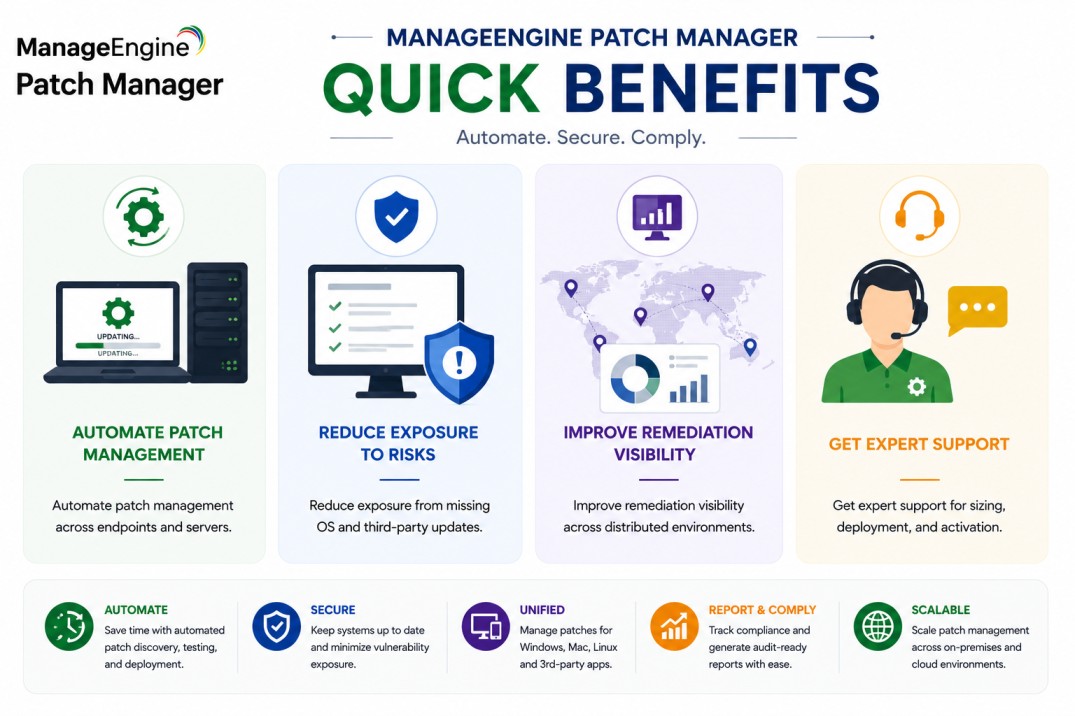
- Automate patch management across endpoints and servers
- Reduce exposure from missing OS and third-party updates
- Improve remediation visibility across distributed environments
- Get expert support for sizing, deployment, and activation
ManageEngine Patch Manager At a glance
What it does : ManageEngine Patch Manager provides centralized patch management for operating systems, third-party applications, servers, and enterprise endpoints.
License type : Subscription or perpetual licensing (endpoint/device-based)
Typical term : 1 year · 3 years · perpetual options
Activation method : Online activation or offline XML-based activation
Who needs it : Organizations requiring centralized patch automation, vulnerability remediation, and endpoint update visibility across enterprise environments

License Overview
Organizations usually size patch management platforms based on how many endpoints and servers need to be scanned, updated, and tracked within the operational environment. The ManageEngine Patch Manager license is generally aligned with the number of managed endpoints, patching scope, and enabled deployment capabilities. This may include desktops, laptops, servers, remote systems, and distributed endpoint environments.
Because patching requirements vary across operating systems, third-party applications, remote users, and branch offices, deployment planning should focus on actual remediation coverage rather than only device inventory size. A properly aligned license helps organizations maintain consistent patch visibility, reduce unmanaged update gaps, and support scalable remediation workflows as the endpoint environment grows.
Product Overview
Unpatched systems remain one of the most common sources of operational and security exposure. As environments expand across remote users, servers, and distributed endpoints, tracking missing updates manually becomes difficult and unreliable.
ManageEngine Patch Manager is designed to reduce this risk by centralizing patch discovery, approval, testing, deployment, and reporting workflows.
In practice, the platform scans managed systems, identifies missing operating system and third-party application patches, and helps administrators deploy updates based on defined policies and schedules.
One of the key advantages is remediation control. IT teams can approve patches, test deployments, schedule rollouts, and monitor installation status from one centralized console.
For organizations managing large endpoint environments, this approach supports more predictable patch cycles and better visibility into remediation progress.
Core technical flow
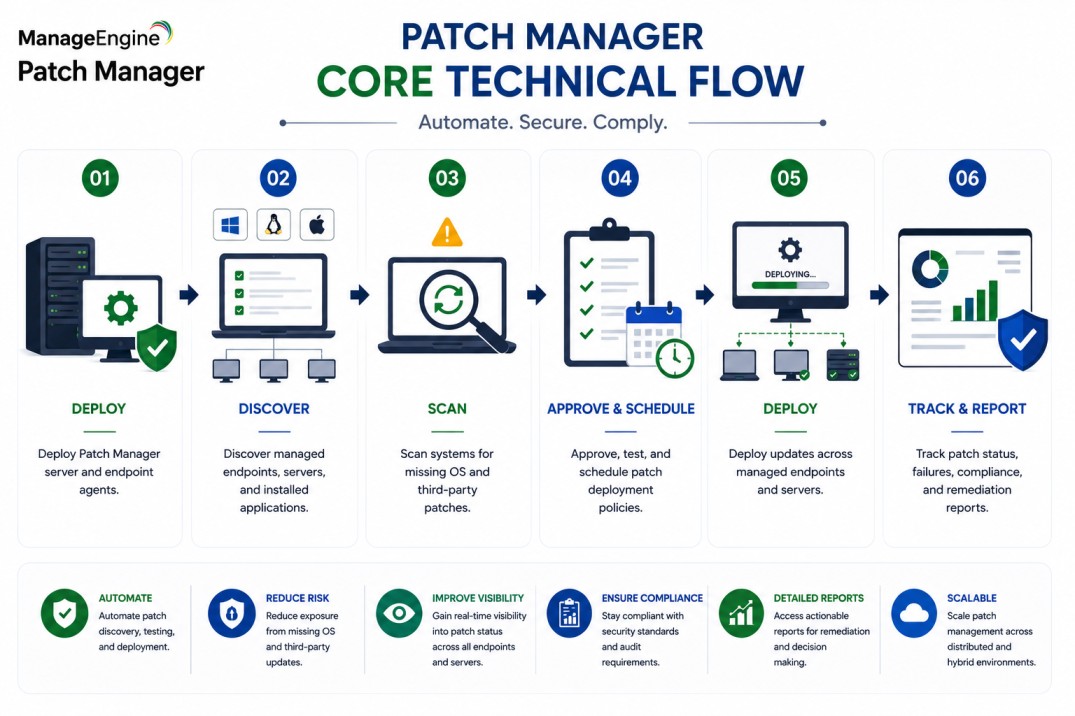
- Deploy the Patch Manager server and endpoint agents
- Discover managed endpoints, servers, and installed applications
- Scan systems for missing OS and third-party patches
- Approve, test, and schedule patch deployment policies
- Deploy updates across managed endpoints and servers
- Track patch status, failures, compliance, and remediation reports
Options & Tiers
| Licensing Model | Best for | Typical Scope | What affects pricing |
|---|---|---|---|
| Standard patch deployment | Core patch operations | OS and application patching | Endpoint count |
| Enterprise patch management | Large distributed environments | Advanced patch automation | Infrastructure scale |
| Subscription or perpetual | Flexible deployment models | Annual or permanent usage | Term and maintenance |
| Remote endpoint coverage | Distributed workforces | Agent-based patch visibility | Remote device scope |
Features & Benefits
As endpoint environments grow across offices, remote users, and server infrastructures, maintaining consistent patch coverage becomes more challenging. ManageEngine Patch Manager helps organizations centralize patch operations by bringing scanning, approval, deployment, and reporting into a single operational workflow.
One of the major benefits is faster remediation. IT teams can identify missing patches, prioritize critical updates, and deploy them across managed systems with better control. The platform also improves operational consistency by helping administrators standardize patch policies across endpoints, servers, and third-party applications. Over time, this helps reduce exposure from outdated software while supporting more scalable and reliable patch management operations.
System Requirements
Common environments
- Enterprise endpoint environments
- Server and workstation infrastructures
- Remote and distributed workforces
- Centralized patch management operations
Technical requirements
- Supported Windows or Linux deployment infrastructure
- Endpoint agent deployment or managed system connectivity
- Internet connectivity or offline XML activation support
How activation works
Activating a ManageEngine Patch Manager license typically starts with deploying the Patch Manager server and applying the license based on the selected edition and managed endpoint capacity. In online environments, activation can usually be completed from the administration interface using the provided license information.
For restricted or offline environments, Patch Manager also supports XML-based activation workflows. In these cases, administrators generate or import an XML file with the customer’s chosen name and deployment details to activate the platform manually without requiring direct internet connectivity.
Depending on the deployment architecture, activation may also validate managed endpoint capacity, enabled patch modules, agent coverage, remote office components, and third-party application patching features. After activation, organizations should review endpoint coverage, patch deployment scope, and remediation reporting regularly to ensure that infrastructure growth remains aligned with the licensed environment.
Pricing factors + quote process
Organizations usually size ManageEngine Patch Manager according to managed endpoint count, patching requirements, and operational deployment scope.
Environments with remote users, multiple operating systems, broader third-party application coverage, or distributed offices may require expanded licensing capacity and more advanced deployment planning.
Additional considerations, such as edition type, endpoint agent coverage, remote office requirements, maintenance scope, and subscription term, can also influence licensing requirements.
During the quote process, patch management goals, endpoint environment size, and deployment workflow requirements are reviewed first so the licensing approach can match the organization’s remediation strategy more accurately.
After you request a quote
- We review your endpoint and patching environment
- Recommend the most suitable Patch Manager licensing model
- Provide official pricing and delivery details
- Share activation and deployment guidance
ManageEngine pricing depends on your license edition, users, devices, deployment model, term, and support needs.