

Palo Alto License provides organizations with access to a broad cybersecurity portfolio covering network security, cloud protection, endpoint security, threat intelligence, and security operations. Through platforms such as Next-Generation Firewalls, Prisma Security solutions, and Cortex security products, Palo Alto enables businesses to build layered protection against modern cyber threats.
Quick Benefits
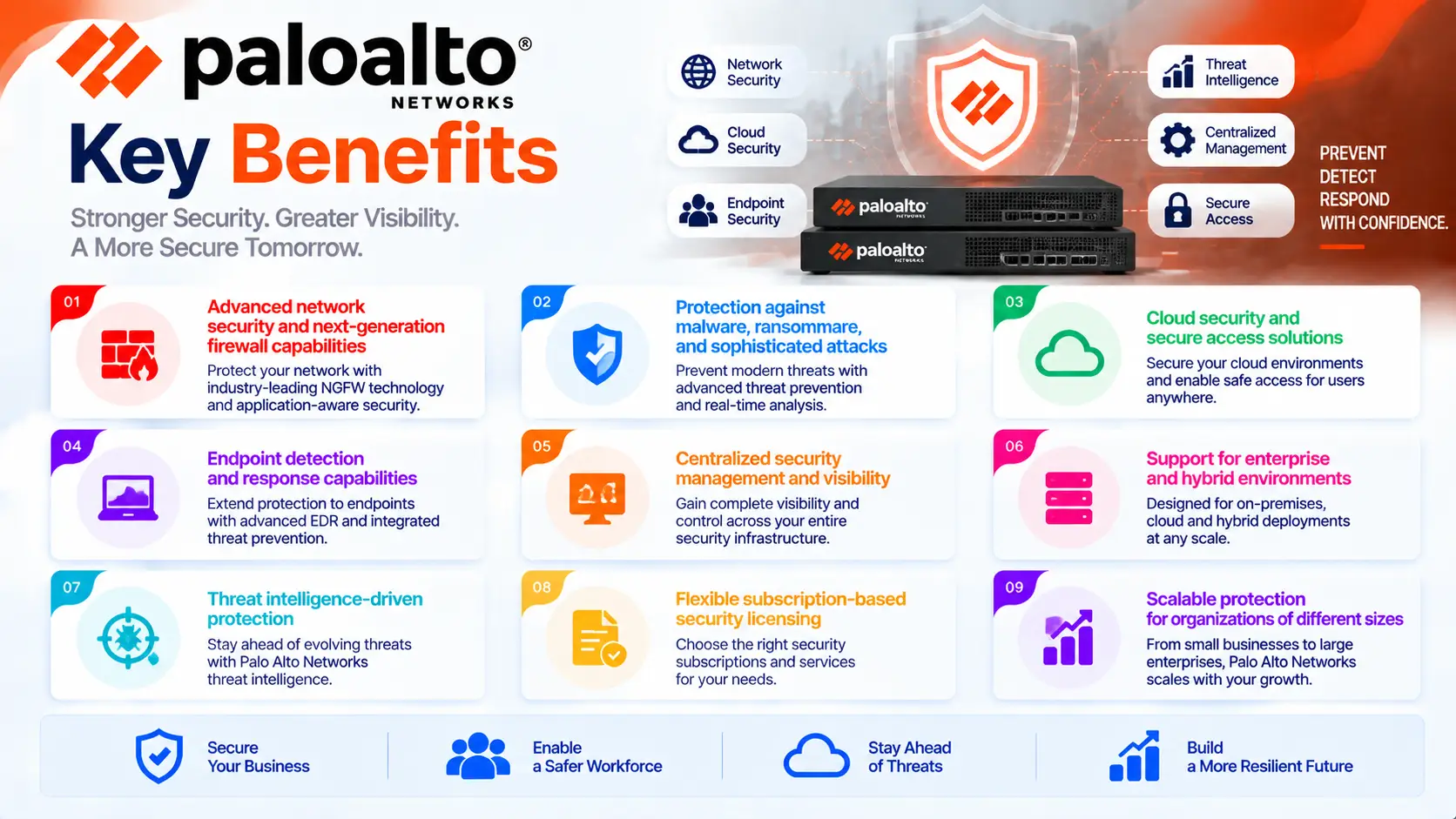
- Advanced network security and next-generation firewall capabilities
- Protection against malware, ransomware, and sophisticated attacks
- Cloud security and secure access solutions
- Endpoint detection and response capabilities
- Centralized security management and visibility
- Support for enterprise and hybrid environments
- Threat intelligence-driven protection
- Flexible subscription-based security licensing
- Scalable protection for organizations of different sizes
Palo Alto License At a Glance
What it is: Enterprise cybersecurity licensing portfolio
Vendor: Palo Alto Networks
Main platforms: Next-Generation Firewall, Prisma Security, and Cortex Security Platform
License type: Subscription-based and feature-based security licensing
Primary licensing metrics: Devices, users, protected workloads, endpoints, subscriptions, and security modules
Deployment models: Physical, virtual, cloud, and hybrid environments
Main users: Enterprises, security teams, SOC teams, network administrators, and cloud security teams
Security areas: Network Security, Cloud Security, Endpoint Security, Threat Intelligence, and Security Operations

License Overview
A Palo Alto License provides access to security capabilities that extend beyond the basic functionality of Palo Alto Networks platforms. The licensing structure is built around the organization’s selected security products, deployment model, protected assets, and required advanced features.
Unlike traditional hardware-focused licensing models, Palo Alto licensing often combines platform licensing with subscription services. For example, a Next-Generation Firewall appliance may provide the base security platform, while additional subscriptions enable advanced capabilities such as threat prevention, URL filtering, WildFire malware analysis, advanced DNS security, or SD-WAN functionality.
Organizations selecting a Palo Alto license should first identify their security objectives and infrastructure requirements. A company protecting a branch network may focus on firewall subscriptions, while an enterprise operating across multiple clouds may require Prisma Cloud, Prisma Access, or Cortex security capabilities.
The licensing model can vary depending on whether the organization requires protection for physical appliances, virtual firewalls, cloud workloads, endpoints, or security operations environments. When evaluating a Palo Alto License, businesses should consider current infrastructure, expected growth, compliance requirements, and the level of security automation required. Choosing the correct combination of subscriptions helps organizations maximize security value without purchasing unnecessary capabilities.
How Palo Alto Licensing Works
Palo Alto licensing begins with selecting the security platform that matches the organization’s architecture, such as a physical Next-Generation Firewall, virtual security deployment, cloud security solution, or security operations platform. After selecting the platform, organizations choose the required subscriptions and security services based on their protection requirements.
Once activated, licenses enable additional security capabilities through Palo Alto management platforms. Administrators can configure policies, deploy security controls, monitor threats, and use advanced security intelligence features according to the purchased services.
The modular licensing approach allows organizations to expand protection over time. A business may begin with firewall protection and later add advanced threat prevention, cloud security, endpoint protection, or security operations capabilities as its environment becomes more complex.
Palo Alto Security Portfolio Overview
| Solution Family | Purpose |
|---|---|
| Next-Generation Firewall (NGFW) | Advanced network security, application control, threat prevention, and traffic inspection |
| Prisma Access | Cloud-delivered security access for remote users, branches, and distributed environments |
| Prisma Cloud | Cloud security and workload protection across modern cloud infrastructures |
| Cortex XDR | Extended detection and response across endpoints, networks, and security data sources |
| Cortex XSOAR | Security orchestration, automation, and incident response management |
| Cortex Xpanse | Attack surface management and external exposure discovery |
| VM-Series Firewall | Virtual firewall protection for cloud and virtualized environments |
| GlobalProtect | Secure remote access and endpoint connectivity solution |
Licensing Models and Options
| License Model | Description | Suitable For |
|---|---|---|
| Firewall Subscription Licensing | Adds advanced security services to Palo Alto firewall platforms | Organizations deploying NGFW protection |
| Device-Based Licensing | Licensing based on physical or virtual security appliances | Data centers and enterprise networks |
| User-Based Licensing | Protection based on users requiring secure access or security services | Remote workforce and access solutions |
| Cloud Security Licensing | Subscription for cloud workloads and application protection | Organizations operating cloud environments |
| Endpoint Security Licensing | Coverage for endpoint detection and response capabilities | Security teams requiring endpoint visibility |
| Security Operations Licensing | Enables automation, analytics, and incident response capabilities | SOC environments |
| Multi-Year Subscription | Longer security coverage with predictable planning | Enterprise organizations |
Features and Benefits
Palo Alto License enables organizations to create a layered security architecture where network, cloud, endpoint, and security operations capabilities can work together. One of the strongest advantages of the Palo Alto ecosystem is the ability to combine prevention, detection, and response technologies under a unified security strategy.
For network environments, Palo Alto Next-Generation Firewalls provide advanced traffic inspection, application visibility, threat prevention, and policy enforcement. Additional subscriptions extend these capabilities with services such as malware analysis, URL protection, and threat intelligence.
In cloud environments, Palo Alto solutions help organizations secure workloads, applications, and remote access scenarios while maintaining visibility across distributed infrastructures. For security teams, Cortex solutions provide deeper investigation and automation capabilities, helping analysts identify threats faster and respond more efficiently. The broad Palo Alto security portfolio allows organizations to adapt their licensing strategy as security requirements evolve.
Compatibility and Requirements
Before selecting a Palo Alto License, organizations should evaluate their infrastructure and security requirements.
Important considerations include:
- Existing Palo Alto platforms
- Number of firewalls, users, or workloads
- Physical, virtual, or cloud deployment model
- Required security subscriptions
- Network architecture
- Cloud environments
- Compliance requirements
- Security operations needs
Palo Alto solutions support a wide range of enterprise environments, including data centers, branch offices, cloud infrastructures, and remote user scenarios. A proper assessment ensures that organizations select the correct combination of platforms and subscriptions.
Activation and Deployment
Palo Alto license deployment begins after selecting the required security platform and activating the purchased subscriptions.
Typical deployment steps include:
- Activating Palo Alto subscriptions
- Registering devices or services
- Connecting management platforms
- Enabling security features
- Configuring security policies
- Monitoring security events
Organizations usually deploy core security capabilities first and expand licensing as additional requirements emerge. For enterprise environments, planning subscription requirements before deployment helps prevent gaps in security coverage.
Pricing and Quote Process
Pricing for a Palo Alto License depends on the selected platform, number of protected assets, subscription services, deployment model, and licensing duration.
Before requesting a quote, organizations should define:
- Required Palo Alto products
- Number of devices, users, or workloads
- Required security subscriptions
- Deployment environment
- Subscription term
- Support requirements
- Expansion plans
Because Palo Alto licensing includes many different security platforms, accurate sizing is important to avoid selecting insufficient protection or unnecessary services. Organizations should also consider future growth because additional users, locations, cloud workloads, or security requirements may affect licensing needs.
Palo Alto pricing depends on your security solution, firewall model, license edition, deployment model, license term, and support requirements.