

BIG-IP 4000 Series is a legacy F5 physical application delivery platform built for enterprise traffic management, load balancing, SSL/TLS processing, and supported BIG-IP application services. The family includes BIG-IP 4000s and BIG-IP 4200v, which share the same basic hardware architecture but provide different performance levels.
F5 described the 4000 Series as an enterprise traffic-management platform designed to balance performance with cost. Its 1RU chassis provides a mix of 1GbE copper and 10GbE optical connectivity, making it suitable for the application environments common during its generation. Today, most BIG-IP 4000 Series requests involve identifying an installed license, maintaining an existing system, locating a specific part number, or planning a move to newer F5 hardware.
Series Highlights
- Legacy F5 BIG-IP Standard Series hardware family
- Includes BIG-IP 4000s and BIG-IP 4200v
- Shared F5 platform ID C113
- 1RU rack-mount architecture
- 16 GB system memory
- 500 GB internal hard drive
- Eight 1GbE copper data interfaces
- Two 1/10GbE SFP+ interfaces
- Up to 10 Gbps L4/L7 throughput
Review BIG-IP 4000 Series Price List and request a quote tailored to your licensing needs.
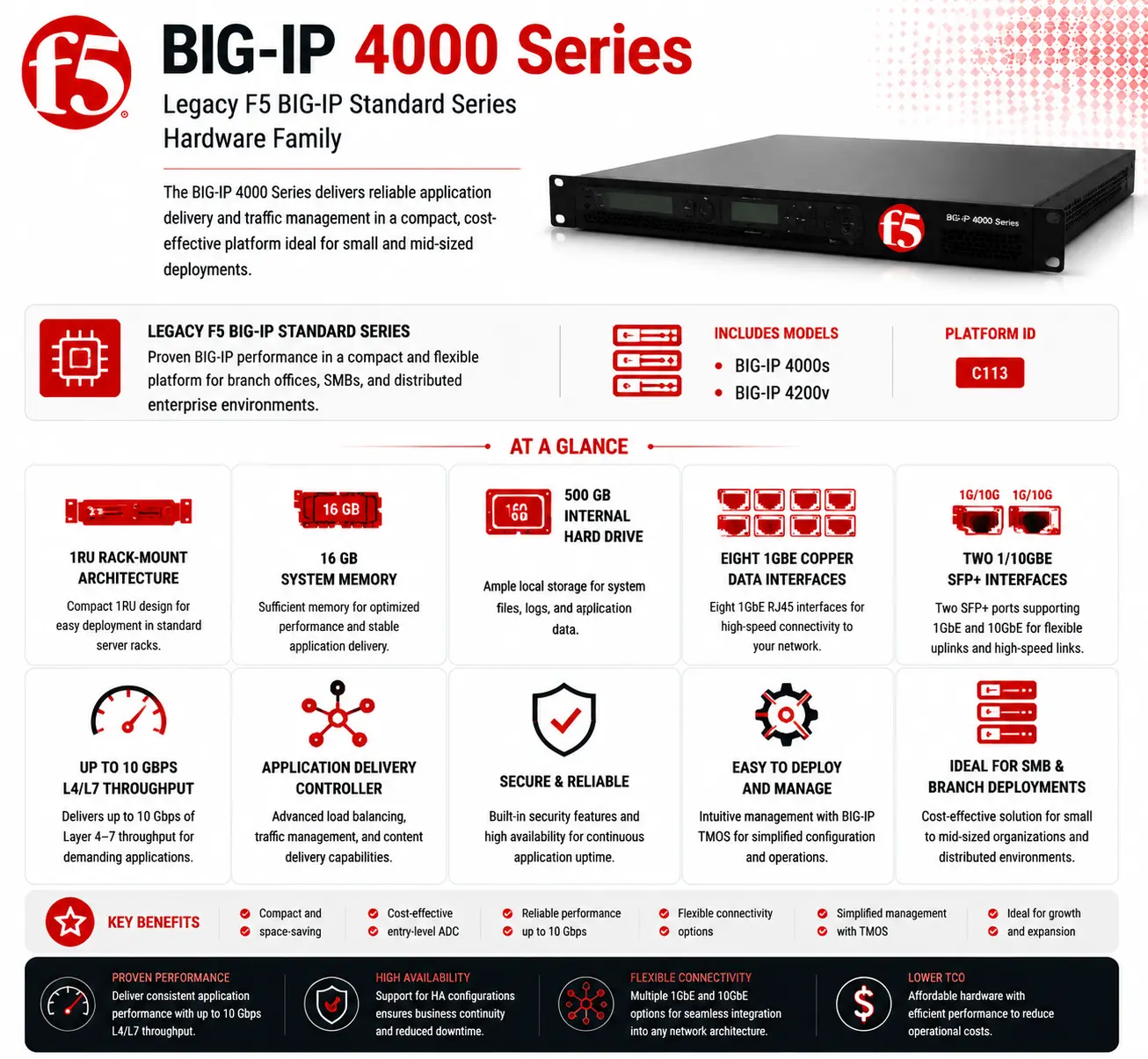
BIG-IP 4000 Series At a glance
What it is: Legacy enterprise F5 BIG-IP physical ADC family
Product family: BIG-IP Standard Series
Models: BIG-IP 4000s and BIG-IP 4200v
Platform ID: C113
Software architecture: BIG-IP TMOS
Memory: 16 GB
Storage: 500 GB HDD
Interfaces: Eight 1GbE RJ45 plus two 1/10GbE SFP+
Series Overview
The BIG-IP 4000 Series uses a quad-core Intel Xeon processor with eight hyperthreaded logical processing cores. F5’s platform guide lists 16 GB of RAM, a 500 GB drive, eight copper Gigabit Ethernet interfaces, and two 10GbE SFP+ ports. An optional second power supply could also be installed for greater hardware resilience.
The two primary models use that hardware differently.
| Model | Typical positioning |
|---|---|
| BIG-IP 4000s | Base performance tier |
| BIG-IP 4200v | Higher licensed performance tier |
Both were rated at 10 Gbps L4/L7 throughput, but the higher-tier 4200v approximately doubled several traffic-processing metrics. Historical F5 specifications list 425,000 L7 requests per second for 4000s versus 850,000 for 4200v, and 150,000 versus 300,000 L4 connections per second. That difference matters when replacing an installed appliance. Two C113 systems can look essentially the same while carrying substantially different workload expectations.
Licensing and Part Number Guidance
The hardware model alone does not describe the complete BIG-IP configuration. Part numbers were sold for different BIG-IP License services and bundles, including LTM, application security, access, firewall, and other supported module combinations. F5 software documentation identifies both 4000s and 4200v as C113 platforms capable of supporting multiple licensable BIG-IP products, depending on software release and provisioning.
The 4000s also had an on-demand upgrade path to 4200v. In practical terms, an organization could purchase an upgrade license to unlock the higher performance level without changing to a different C113 chassis. When working with an existing appliance, confirm the registration key and installed license rather than assuming its capabilities from the front-panel label.
Common Use Cases
| Use case | Typical 4000 Series role |
|---|---|
| Enterprise load balancing | LTM traffic distribution and health monitoring |
| SSL/TLS offload | Reduce encryption processing on application servers |
| Web applications | Front-end traffic control for business services |
| DNS | BIG-IP DNS/GTM services when licensed |
| Application access | APM functions on supported configurations |
| Application security | Supported BIG-IP security modules |
| HA deployment | Pair of systems for application availability |
| Legacy refresh | Replacement or migration to newer F5 architecture |
Models, Licenses, and Ordering Scope
| Area | What to confirm |
|---|---|
| Model | 4000s or 4200v |
| Platform ID | C113 |
| BIG-IP services | LTM, DNS, APM, application security, AFM, or existing bundle |
| Software | Installed TMOS/BIG-IP version |
| Performance | Application traffic, connections, and SSL/TLS demand |
| Interfaces | 1GbE or 10GbE requirements |
| Availability | Standalone or HA pair |
| Power | Single or redundant PSU |
| Support | Existing service and lifecycle status |
| Part number | Appliance, module, support, upgrade, or accessory SKU |
What to Check Before Requesting a Quote
Start with the exact appliance identity. Confirm whether the system is a 4000s or 4200v, then collect the active BIG-IP modules, software version, registration information, traffic levels, SSL usage, and HA configuration. For replacement projects, do not map the old platform to a new model simply because the numbers look similar. The later i4000 generation changed the hardware significantly, and current rSeries platforms introduce F5OS and BIG-IP tenant architecture. A better quote starts with the workload: what applications are behind the ADC, how much encrypted traffic it handles, which modules are actually provisioned, and how much growth is expected.
Activation and Delivery Notes
BIG-IP 4000 Series uses the traditional TMOS appliance model. Licensing is activated on the physical system, after which the required BIG-IP modules are provisioned and application configuration is applied. Because this is an older platform, software compatibility should be checked before any upgrade or replacement work. F5 release documentation shows 4000s and 4200v as a distinct C113 platform family, separate from the later i4000 models. If the system is being replaced, preserve the current UCS/configuration backup, registration information, module inventory, VLAN/interface design, and HA details before beginning migration.
F5 pricing depends on your product edition, license type, deployment model, traffic needs, term, and support requirements.