

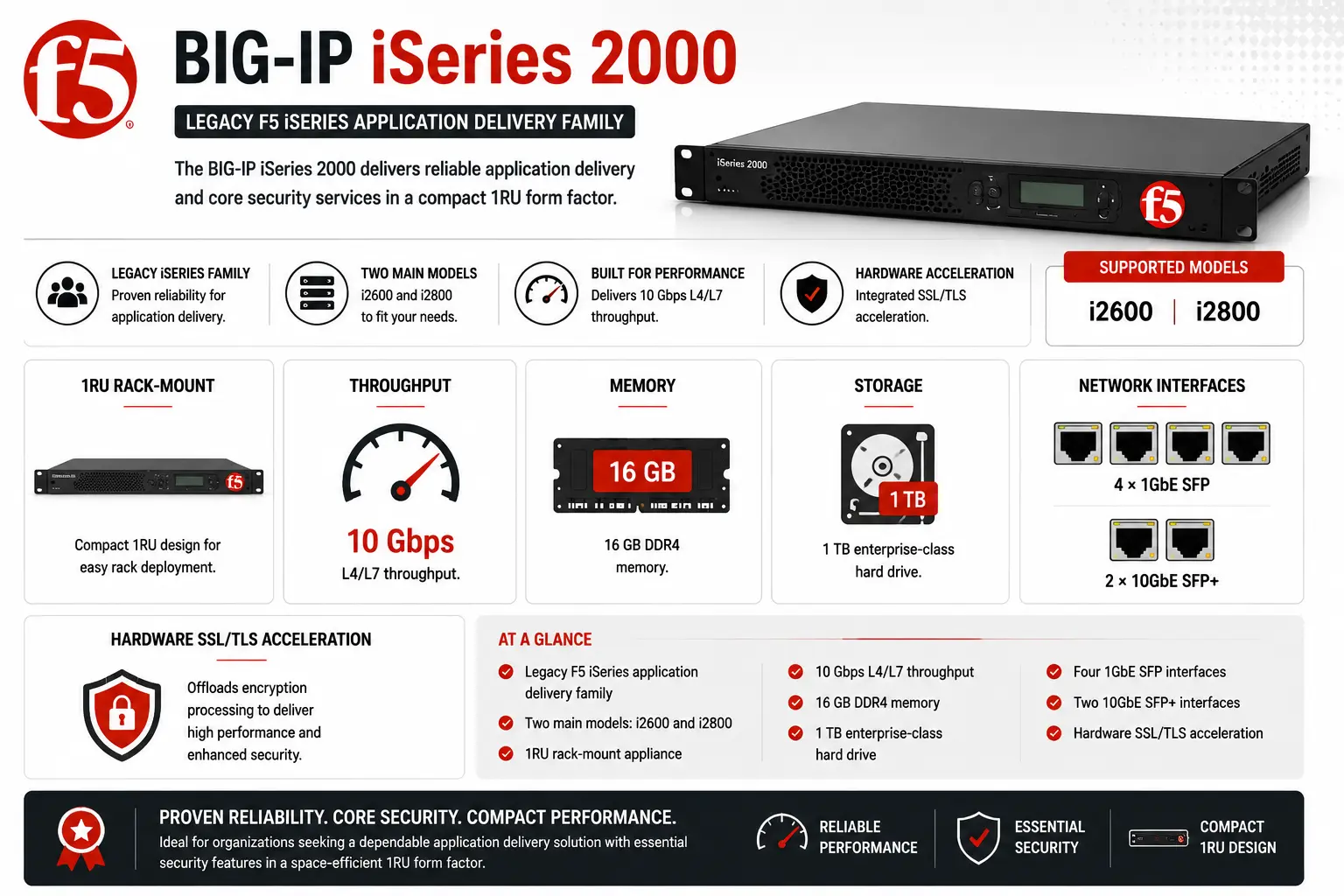
BIG-IP i2000 is an F5 iSeries application delivery appliance family built for smaller enterprise and application-edge environments. The family includes the BIG-IP i2600 and BIG-IP i2800, both providing 10 Gbps L4/L7 throughput, hardware-assisted SSL/TLS processing, four 1GbE SFP interfaces, and two 10GbE SFP+ interfaces in a compact 1RU chassis.
Although the two models use the same underlying hardware, their processing and SSL capacity differ. The i2600 was designed as the lower performance tier and can be upgraded through licensing to i2800 capacity. For existing installations, this distinction matters when reviewing licenses, replacement hardware, support requirements, or a move to the newer F5 r2000 platform.
Series Highlights
- Legacy F5 iSeries application delivery family
- Two main models: i2600 and i2800
- 1RU rack-mount appliance
- 10 Gbps L4/L7 throughput
- 16 GB DDR4 memory
- 1 TB enterprise-class hard drive
- Four 1GbE SFP interfaces
- Two 10GbE SFP+ interfaces
- Hardware SSL/TLS acceleration
Review BIG-IP i2000 Price List and request a quote tailored to your licensing needs.
BIG-IP i2000 At a glance
What it is: Entry-level F5 iSeries physical application delivery family
Product family: BIG-IP iSeries
Models: i2600 and i2800
Software architecture: 64-bit BIG-IP TMOS
Memory: 16 GB DDR4
Storage: 1 TB enterprise-class HDD
Interfaces: Four 1GbE SFP plus two 10GbE SFP+
Series Overview
The i2600 and i2800 share a dual-core Intel processor with four hyperthreaded logical processing cores, 16 GB RAM, and the same basic network-interface layout. The main difference is the performance entitlement.
F5 rates i2600 at approximately 350,000 L7 requests per second and 125,000 L4 connections per second. The i2800 increases those figures to 650,000 L7 requests and 250,000 L4 connections per second. Both are rated for 10 Gbps L4/L7 throughput.
SSL performance also changes noticeably. F5 published 5 Gbps bulk encryption and 2,500 RSA 2K transactions per second for i2600, versus 8 Gbps and 4,300 RSA 2K TPS for i2800.
This is why the exact model matters even when the chassis appears identical.
Licensing and Part Number Guidance
A BIG-IP i2000 part number normally identifies both the hardware model and the BIG-IP License service or bundle purchased with it. An i2600 used primarily for LTM may have a different SKU from an i2600 licensed for access, DNS, or application-security services.
The most important historical capacity option is the i2600-to-i2800 on-demand upgrade. F5 documents i2600 as software-upgradable, while i2800 represents the higher performance level of the same i2000 hardware.
For an existing appliance, avoid selecting a replacement or license based only on “i2000.” Check the full model, registration key, installed modules, and bundle first.
For modernization projects, F5’s rSeries sizing guidance directly compares i2000 with r2000. Moving from i2000 to r2000 doubles platform memory from 16 GB to 32 GB, while the newer architecture uses a different CPU and resource model.
Common Use Cases
| Use case | Typical i2000 role |
|---|---|
| Application load balancing | LTM traffic distribution and health monitoring |
| SSL/TLS offload | Reduce encryption workload on application servers |
| Internet application edge | Front-end ADC for smaller production services |
| DNS | BIG-IP DNS where appropriately licensed |
| Secure application access | APM functions with the correct entitlement |
| Application security | Supported BIG-IP security modules |
| Existing HA pair | Two appliances for application availability |
| Hardware refresh | Migration from i2600/i2800 toward r2000 |
Models, Licenses, and Ordering Scope
| Area | What to confirm |
|---|---|
| Model | i2600 or i2800 |
| BIG-IP services | LTM, DNS, APM, security, or existing bundle |
| Performance | Traffic, connections, SSL/TLS, and application load |
| Interfaces | 1GbE or 10GbE optics |
| Upgrade | Existing i2600 or upgraded i2800-level requirement |
| Availability | Standalone or HA pair |
| Software | Installed BIG-IP/TMOS version |
| Storage | 1 TB HDD |
| Power | AC or supported DC configuration |
| Support | Existing coverage and lifecycle requirements |
| Part number | Exact hardware, software bundle, support, and accessories |
What to Check Before Requesting a Quote
For an existing i2000 environment, start with the appliance label or system information. Confirm whether it is i2600 or i2800, because the hardware appearance alone does not reveal the licensed performance level.
Then identify the BIG-IP modules currently in use, software version, application traffic, SSL volume, interface requirements, HA configuration, and whether the request concerns a renewal, replacement unit, upgrade, or full migration.
A migration should not be sized only by matching model numbers. F5 notes that the newer r2000 generation has twice the platform memory of i2000 and different per-CPU characteristics. Actual workload measurements are more useful than assuming i2600 automatically maps one-for-one to r2600.
Activation and Delivery Notes
BIG-IP i2000 uses the traditional TMOS appliance architecture, unlike rSeries, which separates F5OS from BIG-IP tenants.
The platform license and enabled BIG-IP modules should be reviewed before software changes, hardware replacement, or configuration migration. For an HA environment, both appliances should also be checked for compatible software, provisioning, licenses, interfaces, and failover configuration before work begins.
When moving to rSeries, remember that the architecture changes. rSeries runs F5OS at the platform layer and deploys BIG-IP as a tenant, so migration involves more than simply restoring the old hardware model onto a newer chassis. F5’s current rSeries documentation describes this tenant-based deployment model.
F5 pricing depends on your product edition, license type, deployment model, traffic needs, term, and support requirements.