

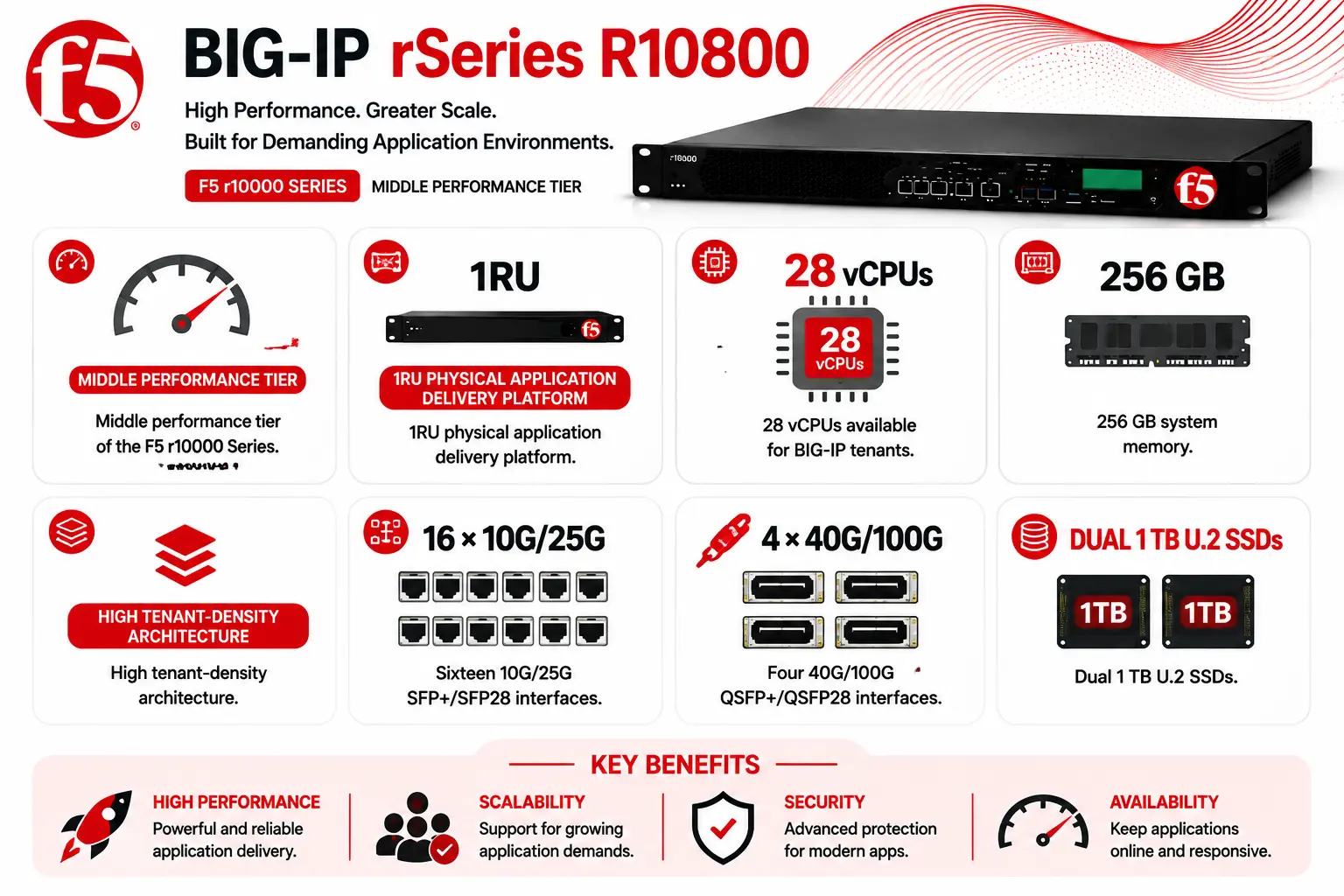
BIG-IP R10800 is the middle performance tier of the F5 r10000 Series, designed for large application delivery and security environments that need more tenant compute than R10600 without immediately purchasing the fully enabled R10900 tier. The platform combines 28 vCPUs available to BIG-IP workloads, 256 GB of system memory, high-density 25G/100G connectivity, and redundant internal storage in a 1RU appliance.
R10800 shares the same physical r10000 hardware with R10600 and R10900. The difference is how much CPU capacity is unlocked through licensing. An organization can start at R10800 and later move to R10900 through F5 Pay-as-you-Grow licensing without replacing the underlying appliance.
Series Highlights
- Middle performance tier of the F5 r10000 Series
- 1RU physical application delivery platform
- 28 vCPUs available for BIG-IP tenants
- 256 GB system memory
- High tenant-density architecture
- Sixteen 10G/25G SFP+/SFP28 interfaces
- Four 40G/100G QSFP+/QSFP28 interfaces
- Dual 1 TB U.2 SSDs
Review BIG-IP R10800 Price List and request a quote tailored to your licensing needs.
BIG-IP R10800 At a glance
What it is: Mid-tier F5 r10000 Series application delivery and security appliance
Product family: BIG-IP rSeries License
Platform layer: F5OS
Tenant compute: 28 vCPUs
System memory: 256 GB
Tenant memory: Large shared memory pool for BIG-IP workloads
Maximum tenant count: Up to 28 under minimum-size configurations
Storage: Two 1 TB U.2 SSDs
Interfaces: Sixteen 10G/25G plus four 40G/100G ports
Series Overview
The underlying r10000 hardware contains a 24-core Intel Xeon processor presented as 48 hyperthreaded logical cores. Twelve vCPUs are reserved for the F5OS platform layer. On R10800, another eight are disabled by the performance license, leaving 28 vCPUs available to BIG-IP tenants.
Those resources can be assigned to one large tenant or split across several workloads. F5 documents up to 28 single-vCPU tenants on R10800, although F5 also cautions that minimum-size single-vCPU tenants are suitable only for very lightweight LTM or DNS workloads. Production designs normally use fewer, larger tenants sized around the actual application and security load.
The hardware also provides a substantial network edge: sixteen 10G/25G interfaces and four 40G/100G interfaces. This gives R10800 considerably more physical connectivity than r5000 platforms while retaining a 1RU form factor.
Licensing and Part Number Guidance
The R10800 designation controls how much r10000 compute capacity is unlocked. It does not determine the BIG-IP services themselves. A deployment may use BIG-IP License services such as LTM for application delivery, Advanced WAF for web and API protection, DNS for global traffic services, APM for access, AFM for network-security functions, or a combination appropriate to the environment. The final order therefore needs to account for hardware, BIG-IP entitlement, optics, power, support, and redundancy.
R10800 sits between R10600 and R10900 in the three-tier r10000 PAYG model. R10600 can move to R10800 or directly to R10900, while R10800 has one remaining upgrade step to R10900. The change is implemented through licensing because all three models use the same underlying hardware.
For a new environment already expected to consume most of 28 vCPUs, requesting an R10900 comparison at quote stage is usually more useful than designing around an early upgrade.
Common Use Cases
| Use case | Why R10800 can fit |
|---|---|
| Large enterprise ADC | More tenant compute than R10600 |
| Application security | Capacity for heavier inspection workloads |
| SSL/TLS processing | Hardware acceleration for encrypted applications |
| BIG-IP consolidation | Multiple isolated BIG-IP environments |
| Data-center edge | Dense 25G and 100G connectivity |
| DNS and access services | Separate application roles into individual tenants |
| iSeries modernization | Current rSeries platform for larger refresh projects |
| Growth deployment | One remaining PAYG path to R10900 |
F5 also supports crypto/compression hardware acceleration for rSeries tenants. When enabled during tenant deployment, hardware resources are assigned in proportion to the tenant’s vCPU allocation.
Models, Licenses, and Ordering Scope
| Area | What to confirm |
|---|---|
| Platform | BIG-IP R10800 |
| BIG-IP services | LTM, DNS, Advanced WAF, AFM, APM, or required combination |
| Compute | Required vCPUs for each tenant |
| Tenant design | Number, image, CPU, memory, and service role |
| Interfaces | 10G, 25G, 40G, or 100G |
| Availability | Standalone or two-appliance HA |
| PAYG | Stay on R10800 or plan R10900 |
| Storage | Dual 1 TB U.2 SSDs |
| Power | AC, DC, or HVDC configuration |
| Optics | SFP+, SFP28, QSFP+, or QSFP28 |
| Support | Required F5 support level and term |
| Part numbers | Appliance, software, PAYG, optics, support, and accessories |
What to Check Before Requesting a Quote
Start with tenant allocation rather than the model name. List the BIG-IP services that each tenant will run, expected peak traffic, SSL/TLS demand, concurrent connections, application-security inspection, and interface requirements.
If several tenants are planned, estimate resources for them separately. A lightweight DNS tenant and a large Advanced WAF deployment should not be treated as equal just because both consume a tenant slot.
Also look at future growth. R10800 provides four more tenant vCPUs than R10600, but R10900 increases the ceiling to 36. If most of the 28 available vCPUs will be committed on day one, the fully enabled tier may be the cleaner commercial decision.
Activation and Delivery Notes
R10800 deployment begins at the F5OS platform layer. The administrator configures platform networking, imports the required BIG-IP or supported BIG-IP Next image, defines VLAN access, assigns tenant CPU and memory, and then deploys the tenant. Each deployed tenant receives dedicated vCPU resources.
Crypto/compression acceleration can also be enabled when the tenant is created, allowing SSL/TLS and compression processing to use hardware resources rather than relying entirely on software.
Before delivery, confirm the exact performance tier, BIG-IP entitlement, tenant plan, optics, power configuration, support coverage, and HA quantity. If future R10900 capacity is anticipated, include the PAYG path in the commercial comparison rather than treating it as an unrelated purchase.
F5 pricing depends on your product edition, license type, deployment model, traffic needs, term, and support requirements.