

Splunk PCI (Payment Card Industry Data Security Standard) helps organizations stay on top of PCI DSS compliance by bringing log data together, simplifying monitoring, and making reporting much easier to manage.
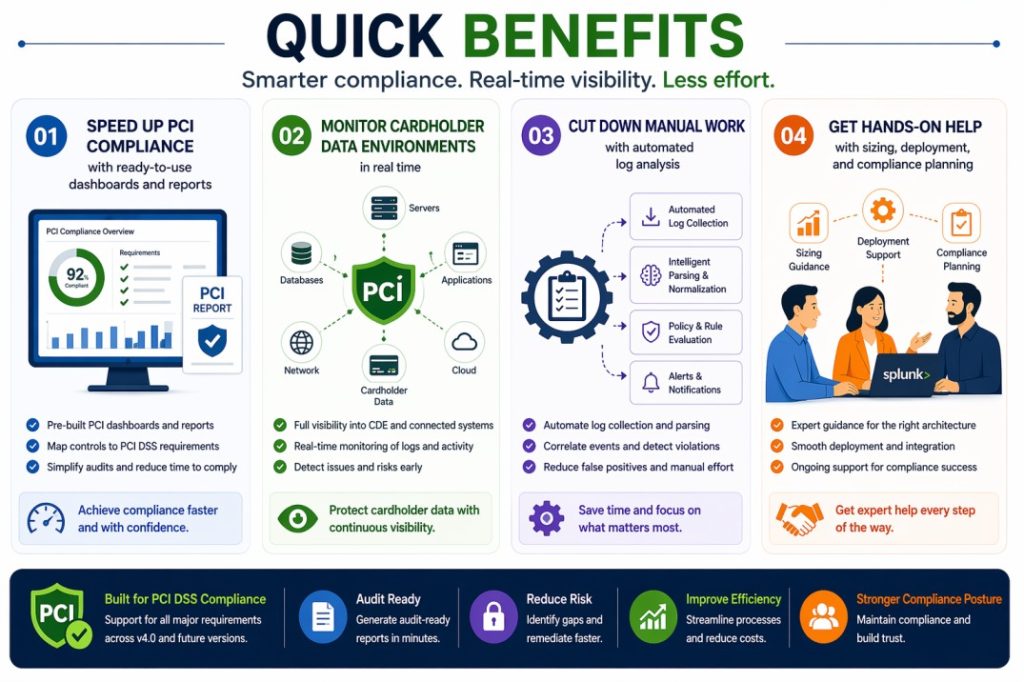
Quick benefits
- Speed up PCI compliance with ready-to-use dashboards and reports
- Monitor cardholder data environments in real time
- Cut down manual work with automated log analysis
- Get hands-on help with sizing, deployment, and compliance planning
Review Splunk PCI Price List and request a quote tailored to your licensing needs.
Splunk PCI At a glance
What it does : Splunk PCI provides monitoring, reporting, and analytics designed specifically for PCI DSS compliance, using data collected from across your environment.
License type : Add-on to Splunk Enterprise (subscription-based)
Typical term : 1 year · 3 years · 5 years
Activation method : Installed as an app on Splunk and activated through license entitlement
Who needs it : Organizations that handle payment card data and need to meet PCI DSS requirements while maintaining ongoing visibility

License Overview
The Splunk License model defines access to Splunk PCI as a compliance-focused layer within your Splunk environment. It helps organizations monitor and report on systems within their cardholder data environment (CDE) by analyzing security and operational data collected through Splunk. It’s designed to help you monitor and report on systems that are part of your cardholder data environment without having to rely on manual processes.
In practice, licensing is tied closely to how much data you’re bringing into Splunk. Since all compliance checks depend on analyzing logs and events, the size of your environment, and the number of systems involved, directly affects how the solution is sized.
Getting started is fairly straightforward. Once Splunk PCI is installed and the license is applied, it begins using your existing data to populate dashboards, generate reports, and track activity related to PCI requirements. From there, it becomes part of your ongoing monitoring workflow.
Because PCI environments are usually strict and highly regulated, sizing matters more than usual. If coverage is too limited, you might miss important events. If it’s oversized, you could be paying for capacity you don’t need. A well-sized setup helps keep everything balanced, reliable, and ready for audits.
Product Overview
Splunk PCI is built to make PCI DSS compliance feel more manageable day to day. Instead of pulling logs from different systems and trying to piece everything together manually, it gives you a central place to monitor and report on compliance-related activity.
In a typical environment, data is collected from systems inside the cardholder data environment, like servers, network devices, and security tools. That data is then processed and presented through dashboards and reports that are aligned with PCI requirements.
One of the biggest advantages is visibility. You’re not waiting for audits or running checks every few months, you can actually see what’s happening in real time. That makes it easier to catch issues early and fix them before they become bigger problems.
As your environment changes or grows, Splunk PCI continues to track everything in a consistent way, which helps maintain compliance over time instead of treating it as a one-off task.
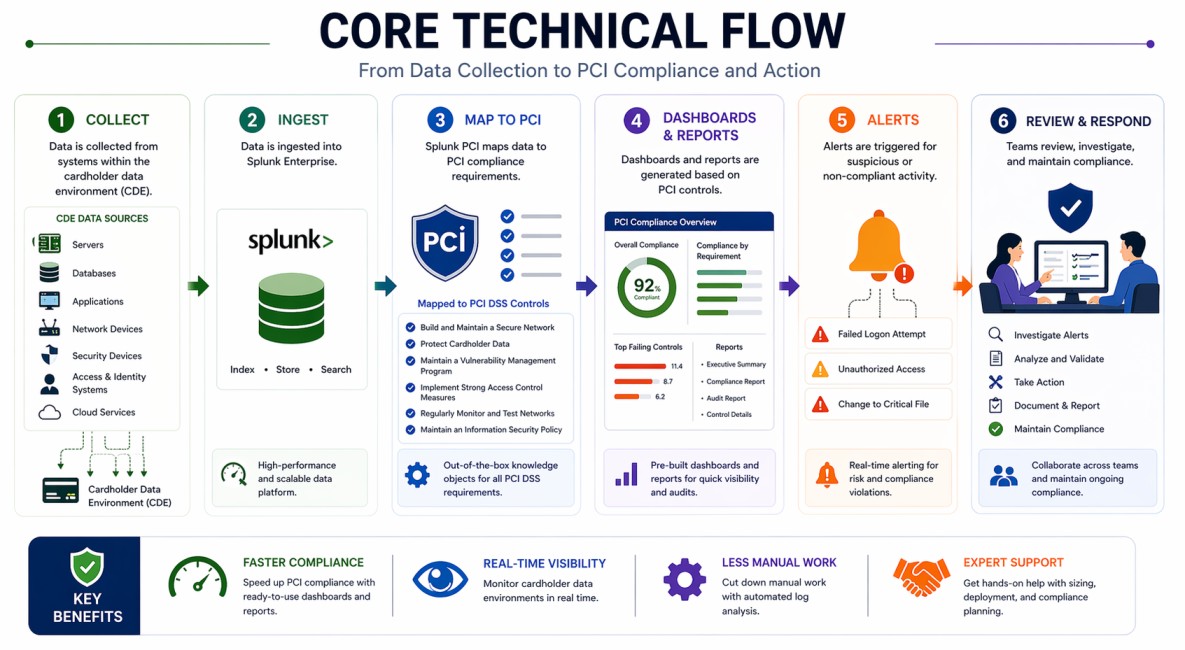
Core technical flow
- Data is collected from systems within the cardholder data environment (CDE)
- Data is ingested into Splunk Enterprise
- Splunk PCI maps data to PCI compliance requirements
- Dashboards and reports are generated based on PCI controls
- Alerts are triggered for suspicious or non-compliant activity
- Teams review, investigate, and maintain compliance
Options & Tiers
| Plan / Model | Best for | Key inclusions | What affects price |
|---|---|---|---|
| Splunk PCI standard deployment | Most compliance environments | PCI dashboards + reporting | Data volume, term |
| PCI + Splunk ES integration | Advanced security + compliance | SIEM + compliance visibility | Data scope, integration |
| Distributed deployment | Large environments | Scalable compliance monitoring | Architecture complexity |
| Hybrid deployment | Mixed environments | Flexible integration across systems | Deployment scope |
Features & Benefits
Splunk PCI helps simplify compliance by turning what is usually a manual process into something more structured and automated. Instead of collecting logs from different systems and trying to interpret them separately, everything is centralized and easier to understand.
Another important benefit is real-time monitoring. Instead of preparing for audits at specific times, you can continuously track what’s happening in your environment. This makes compliance more of an ongoing process rather than a last-minute effort.
It also helps reduce workload. Built-in dashboards and reports save time, while integration with other Splunk tools gives you deeper visibility into security events when needed.
Compatibility & Requirements
Common environments
- Payment processing systems
- Retail and e-commerce platforms
- Financial services environments
Typical prerequisites
- Splunk Enterprise deployment
- Defined cardholder data environment (CDE)
- Access to relevant log sources
How activation works
- Set up or confirm your Splunk Enterprise environment
- Install Splunk PCI
- Apply the license entitlement
- Connect data sources from your CDE
- Configure dashboards and compliance reports
Pricing factors + quote process
Splunk PCI pricing mainly depends on how much data is being processed and how large your cardholder data environment is. Since everything is based on log analysis, more systems and more data will naturally increase the required capacity.
The way your environment is set up can also affect cost. Larger or more complex deployments may need additional resources to maintain performance and coverage. Subscription length plays a role too, with longer terms often offering better overall value.
The best way to get accurate pricing is to base it on your actual environment rather than estimates.
After you request a quote
- We review your PCI environment and data scope
- Recommend the most suitable deployment approach
- Provide official pricing and delivery details
- Share clear activation and compliance guidance
Splunk Pricing depends on your license edition, quantity, term, and deployment needs.