

Cisco Solution refers to Cisco’s architecture-based approach for solving network, data center, WAN, campus, automation, segmentation, and application connectivity challenges through multiple Cisco products working together. This page focuses on major Cisco solution areas such as Cisco ACI, Cisco SD-WAN, and Cisco SD-Access, where the right design depends on the environment, required platforms, software licenses, deployment model, Smart Licensing workflow, and long-term support requirements.
Cisco Solutions Highlights
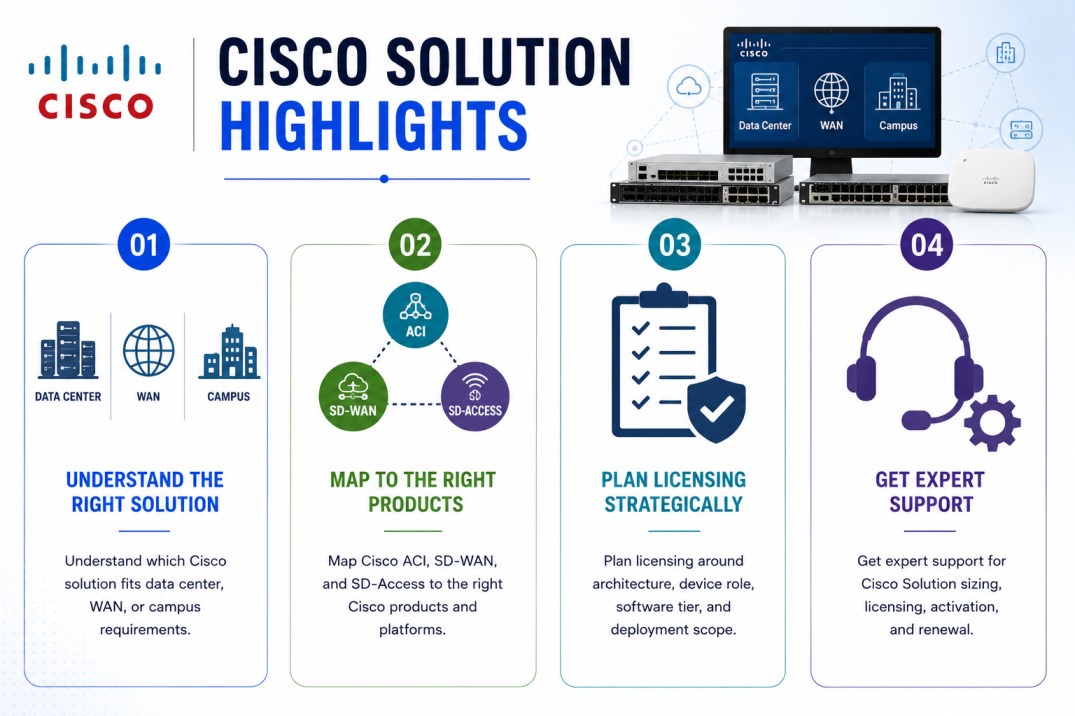
- Understand which Cisco solution fits data center, WAN, or campus requirements
- Map Cisco ACI, SD-WAN, and SD-Access to the right Cisco products and platforms
- Plan licensing around architecture, device role, software tier, and deployment scope
- Get expert support for Cisco Solution sizing, licensing, activation, and renewal
Cisco Solutions At a glance
What it does : Cisco Solution pages help organizations understand how different Cisco technologies work together to solve infrastructure challenges such as data center automation, WAN transformation, campus segmentation, application connectivity, and secure network access.
License category : Cisco License
Main solution areas : Cisco ACI, Cisco SD-WAN, and Cisco SD-Access.
License type : Product-dependent. Licensing may include Cisco Data Center Networking licenses, Nexus or ACI licensing, Cisco DNA / Catalyst subscriptions, WAN subscriptions, SD-WAN licensing, Smart Licensing, and product-specific entitlements.
Who needs it : Organizations planning Cisco network transformation, data center fabric deployment, branch SD-WAN rollout, campus segmentation, automation, or identity-based access control.

Cisco Solutions Overview
Cisco Solution is not one physical product or one fixed license. It is a category that connects Cisco products, software, controllers, and licenses into a practical architecture.
For example, Cisco ACI is a data center solution that uses Cisco Nexus switching and Cisco APIC to build a policy-based fabric. Cisco SD-WAN is a WAN and branch solution that uses Cisco edge platforms such as Catalyst 8000, ISR, or virtual routers to manage secure multi-site connectivity. Cisco SD-Access is a campus networking solution that uses Catalyst Center, Cisco ISE, Catalyst switches, and wireless infrastructure to provide automation, segmentation, and identity-based access.
Because each Cisco Solution uses different products, the licensing model also changes. A Cisco ACI project may require data center networking or Nexus-related licensing. A Cisco SD-WAN project may require WAN or routing subscriptions. A Cisco SD-Access project may require Catalyst / Cisco DNA licensing, Cisco ISE licensing, and supported Catalyst infrastructure.
The main goal of this page is to help users understand which Cisco solution fits their environment before choosing the exact product category, license model, and quote scope.
How Cisco Solutions Works
Cisco Solution architecture usually starts with a business or technical requirement. The organization may need to modernize its data center, connect branches more efficiently, secure campus access, automate network policy, or simplify operations across multiple locations.
Once the requirement is clear, the correct Cisco solution can be selected.
For a data center fabric, Cisco ACI is usually the relevant solution. It brings policy-based networking, automation, application connectivity, and fabric control into the data center environment.
For WAN transformation, Cisco SD-WAN is usually the relevant solution. It helps connect branches, data centers, cloud platforms, SaaS services, and remote sites through a more flexible and centrally managed WAN architecture.
For campus access and segmentation, Cisco SD-Access is usually the relevant solution. It helps organizations automate access networks, apply identity-based policies, and segment users, devices, and applications more consistently across wired and wireless environments.
After the solution is selected, the related Cisco products, controllers, switches, routers, licenses, and support coverage can be planned more accurately.
Core technical flow
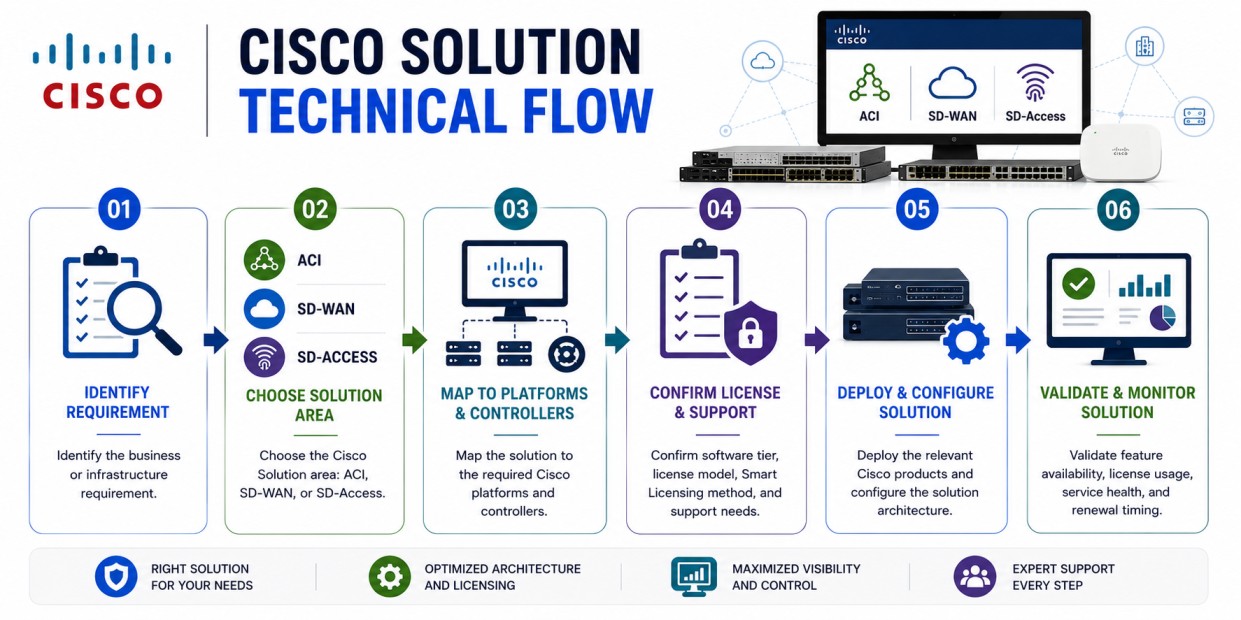
- Identify the business or infrastructure requirement
- Choose the Cisco Solution area: ACI, SD-WAN, or SD-Access
- Map the solution to the required Cisco platforms and controllers
- Confirm software tier, license model, Smart Licensing method, and support needs
- Deploy the relevant Cisco products and configure the solution architecture
- Validate feature availability, license usage, service health, and renewal timing
Main Cisco Solutions Areas
| Cisco Solution | Best for | Main Cisco products and platforms |
|---|---|---|
| Cisco ACI | Data center fabric, application policy, automation, segmentation | Cisco Nexus 9000, Cisco APIC, ACI fabric, Nexus Dashboard |
| Cisco SD-WAN | Branch connectivity, WAN optimization, cloud access, secure edge routing | Cisco Catalyst 8000, Catalyst 8000V, ISR, ASR, SD-WAN edge platforms |
| Cisco SD-Access | Campus access, identity-based segmentation, wired and wireless automation | Cisco Catalyst Center, Cisco ISE, Catalyst 9000 switches, wireless access points |
| Cisco Data Center Solution | Data center networking and operations | Nexus, ACI, APIC, MDS, UCS, Nexus Dashboard |
| Cisco Networking Solution | Routing, switching, wireless, WAN, SD-WAN | Catalyst, ISR, ASR, NCS, Catalyst 8000, wireless infrastructure |
| Cisco Security Solution | Firewall, identity, access, threat visibility | Cisco Secure Firewall, ISE, SNA, Talos, Umbrella, Secure Client |
Cisco ACI Platform Mapping
Cisco ACI is mainly useful for data center environments that need fabric automation, policy-based networking, segmentation, application connectivity, and centralized fabric control.
Cisco ACI platforms and products
- Cisco Nexus 9000 switches
- Cisco APIC
- Cisco ACI fabric
- Cisco Nexus Dashboard
- Cisco Data Center Networking licenses
- Cisco Nexus License
- Cisco ACI License
- Cisco APIC License
Cisco ACI is usually not used for branch routing or campus access switching. Its main role is inside the data center, where applications, servers, virtual workloads, and network policies need to be managed as part of one fabric.
Cisco SD-WAN Platform Mapping
Cisco SD-WAN is mainly useful for WAN, branch, cloud, and multi-site connectivity. It helps organizations connect users, branches, data centers, and cloud applications through a centrally managed WAN architecture.
SD-WAN platforms and products
- Cisco Catalyst 8000 platforms
- Cisco Catalyst 8200, 8300, and 8500
- Cisco Catalyst 8000V
- Cisco ISR routers
- Cisco ASR routers
- Cisco SD-WAN Manager
- Cisco Router License
- Cisco Catalyst 8000 License
- Cisco ISR License
- Cisco ASR License
Cisco SD-WAN is usually not the main solution for data center fabric automation. It is more focused on WAN connectivity, branch routing, secure edge, transport independence, and cloud application access.
Cisco SD-Access Platform Mapping
Cisco SD-Access is mainly useful for campus networks, enterprise access layers, wired and wireless segmentation, and identity-based policy enforcement.
SD-Access platforms and products
- Cisco Catalyst Center
- Cisco Identity Services Engine
- Cisco Catalyst 9000 switches
- Cisco wireless access points
- Cisco DNA / Catalyst software subscriptions
- Cisco Switch License
- Cisco Catalyst License
- Cisco ISE License
- Cisco Networking License
Cisco SD-Access is usually used in campus and access environments, not as a replacement for ACI in the data center or SD-WAN at the WAN edge. Its main role is to simplify access network policy, segmentation, and automation.
Features & Benefits
Cisco Solution planning helps organizations avoid choosing products in isolation. Instead of buying a router, switch, controller, or license without context, teams can first identify the architecture they need.
One major benefit is better platform alignment. Cisco ACI points toward Nexus, APIC, and data center licensing. Cisco SD-WAN points toward Catalyst 8000, ISR, ASR, and WAN subscriptions. Cisco SD-Access points toward Catalyst Center, ISE, Catalyst switches, wireless, and Cisco DNA licensing. Another benefit is cleaner licensing. Since each solution has a different product and license structure, mapping the solution first helps reduce under-sizing, wrong tier selection, and unnecessary purchases.
Cisco Solution planning also supports long-term operations. When the architecture is clear, it becomes easier to plan support, activation, Smart Licensing, renewal timing, migration, and future expansion. Over time, this helps organizations build Cisco environments that are more scalable, easier to manage, and better aligned with real business and technical requirements.
System Requirements
- Data center modernization projects
- Campus network automation and segmentation
- Branch and WAN transformation
- SD-WAN and cloud connectivity projects
- Cisco Catalyst, Nexus, ISR, ASR, ISE, APIC, and Catalyst Center environments
- Multi-site enterprise network designs
How deployment and activation work
Deploying a Cisco Solution usually starts with selecting the architecture and then mapping the required products to that architecture.
For Cisco ACI, the deployment normally focuses on the data center fabric, Cisco Nexus switches, Cisco APIC, fabric policies, tenants, endpoint groups, contracts, and operational visibility.
For Cisco SD-WAN, the deployment normally focuses on WAN edge devices, SD-WAN controllers, transport links, routing policies, security settings, application-aware routing, and branch connectivity.
For Cisco SD-Access, the deployment normally focuses on Catalyst Center, Cisco ISE, Catalyst switches, wireless infrastructure, fabric roles, virtual networks, group-based policy, and access segmentation.
Licensing and activation are then handled according to the products used in the solution. Some products use Smart Licensing, some use Smart Licensing Using Policy, some are managed through cloud portals or controllers, and some require product-specific entitlement workflows.
After activation, administrators should validate license status, feature availability, controller health, device onboarding, support coverage, and renewal timing to ensure the Cisco Solution remains aligned with the deployed environment.
Pricing factors + quote process
Pricing for Cisco Solution projects depends on the selected solution area, required platforms, number of devices, software tier, subscription model, support coverage, and deployment scope.
A Cisco ACI project may be influenced by Nexus switch models, APIC requirements, fabric size, data center networking tier, and Nexus Dashboard services. A Cisco SD-WAN project may be influenced by edge router models, WAN subscription tier, throughput, security requirements, and controller architecture. A Cisco SD-Access project may be influenced by Catalyst Center, ISE, Catalyst switch count, wireless scope, and Cisco DNA / Catalyst subscription level.
Additional considerations such as Smart Licensing method, support term, renewal status, migration from legacy platforms, multi-site design, cloud integration, and future expansion can also affect the final quote.
During the quote process, the solution requirement is reviewed first. Then the required Cisco products, platforms, license tiers, activation model, and support term are mapped into the correct licensing and deployment scope.
After you request a quote
- We review your Cisco Solution requirement and architecture
- Identify whether ACI, SD-WAN, SD-Access, or another Cisco solution fits best
- Map the solution to the required Cisco products and licenses
- Provide official pricing, delivery details, and activation guidance
Cisco Solutions pricing depends on your license type, deployment model and support requirements.