

BIG-IP Virtual Edition brings F5 application delivery and security services into virtualized data centers, private clouds, and public cloud environments without requiring a dedicated BIG-IP hardware appliance. It runs BIG-IP software as a virtual machine while providing familiar services such as traffic management, DNS, application security, network protection, and secure access.
That flexibility makes licensing an important part of VE sizing. A virtual machine with enough CPU and memory does not automatically deliver unlimited BIG-IP performance. The license can define available services and, for standard VE licenses, the permitted throughput level. A small internal application may fit a 200 Mbps or 1 Gbps deployment; an internet-facing service processing considerably more traffic may need 5 Gbps, 10 Gbps, or a High Performance VE design.
Quick Benefits
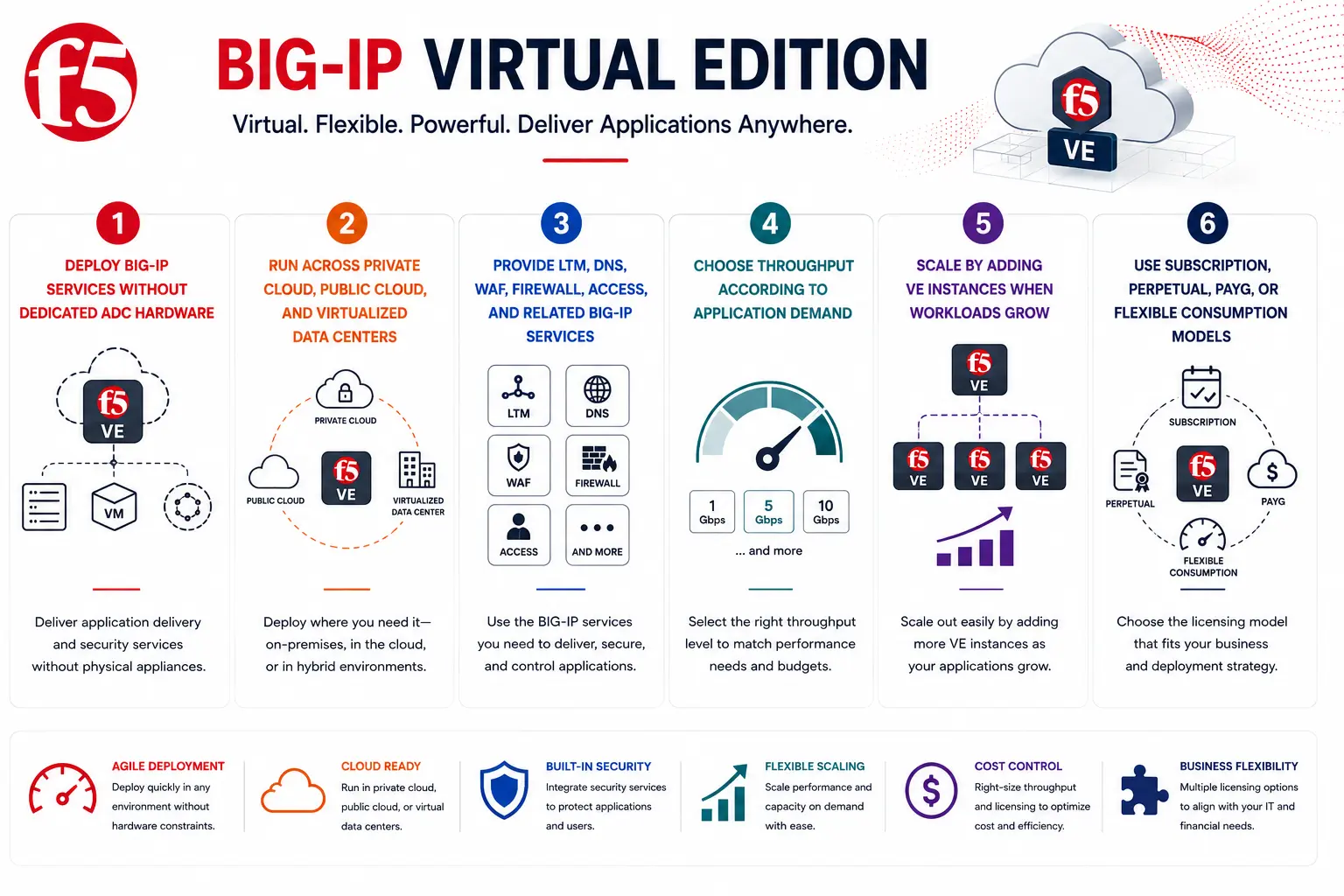
- Deploy BIG-IP services without dedicated ADC hardware
- Run across private cloud, public cloud, and virtualized data centers
- Provide LTM, DNS, WAF, firewall, access, and related BIG-IP services
- Choose throughput according to application demand
- Scale by adding VE instances when workloads grow
- Use subscription, perpetual, PAYG, or flexible consumption models
BIG-IP Virtual Edition At a Glance
What it is: Software-based virtual application delivery controller
Product family: BIG-IP License
Typical role: Load balancing, application delivery, WAF, DNS, access, and network security
Deployment: Public cloud, private cloud, virtualization platform, or hybrid environment
Supported environments: AWS, Azure, Google Cloud, OCI and other public clouds; VMware, KVM, Hyper-V and additional supported virtualization platforms
Standard throughput licenses: 25 Mbps, 200 Mbps, 1 Gbps, 3 Gbps, 5 Gbps, and 10 Gbps
Higher performance: High Performance VE options are available above 10 Gbps on supported platforms.
Licensing models: Subscription, perpetual, PAYG, Flex Consumption, and supported cloud marketplace models
BIG-IP Virtual Edition License Overview
A BIG-IP VE license does two jobs: it determines the entitled BIG-IP functionality and can also place a throughput ceiling on the virtual appliance.
F5 currently lists standard VE licenses at 25 Mbps, 200 Mbps, 1 Gbps, 3 Gbps, 5 Gbps, and 10 Gbps. For workloads above 10 Gbps, High Performance Virtual Edition licensing uses a different performance approach and requires a supported host/network configuration.
This is why simply allocating additional vCPUs does not necessarily solve a capacity problem. If a VE has a 1 Gbps entitlement, the licensing boundary still matters even when the underlying host could process more traffic.
Application services are another part of the decision. BIG-IP VE supports F5 modules for traffic management, DNS, firewalling, access, application security, and other BIG-IP functions.
BIG-IP Virtual Edition Product Overview
Operationally, VE performs the same basic role as a physical BIG-IP appliance, but the infrastructure underneath it is virtual.
A client connects to an application through BIG-IP VE. The virtual appliance evaluates the connection, checks application health and configured policies, performs SSL/TLS or security processing where required, and forwards approved traffic to an available application instance.
Because the platform is software-defined, another VE can be deployed when a new cloud region, application environment, or recovery site needs BIG-IP services. F5 supports BIG-IP VE across major public clouds as well as VMware, KVM, Hyper-V, and other validated platforms.
Core Technical Flow
User → BIG-IP VE → Traffic / Security Policy → Application Pool → Response
When a user or application sends a request, BIG-IP Virtual Edition receives the connection before it reaches the backend servers. BIG-IP VE evaluates the configured virtual server, health monitors, persistence rules, SSL/TLS settings, and any traffic or security policies associated with that application. Based on those checks, it decides whether the connection should be allowed, inspected further, redirected, or forwarded to a healthy application resource.
The exact inspection path depends on the licensed BIG-IP services. LTM handles local traffic management, load balancing, connection persistence, and SSL processing. Advanced WAF can inspect HTTP and API traffic for application-layer attacks, while AFM adds network firewall and DDoS protection. BIG-IP DNS can direct users toward the most appropriate application location or data center, and access services can apply authentication and identity-aware policies before access is granted.
After the required policies are applied, BIG-IP VE selects an available server or application instance from the configured pool and forwards the request. The response returns through BIG-IP VE, allowing the platform to maintain session state, apply additional policies, and continue monitoring application health for subsequent connections.
Options & Licensing Models
| Option | Where it fits |
|---|---|
| Perpetual VE | Predictable, long-term deployments |
| VE Subscription | Environments needing flexible instance counts |
| PAYG | Temporary or cloud marketplace workloads |
| Flex Consumption Program | Larger environments with changing software consumption |
| Standard VE | Up to licensed throughput tier |
| High Performance VE | Workloads exceeding standard 10 Gbps licensing |
| Per-App VE | Selected application-specific deployments |
F5 currently offers VE subscriptions in renewable 1-, 2-, and 3-year terms. Subscription customers can adjust the number of instances during the term, while available packaging includes bundled and standalone application services.
The Flex Consumption Program provides another option for organizations that expect their F5 software footprint to change over time. BIG-IP VE is included among the deployable software supported by this program.
Features & Benefits
The strongest reason to use BIG-IP Virtual Edition is mobility. Application services no longer have to remain tied to one physical ADC.
For example, an organization may keep physical BIG-IP appliances in its primary data center but deploy VE in Azure for a cloud application and another instance in a disaster-recovery environment. Policies and operational practices can remain familiar even though the underlying infrastructure changes. F5 specifically positions VE for consistent application services across multi-cloud environments.
It also allows capacity to be purchased more deliberately. A smaller workload does not need the same license as a high-volume internet service, and additional instances can be introduced as applications expand.
Compatibility & Requirements
Before ordering BIG-IP Virtual Edition, confirm:
- Hypervisor or public cloud platform
- Required BIG-IP software version
- LTM, DNS, WAF, AFM, APM, or other services
- Expected throughput
- SSL/TLS and security inspection workload
- Number of instances
- vCPU and memory allocation
- Network adapter and SR-IOV requirements
- HA architecture
- BYOL, subscription, PAYG, or other purchasing model
There is an important technical detail at higher speeds: F5 notes that single-NIC VE configurations are limited to 1 Gbps, and some 10 Gbps or higher deployments require SR-IOV or other supported high-performance networking.
How BIG-IP Virtual Edition Activation Works
A standalone VE normally uses a Base Registration Key supplied with the purchased entitlement. Connected environments can activate automatically against F5 licensing services; isolated environments can use manual activation by generating a dossier and applying the returned license.
Organizations managing larger numbers of BIG-IP VE instances can also use BIG-IQ licensing pools. BIG-IQ can hold eligible registration keys and assign or revoke them for VE instances as infrastructure changes.
BIG-IP Virtual Edition Pricing & Quote Process
BIG-IP VE pricing depends on more than the number of virtual machines. The main variables are throughput, BIG-IP services, number of instances, purchasing model, subscription term, cloud or hypervisor platform, and support requirements.
Before requesting a quote, identify the target environment and approximate traffic first. Then confirm whether the workload needs only traffic management or additional services such as Advanced WAF, DNS, firewalling, or access management.
For pricing, select F5 as the brand and BIG-IP Virtual Edition as the product. If you already have an architecture diagram, license inventory, required throughput, or existing BIG-IP configuration, attach it to the request so the license can be sized around the actual workload.
F5 pricing depends on your product edition, license type, deployment model, traffic needs, term, and support requirements.