

Cisco UCCX (Cisco Unified Contact Center Express) is Cisco’s on-premises contact center platform for managing customer interactions, agent workflows, IVR, call routing, reporting, and multichannel service operations. The Cisco UCCX License is usually planned around the number of agents, selected Flex Standard or Flex Premium capability, deployment model, IVR and routing requirements, Smart Licensing workflow, support coverage, and whether the environment needs voice, email, chat, outbound, reporting, or supervisor functions.
Key Benefits
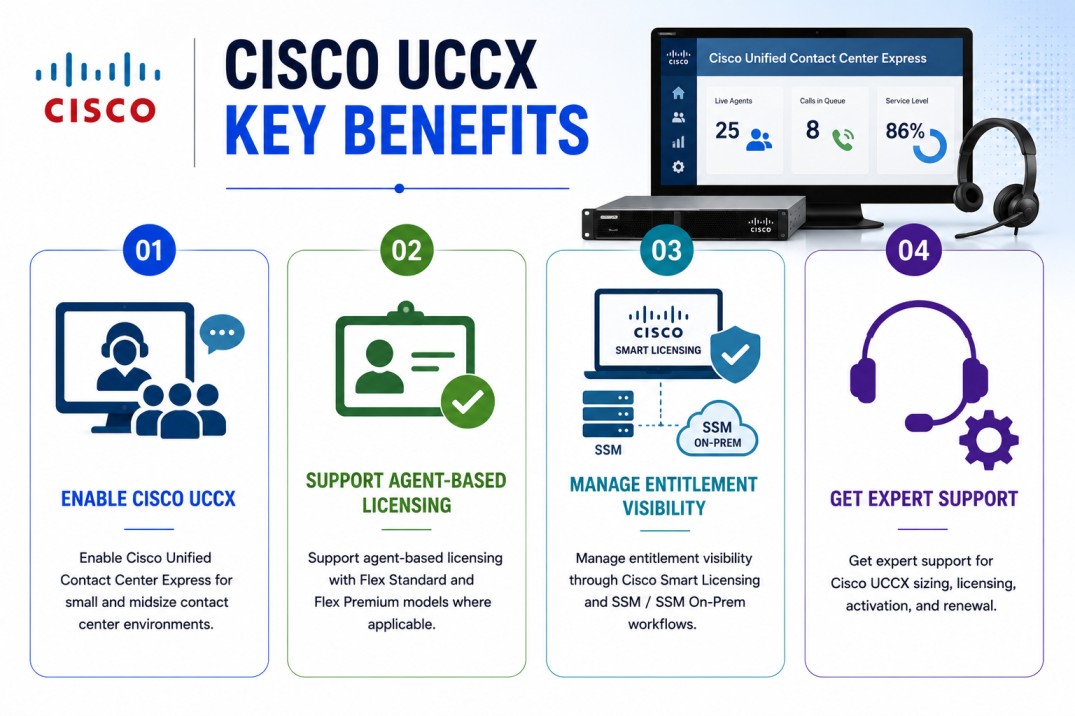
- Enable Cisco Unified Contact Center Express for small and midsize contact center environments
- Support agent-based licensing with Flex Standard and Flex Premium models where applicable
- Manage entitlement visibility through Cisco Smart Licensing and SSM / SSM On-Prem workflows
- Get expert support for Cisco UCCX sizing, licensing, activation, and renewal
Review Cisco UCCX Price List and request a quote tailored to your licensing needs.
Cisco UCCX At a glance
What it does : Cisco UCCX provides contact center capabilities for call routing, IVR, agent desktops, supervisor tools, customer interaction handling, reporting, and administration inside Cisco collaboration environments.
Product family : Cisco UC License.
License type : Cisco UCCX licensing is generally agent-based and tied to the selected contact center capability level. Modern deployments commonly use Flex licensing models such as Flex Standard and Flex Premium, depending on the required features and Cisco collaboration licensing structure.
Typical term : Subscription or entitlement-based depending on the Cisco Collaboration Flex Plan, contact center offer, support agreement, and renewal model.
Activation method : Cisco Smart Licensing through Cisco Smart Software Manager, Cisco Smart Account, Virtual Account, Unified CCX Administration, or Cisco Smart Software Manager On-Prem for controlled environments.
Who needs it : Organizations that need a Cisco-based contact center for customer support, help desk operations, IVR, agent routing, supervisor monitoring, reporting, voice queues, email or chat workflows, and CUCM-integrated customer service.

License Overview
Organizations deploying Cisco UCCX usually need licensing that reflects the real contact center environment. The most important factors include agent count, concurrent or named usage model where applicable, feature tier, IVR requirements, reporting needs, supervisor functions, and integration with Cisco Unified Communications Manager.
The Cisco UCCX License is commonly aligned with Flex contact center licensing. In practical terms, this means the license should be sized around the agents and features that will actually be used, not simply around the server where UCCX is installed. A small support desk with a limited number of agents may need a different license scope than a larger service center with supervisors, advanced routing, outbound requirements, reporting, and multichannel interaction needs.
Cisco UCCX licensing may include different capability levels depending on the selected offer. Flex Standard and Flex Premium are commonly used to separate the required feature depth for inbound voice, IVR, CTI, agent and supervisor desktops, reporting, administration, and advanced contact center workflows.
Because Cisco UCCX is usually deployed with Cisco CUCM, its licensing should be reviewed within the wider Cisco License portfolio as well as the surrounding Unified Communications environment. Call control, SIP integration, agent phones, CTI ports, voicemail, reporting, high availability, and support coverage can all affect the final licensing plan. A properly aligned license helps organizations avoid agent entitlement gaps, maintain contact center availability, support service growth, and keep Cisco UCCX operations aligned with the real customer engagement model.
Product Overview
Customer service environments become harder to manage when calls, agents, IVR menus, supervisors, reporting, and service queues are handled through disconnected tools.
Cisco UCCX is designed to centralize contact center operations for small and midsize environments that need structured customer interaction handling inside the Cisco collaboration ecosystem.
In practice, Cisco Unified Contact Center Express can route customer calls to the right agents, provide IVR menus, support queue treatment, enable agent and supervisor desktops, collect reporting data, and integrate with Cisco Unified Communications Manager for call control.
One of the main operational advantages is controlled customer interaction routing. Instead of relying only on basic hunt groups or manual call handling, organizations can use UCCX to manage queues, skills, scripts, agents, supervisors, and reporting from a dedicated contact center platform.
For organizations already using Cisco CUCM, Cisco UCCX adds a structured contact center layer that improves call handling, customer support visibility, and service team productivity.
Core technical flow
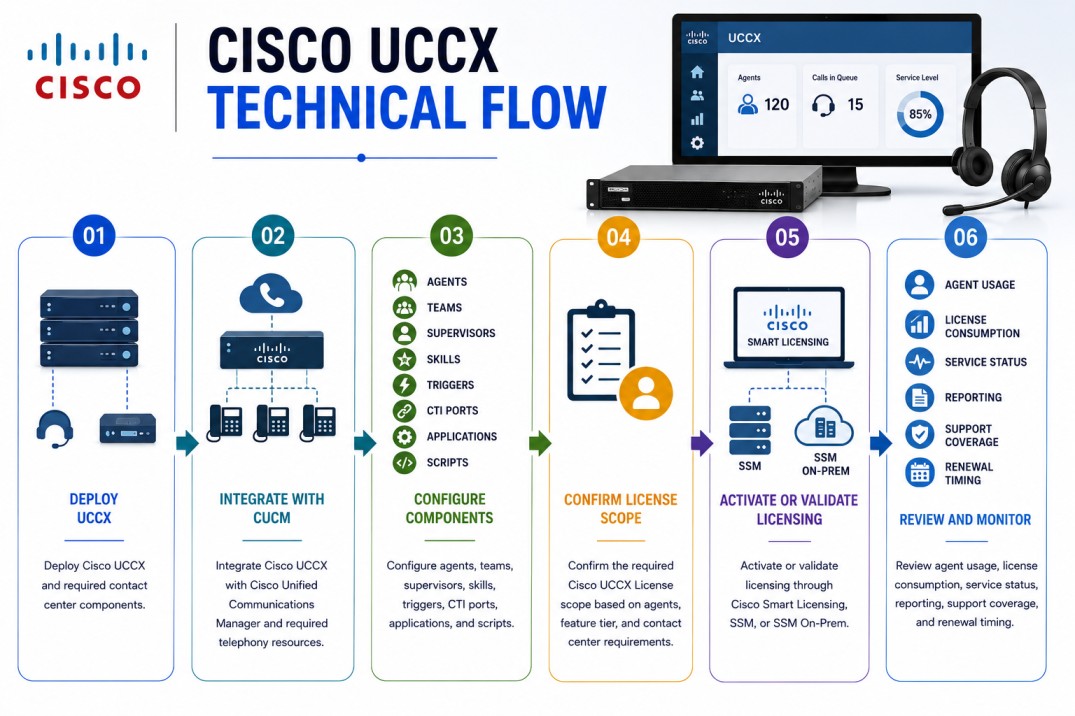
- Deploy Cisco UCCX and required contact center components
- Integrate Cisco UCCX with Cisco Unified Communications Manager and required telephony resources
- Configure agents, teams, supervisors, skills, triggers, CTI ports, applications, and scripts
- Confirm the required Cisco UCCX License scope based on agents, feature tier, and contact center requirements
- Activate or validate licensing through Cisco Smart Licensing, SSM, or SSM On-Prem
- Review agent usage, license consumption, service status, reporting, support coverage, and renewal timing
Options & Licensing Models
| Licensing Model | Best for | Typical Scope | What affects pricing |
|---|---|---|---|
| Flex Standard | Standard contact center deployments | Inbound voice, IVR, agent/supervisor desktop, reporting, administration | Agent count and required features |
| Flex Premium | Advanced contact center workflows | Broader routing, outbound, multichannel, and advanced contact center capabilities | Feature depth and deployment needs |
| Smart Licensing | Modern UCCX environments | License ownership, usage reporting, and entitlement visibility | Smart Account and deployment model |
| SSM On-Prem | Controlled or restricted environments | Local license management for environments without direct cloud licensing access | Connectivity and security policy |
| Support and renewal coverage | Ongoing contact center operations | Updates, support access, and lifecycle planning | Term and support level |
Features & Benefits
As customer support environments grow, organizations need more than basic call forwarding. They need structured routing, IVR, agent control, reporting, supervisor visibility, and service-level management. Cisco UCCX helps organizations manage these workflows from a Cisco contact center platform that integrates with the wider Cisco Unified Communications environment.
One major benefit is better call routing. Calls can be directed based on scripts, queues, skills, agent availability, and service requirements, helping customers reach the right team more efficiently. Another benefit is improved agent and supervisor visibility. Supervisors can monitor teams, review reporting, and manage contact center performance with clearer operational data.
The platform also supports service consistency. By using IVR menus, queue logic, reporting, and contact center applications, organizations can standardize customer interaction handling across departments or support teams. Over time, Cisco UCCX licensing helps organizations keep contact center capacity, agent access, feature availability, and renewal planning aligned with actual service demand.
System Requirements
Common environments
- Cisco Unified Communications Manager deployments
- Small and midsize contact center environments
- Help desk and customer support operations
- IVR, inbound voice, agent desktop, and supervisor workflows
- Cisco collaboration and on-premises contact center architectures
Technical requirements
- Supported Cisco UCCX version and deployment model
- Cisco Unified Communications Manager integration
- Cisco Smart Account and Virtual Account access where applicable
- Smart Licensing, Cisco SSM, or Cisco SSM On-Prem workflow
- Agent, supervisor, IVR, CTI, script, and reporting requirement planning
How activation works
Activating Cisco UCCX licensing usually starts after the UCCX deployment is installed, integrated with Cisco Unified Communications Manager, and prepared with the correct Cisco Smart Account and entitlement.
In modern deployments, Cisco UCCX uses Cisco Smart Licensing to manage license ownership and consumption. Administrators can manage licensing through Cisco Smart Software Manager and the License Management area inside Unified CCX Administration.
For controlled environments, Cisco Smart Software Manager On-Prem can be used when the customer does not want the UCCX system to communicate directly with Cisco cloud licensing services. In this model, licensing information is handled through the local SSM On-Prem workflow.
After the entitlement is available, administrators should validate the selected license tier, agent usage, system authorization status, Smart Account alignment, and feature availability. This is important because the wrong tier or insufficient agent count may affect contact center functionality or future growth.
After activation, organizations should regularly review license consumption, agent usage, service health, reporting requirements, renewal timing, and support coverage to ensure the Cisco UCCX License remains aligned with the active contact center environment.
Pricing factors + quote process
Pricing for Cisco UCCX usually depends on agent count, feature tier, deployment model, contact center requirements, support coverage, and subscription or renewal term.
A basic inbound voice contact center may require a different license scope than a deployment with advanced IVR, outbound dialing, email, chat, supervisor workflows, reporting needs, or higher service availability requirements.
Additional considerations such as Flex Standard versus Flex Premium, CUCM integration, upgrade path, SSM On-Prem requirement, support level, renewal timing, and migration from older licensing models can also influence the final Cisco UCCX License scope.
During the quote process, the Cisco UCCX environment, agent count, feature requirements, deployment design, and activation workflow are reviewed first so the licensing approach can match the organization’s contact center strategy more accurately.
After you request a quote
- We review your Cisco UCCX deployment and agent requirements
- Identify the right Cisco UCCX License model and entitlement scope
- Validate Smart Licensing, feature tier, support, and renewal requirements
- Provide official pricing, delivery details, and activation guidance
Cisco UCCX pricing depends on your license type, deployment model and support requirements.