



A BIG-IP rSeries License activates the application delivery and security services available on F5’s current rSeries hardware platform. rSeries is the next-generation appliance architecture that replaces iSeries for new hardware deployments, combining BIG-IP services with the F5OS platform layer, modern hardware acceleration, automation, and multi-tenant operation.
For buyers, choosing an rSeries appliance is only half of the configuration. The required performance level, BIG-IP modules, number of tenants, application traffic, SSL demand, and availability design all influence the final license. Two systems built on the same underlying hardware can therefore deliver very different capacity and application services.
Quick Benefits
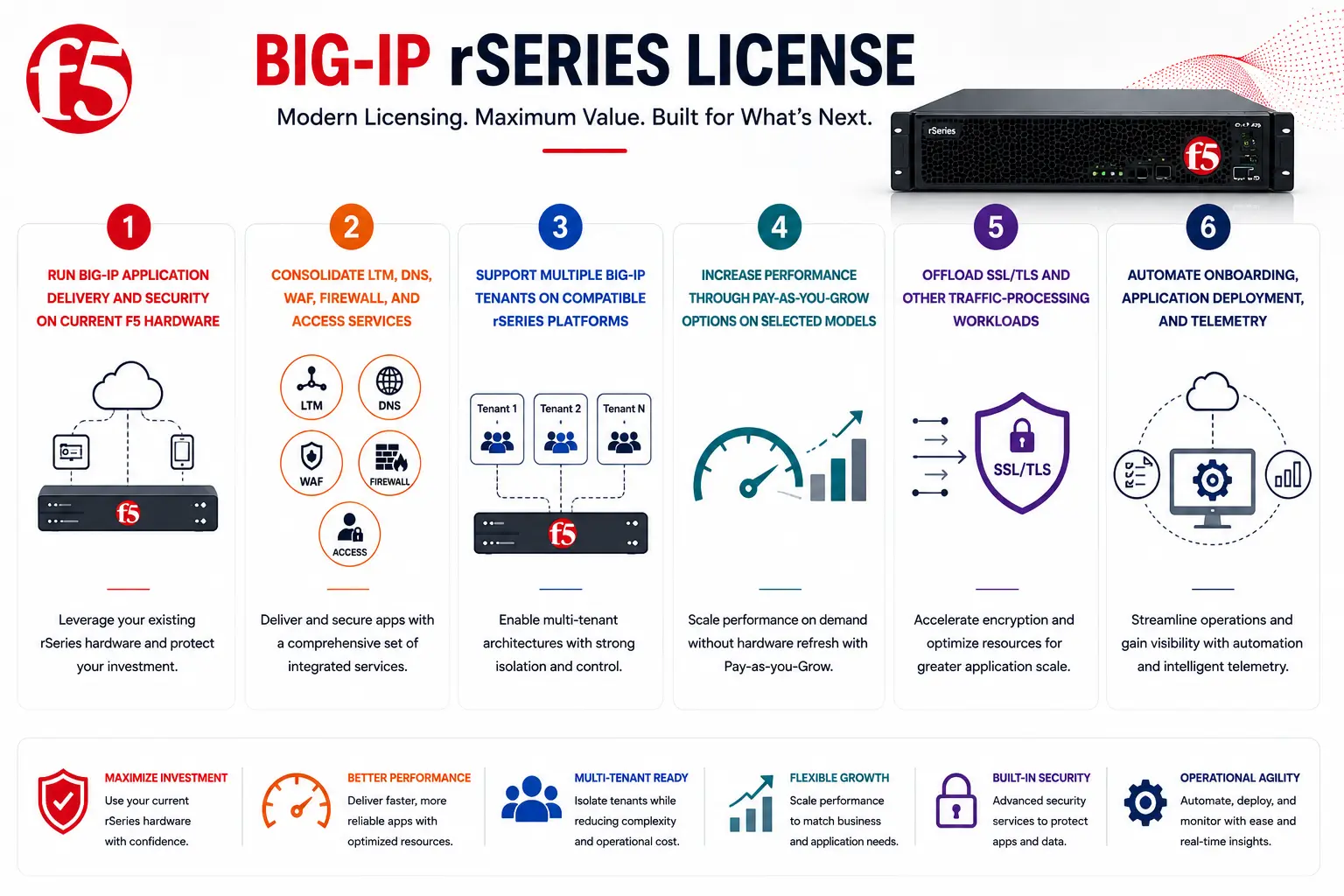
- Run BIG-IP application delivery and security on current F5 hardware
- Consolidate LTM, DNS, WAF, firewall, and access services
- Support multiple BIG-IP tenants on compatible rSeries platforms
- Increase performance through Pay-as-you-Grow options on selected models
- Offload SSL/TLS and other traffic-processing workloads
- Automate onboarding, application deployment, and telemetry
BIG-IP rSeries License At a Glance
What it covers: F5 rSeries platform performance and licensed BIG-IP services
Product family: BIG-IP License
Main families: r2000, r4000, r5000, r10000, and r12000-DS
Typical BIG-IP services: LTM, DNS, Advanced WAF, AFM, and APM
Architecture: Physical rSeries appliance with one or more BIG-IP tenants
Activation: Base Registration Key plus supported add-on keys
Typical use: Enterprise ADC, application security, DNS, access, traffic management, and service-provider environments
BIG-IP rSeries License Overview
Licensing is applied at the rSeries system level within the broader F5 License portfolio, not independently to every BIG-IP tenant. F5OS activates the platform using a Base Registration Key and any purchased add-on keys. The resulting entitlements are then inherited by BIG-IP tenants deployed on that system.
This architecture matters when planning consolidation. A compatible rSeries appliance can run several isolated BIG-IP tenants, each with its own software, users, IP configuration, and allocated CPU resources, while using the license assigned to the underlying platform. The smaller r2000 family has more limited tenant capacity than higher-end platforms.
Selected rSeries families also support Pay-as-you-Grow licensing. The hardware may remain unchanged while a license upgrade unlocks additional CPU resources and moves the platform to a higher performance tier. For example, r2600 can be upgraded toward r2800, while r5600 can move to r5800 or r5900.
BIG-IP rSeries Product Overview
rSeries separates the physical platform from the BIG-IP tenant layer. F5OS-A manages hardware resources, interfaces, licensing, software images, and tenant deployment. BIG-IP software then runs inside one or more tenants and provides the actual application-delivery and security services.
This differs from older iSeries architecture and gives administrators more flexibility when dividing appliance resources between applications or business units.
Main rSeries Families
| Family | Typical positioning |
|---|---|
| r2000 | Smaller enterprise and application deployments |
| r4000 | Mid-range ADC and security environments |
| r5000 | Mid-to-large enterprise workloads |
| r10000 | High-performance enterprise and service-provider use |
| r12000-DS | High-scale application delivery and security |
Higher-end rSeries platforms provide 25G, 40G, and 100G interface options, while selected models use the same physical hardware with different licensed CPU capacity.
Core Technical Flow
Client Traffic → rSeries Hardware → F5OS Platform → BIG-IP Tenant → Licensed Application Services → Application
F5OS manages the physical appliance and allocates resources to each tenant. BIG-IP then evaluates application traffic through services such as load balancing, SSL handling, DNS, WAF, firewall, or access policies before forwarding approved traffic toward application resources.
Options & Licensing Models
The correct BIG-IP rSeries License usually comes down to three decisions:
Platform performance: Select the rSeries family and performance tier that can handle expected traffic, SSL, connection, and application-security demand.
BIG-IP services: Enable the functions actually required, such as LTM for traffic management, DNS for global availability, Advanced WAF for application protection, AFM for network security, or APM for secure access.
Tenant design: Determine whether one BIG-IP instance is enough or whether applications, customers, or operational teams need separate tenants.
Pay-as-you-Grow is especially useful when future demand is uncertain because supported systems can unlock additional resources without replacing the underlying appliance.
Features & Benefits
rSeries is designed for consolidation. One appliance can host several BIG-IP workloads while F5OS keeps platform management separate from individual tenants. This can simplify environments that previously required several standalone ADCs.
Hardware acceleration also helps offload computationally expensive traffic functions. F5 states that rSeries uses modern FPGAs on selected platforms and provides substantial SSL/TLS acceleration, while its API-first architecture supports automated provisioning and application-service deployment.
For an organization replacing iSeries, the practical benefit is not simply higher performance. The bigger change is the ability to modernize the hardware layer while keeping familiar BIG-IP application services and introducing a more flexible tenant architecture.
Compatibility & Requirements
Before ordering, confirm:
- Required rSeries family and performance tier
- BIG-IP or BIG-IP Next tenant version
- LTM, DNS, WAF, AFM, APM, or other add-ons
- Traffic and SSL/TLS capacity
- Number of planned tenants
- HA and redundancy requirements
- Interface and optic speeds
- F5OS and BIG-IP software compatibility
- Existing iSeries migration requirements
F5 maintains separate compatibility guidance for rSeries hardware, F5OS, and BIG-IP software, so the exact software combination should be validated before deployment.
How BIG-IP rSeries License Activation Works
New rSeries systems include the Base Registration Key and associated add-on keys. With internet access, administrators can activate the system directly through the F5OS web interface or CLI. Additional keys can later be added and the license reactivated.
Offline environments can use F5’s manual licensing process instead. Once the platform license is active, BIG-IP tenant images can be imported, resources assigned, and the tenants deployed.
BIG-IP rSeries Pricing & Quote Process
BIG-IP rSeries pricing depends mainly on the appliance family, performance tier, required BIG-IP services, tenant design, HA quantity, interfaces, optics, and support requirements.
For pricing, enter F5 as the brand and BIG-IP rSeries License as the product. Existing iSeries details, registration keys, application-service requirements, or technical specifications can also be attached. Performance upgrades, modules, and migration options can then be reviewed against the actual deployment.
F5 pricing depends on your product edition, license type, deployment model, traffic needs, term, and support requirements.