

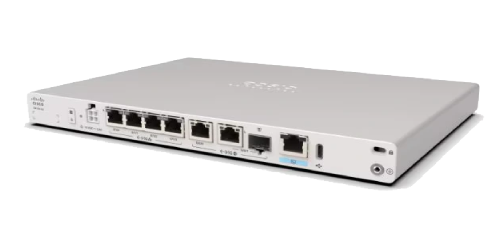
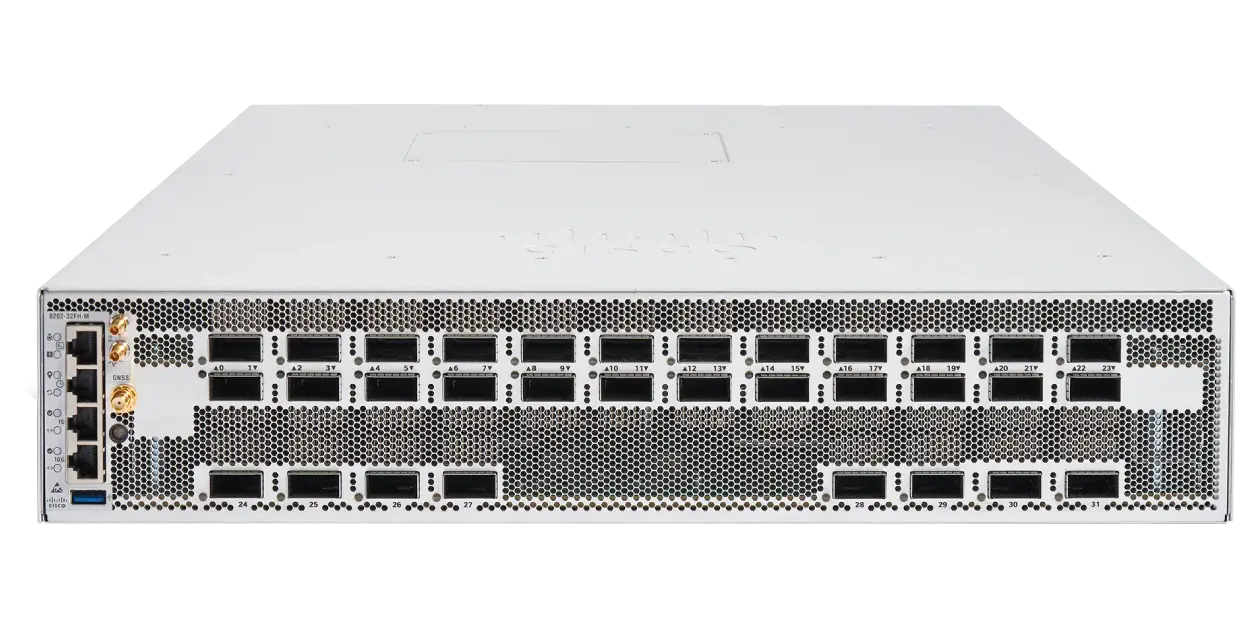
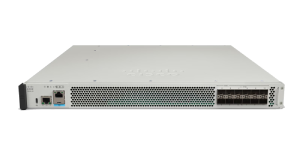
The Cisco 8000 Series is designed for high-performance routing environments where scale, density, reliability, and operational efficiency are critical across service provider, cloud, data center, core, peering, and aggregation networks. Licensing is usually planned around the Cisco 8000 platform model, IOS XR software release, selected software tier, deployment role, support coverage, Smart Licensing method, and whether the environment requires core routing, edge routing, metro aggregation, DDoS edge protection, SONiC, or large-scale transport capabilities.
Key Benefits
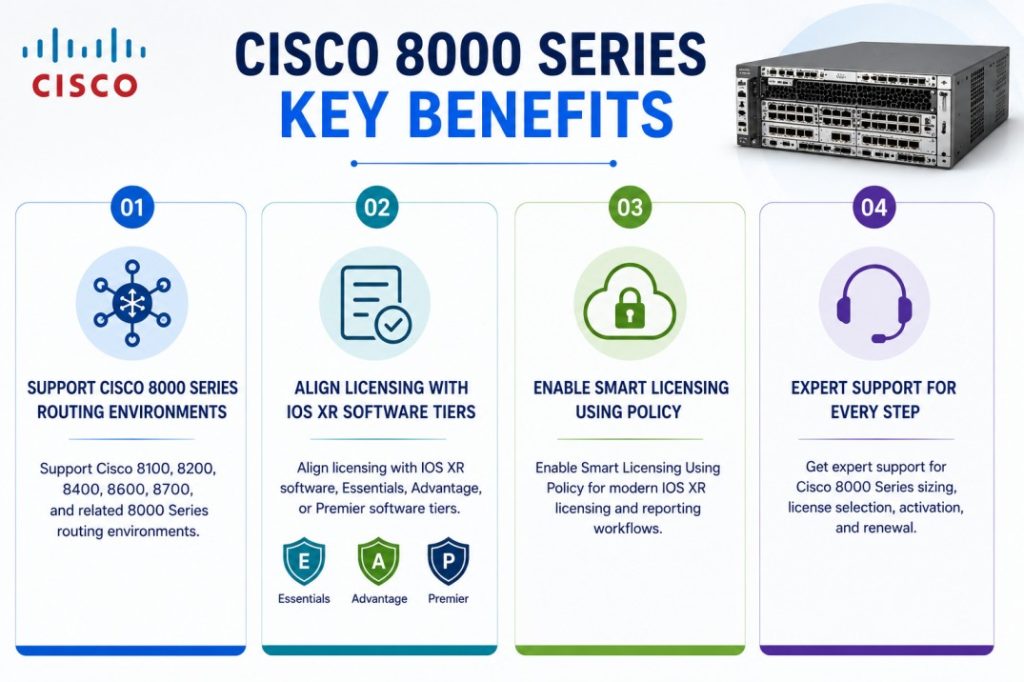
- Support Cisco 8100, 8200, 8400, 8600, 8700, and related 8000 Series routing environments
- Align licensing with IOS XR software, Essentials, Advantage, or Premier software tiers
- Enable Smart Licensing Using Policy for modern IOS XR licensing and reporting workflows
- Get expert support for Cisco 8000 Series sizing, license selection, activation, and renewal
Review Cisco 8000 Series Price List and request a quote tailored to your licensing needs.
Cisco 8000 Series At a glance
What it does : Cisco 8000 Series Routers provide high-scale routing, core networking, metro aggregation, data center interconnect, cloud networking, and service provider-class routing performance. Cisco describes the 8000 Series as delivering service provider-class routing functionality with data center switching density, performance, and power efficiency.
License type : Product and software-release dependent. Cisco IOS XR licensing for the 8000 Series may use Smart Licensing, Smart Licensing Using Policy, perpetual software licensing, or platform-specific entitlement workflows depending on the platform and release. Cisco states that the IOS XR Perpetual Licensing Model can be used with Cisco 8000 Series Routers, with Essentials, Advantage, and Premier software tiers.
Typical term : Depends on the selected software model. Perpetual licensing can be used for eligible Cisco 8000 Series Routers, while support, software access, and operational coverage may still be planned according to the customer’s service and lifecycle requirements.
Activation method : Cisco Smart Licensing or Smart Licensing Using Policy, with usage reporting through Cisco Smart Software Manager, Smart Software Manager On-Prem, Cisco Smart Licensing Utility, or supported offline workflows depending on IOS XR release and environment restrictions. Cisco states that Smart Licensing Using Policy is enabled by default on all IOS XR devices starting with IOS XR Release 24.1.1.
Who needs it : Organizations deploying high-capacity routers for backbone networks, service provider cores, cloud-scale networking, metro access, aggregation, peering, DCI, DDoS edge protection, and high-performance IOS XR routing environments.
License Overview
Cisco 8000 Series licensing depends on the router family, IOS XR release, platform classification, software tier, and operational role of the device.
For eligible deployments, the Cisco 8000 Series may use Cisco IOS XR perpetual software licensing. Cisco explains that this model can be used with Cisco 8000 Series Routers and that each device requires one perpetual license, allowing customers to use the ports needed under that device-level license rather than managing licensing per port.
The software tier is also important. Cisco’s IOS XR perpetual model includes Essentials, Advantage, and Premier tiers. Essentials includes the comprehensive IOS XR routing and management services, Advantage extends Essentials with additional advanced routing and management services, and Premier includes the lower tiers plus scaling and high-performance features.
Because Cisco 8000 environments can include core routers, dense fixed routers, distributed chassis, metro aggregation platforms, DDoS edge roles, SONiC deployments, and cloud-scale network designs, licensing should be planned around the actual network function rather than only the platform name.
A properly aligned licensing model helps organizations avoid feature gaps, simplify IOS XR license planning, support high-scale growth, and maintain compliance with Cisco Smart Licensing or Smart Licensing Using Policy workflows.
Product Overview
The Cisco 8000 Series is built for networks that need very high capacity, efficient forwarding, and long-term scalability. These routers are commonly used in service provider, cloud, web-scale, metro, and large enterprise backbone environments.
Cisco describes the 8000 Series as powered by Cisco Silicon One ASICs and designed to deliver performance, functionality, and scalability. The platform family includes fixed and modular models such as Cisco 8100, 8200, 8400, and 8600 Series, with different capacity and form-factor options depending on deployment role.
In practice, the selected 8000 Series platform and license tier determine which IOS XR software capabilities, routing features, scale functions, and operational tools are available. A dense core deployment may require different planning than a metro aggregation router, cloud data center edge, or DDoS edge protection use case.
One of the main operational advantages is architecture consistency. Cisco states that the 8000 Series combines Cisco Silicon One, IOS XR software, and clean-sheet chassis designs to deliver high-performance routing.
For organizations building modern routing infrastructure, this approach supports scalable bandwidth growth, simplified operations, and stronger lifecycle planning across high-performance network environments.
Core technical flow
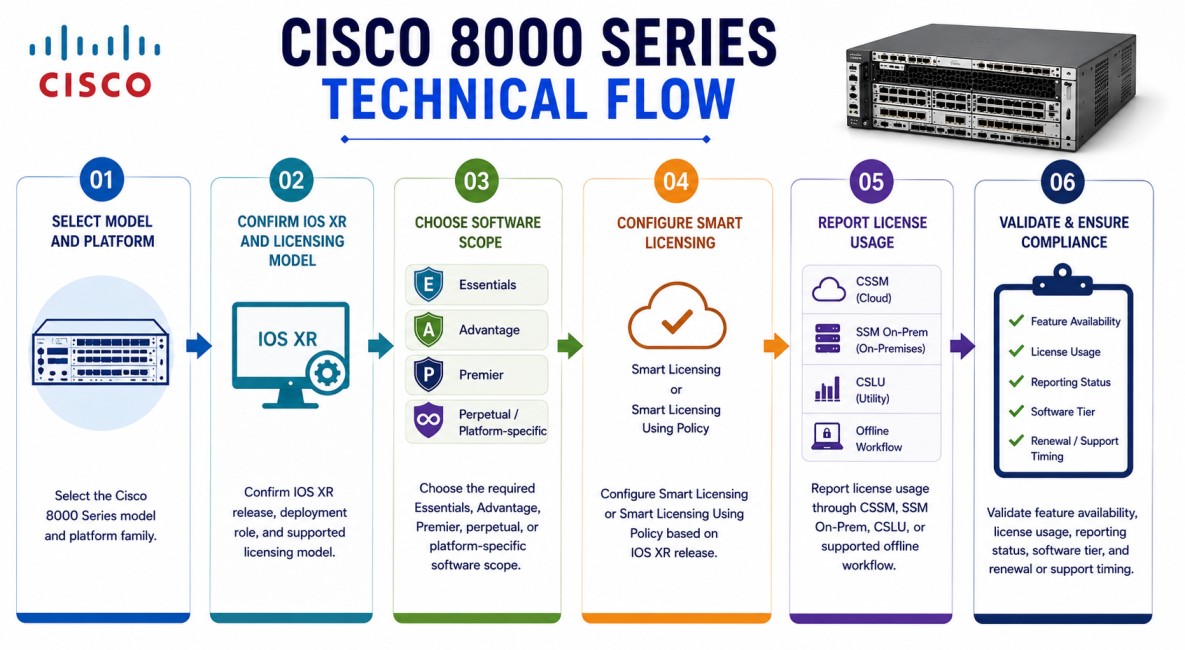
- Select the Cisco 8000 Series model and platform family
- Confirm IOS XR release, deployment role, and supported licensing model
- Choose the required Essentials, Advantage, Premier, perpetual, or platform-specific software scope
- Configure Smart Licensing or Smart Licensing Using Policy based on IOS XR release
- Report license usage through CSSM, SSM On-Prem, CSLU, or supported offline workflow
- Validate feature availability, license usage, reporting status, software tier, and renewal or support timing
Options & Tiers
| Licensing Model | Best for | Typical Scope | What affects pricing |
|---|---|---|---|
| IOS XR Essentials | Foundational routing environments | Core IOS XR routing and management services | Platform classification and feature scope |
| IOS XR Advantage | Advanced routing deployments | Essentials plus broader advanced routing and management functions | Required feature depth |
| IOS XR Premier | High-scale and performance-focused environments | Essentials and Advantage plus scaling and high-performance features | Scale and performance needs |
| IOS XR perpetual licensing | Eligible Cisco 8000 deployments | Device-level perpetual software licensing | Platform type and software tier |
| Smart Licensing Using Policy | Modern IOS XR deployments | Usage reporting and compliance workflow | IOS XR release and reporting method |
| SSM On-Prem / CSLU / offline reporting | Controlled environments | Local, mediated, or air-gapped license reporting | Security and connectivity model |
Features & Benefits
As backbone, cloud, and service provider networks grow, licensing becomes important for keeping high-performance routing capabilities aligned with real infrastructure needs. A well-planned Cisco 8000 Series licensing approach helps teams select the correct IOS XR software tier, supported feature scope, and Smart Licensing workflow for each platform role.
One major benefit is simplified consumption. Cisco’s IOS XR perpetual licensing model is device-based for eligible Cisco 8000 Series Routers, which helps reduce per-port licensing complexity and supports cleaner deployment planning. Another benefit is operational scale. Cisco 8000 Series Routers are positioned for high-performance routing, and Cisco highlights use cases such as dense core networks and cloud data centers.
The licensing model also supports modern reporting. Smart Licensing Using Policy for IOS XR provides a policy-driven model that simplifies licensing, supports activation and management, and helps monitor usage patterns. Over time, this helps organizations reduce licensing uncertainty, simplify IOS XR lifecycle planning, and maintain stronger control over Cisco 8000 Series deployments.
System Requirements
Common environments
- Service provider core and edge networks
- Cloud-scale and web-scale routing environments
- Dense core, metro, and aggregation networks
- Data center interconnect and peering environments
- DDoS edge protection and high-capacity IOS XR networks
Technical requirements
- Supported Cisco 8000 Series router model
- Compatible Cisco IOS XR software release
- Correct Essentials, Advantage, Premier, perpetual, or feature entitlement
- Cisco Smart Account and Virtual Account access where applicable
- CSSM, SSM On-Prem, CSLU, or offline reporting workflow depending on environment
How activation works
Activating Cisco 8000 Series licensing usually starts with confirming the router model, IOS XR version, selected software tier, and Smart Account where the entitlement is available.
For IOS XR deployments using Smart Licensing Using Policy, Cisco states that SLP is enabled by default on all IOS XR devices starting with IOS XR Release 24.1.1 and is used to ensure license compliance through effective license reporting.
For Cisco 8000 Series Routers, Cisco’s licensing quick reference explains that Smart Licensing Using Policy streamlines licensing for IOS XR products and removes the need to register the device during installation. It also notes that devices must establish trust and send the initial license usage report within 90 days.
In connected environments, license usage can be reported to Cisco Smart Software Manager. In controlled environments, organizations may use Smart Software Manager On-Prem or Cisco Smart Licensing Utility. Cisco’s 8000 Series Secure Routers licensing documentation explains that SLP can support direct, mediated, or offline workflows depending on network requirements and security policy.
After activation or reporting configuration, administrators should validate license usage, feature availability, reporting status, Smart Account alignment, software tier, and renewal or support timing.
Pricing factors + quote process
Pricing for Cisco 8000 Series licensing usually depends on the platform model, software tier, deployment role, IOS XR licensing model, support coverage, and activation workflow.
A dense core router, metro aggregation platform, cloud data center router, or secure edge deployment may require different software planning even if all belong to the Cisco 8000 Series family. Cisco also identifies multiple platform families inside the 8000 Series, including Cisco 8100, 8200, 8400, and 8600 models with different bandwidth and form-factor profiles.
Additional considerations such as Essentials versus Advantage or Premier tier, perpetual software licensing eligibility, DDoS edge protection, SONiC requirements, Smart Licensing method, SSM On-Prem or CSLU workflow, support coverage, and lifecycle planning can also influence the final quote.
During the quote process, platform inventory, IOS XR release, deployment architecture, feature requirements, software tier, and activation method are reviewed first so the licensing approach can match the organization’s Cisco 8000 routing strategy more accurately.
After you request a quote
- We review your Cisco 8000 Series model and deployment architecture
- Identify the suitable IOS XR software tier or licensing model
- Validate Smart Licensing, SLP, and reporting requirements
- Provide official pricing, delivery details, and renewal guidance
Cisco 8000 Series pricing depends on your router series, license type, deployment model and support requirements.