

Red Hat License provides access to enterprise open-source software solutions designed for operating systems, cloud platforms, container management, automation, middleware, virtualization, and hybrid infrastructure environments. Red Hat licensing enables organizations to deploy, manage, secure, and receive enterprise support for Red Hat technologies across data centers, cloud platforms, and modern application environments.
With products such as Red Hat Enterprise Linux (RHEL), Red Hat OpenShift, Ansible Automation Platform, and Red Hat Enterprise Linux AI, the Red Hat portfolio helps organizations build scalable, secure, and flexible IT infrastructures while maintaining enterprise-level support and lifecycle management.
Quick Benefits
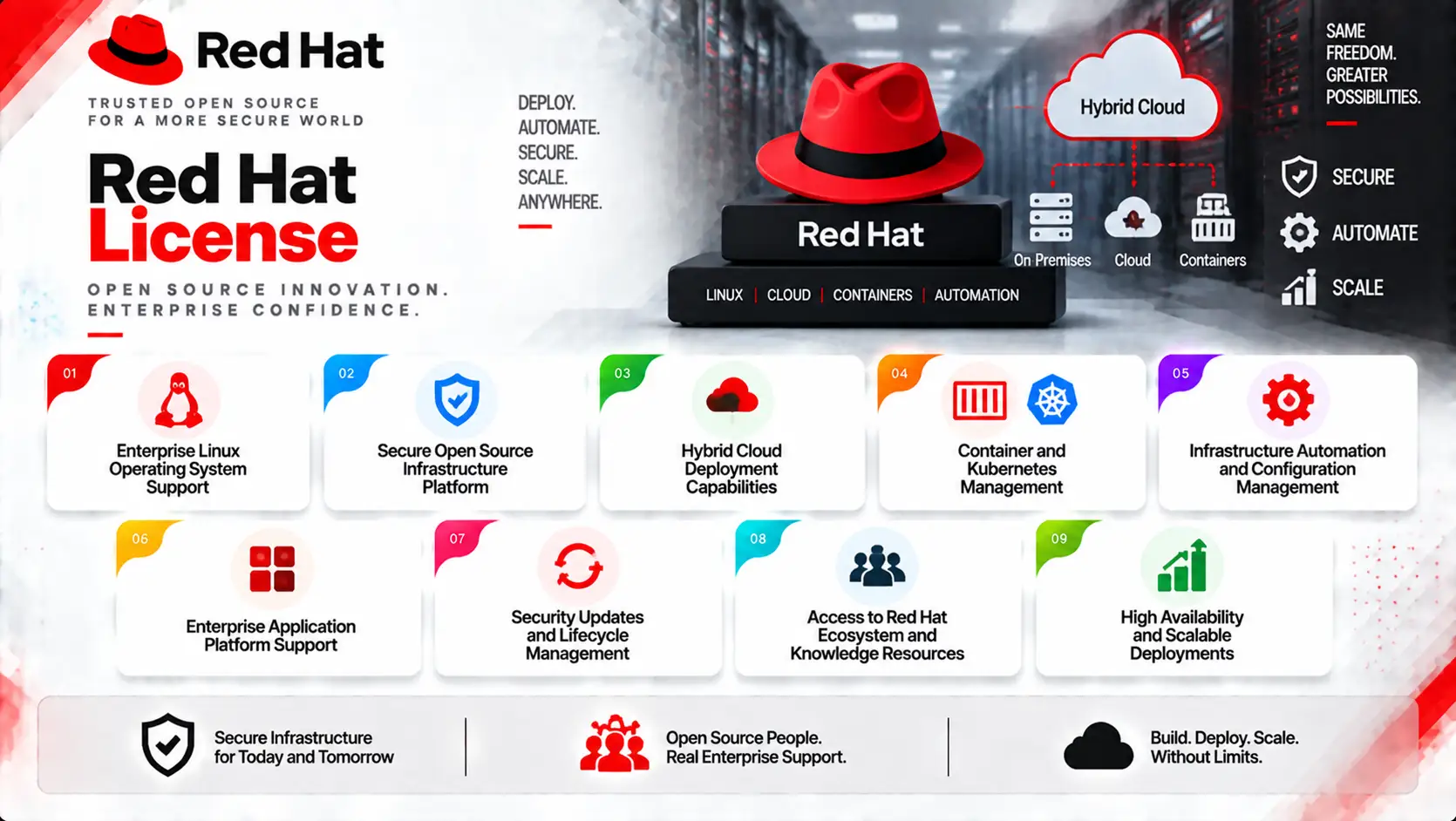
- Enterprise Linux operating system support
- Secure open-source infrastructure platform
- Hybrid cloud deployment capabilities
- Container and Kubernetes management
- Infrastructure automation and configuration management
- Enterprise application platform support
- Security updates and lifecycle management
- Access to Red Hat ecosystem and knowledge resources
- High availability and scalable deployments
Red Hat License At a Glance
What it is: Enterprise open-source software licensing and subscription portfolio
Vendor: Red Hat
Primary products: Red Hat Enterprise Linux, OpenShift, Ansible Automation Platform, Red Hat Satellite, Red Hat Middleware, Red Hat AI
Primary role: Enterprise infrastructure, cloud, automation, container, and application platform management
Software model: Enterprise open-source subscription model
Deployment models: On-premises, cloud, hybrid cloud, edge, and virtualized environments
Management platforms: Red Hat Satellite, OpenShift Console, Ansible Automation Platform, and Red Hat management tools
Core technologies: Linux, Kubernetes, containers, automation, virtualization, middleware, and hybrid cloud
Typical environments: Enterprise IT, government, finance, healthcare, telecommunications, manufacturing, and cloud infrastructure
License model: Subscription-based licensing
License Overview
A Red Hat License follows a subscription-based model rather than a traditional perpetual software ownership model.
Organizations purchase subscriptions that provide access to Red Hat software, updates, security patches, lifecycle support, technical documentation, and enterprise support services.
The licensing model differs depending on the Red Hat product.
Common licensing factors include:
- Number of physical systems
- Virtual machine count
- CPU sockets
- CPU cores
- Compute capacity
- Container cluster size
- Cloud deployment model
- Support level
- Subscription duration
For example, Red Hat Enterprise Linux licensing is commonly based on physical or virtual deployments, while Red Hat OpenShift licensing can depend on cluster resources and compute capacity.
The subscription model allows organizations to maintain supported versions, receive security updates, and access Red Hat-certified software ecosystems.
How Red Hat Licensing Works
Red Hat licensing is built around the relationship between software access, support, and lifecycle management.
A typical process includes:
Product Selection
→ Choose required Red Hat technology
Deployment Planning
→ Define servers, virtual machines, cloud resources, or containers
Subscription Selection
→ Choose required support level and duration
Registration and Activation
→ Register systems with Red Hat subscription services
Lifecycle Management
→ Receive updates, security patches, and supported software versions
This approach allows organizations to maintain predictable software lifecycle management across large environments.
Red Hat Product Portfolio Overview
| Red Hat Product | Primary Purpose |
|---|---|
| Red Hat Enterprise Linux (RHEL) | Enterprise Linux operating system for physical, virtual, cloud, and edge workloads |
| Red Hat OpenShift | Kubernetes-based container application platform |
| Ansible Automation Platform | Infrastructure automation and configuration management |
| Red Hat Satellite | Systems management, patching, and lifecycle control |
| Red Hat Middleware | Application integration, messaging, and development platforms |
| Red Hat Virtualization / Virtualization Solutions | Enterprise virtualization capabilities |
| Red Hat Advanced Cluster Management | Multi-cluster Kubernetes management |
| Red Hat Enterprise Linux AI | Enterprise AI development and deployment platform |
Licensing Options and Models
| Licensing Option | Description | Suitable For |
|---|---|---|
| Red Hat Enterprise Linux Subscription | Provides RHEL access, updates, security patches, and support | Enterprise server and workload environments |
| Standard Subscription | Provides business-hour support and enterprise lifecycle services | Organizations requiring regular technical assistance |
| Premium Subscription | Provides enhanced support response and advanced assistance | Mission-critical environments |
| Virtual Instance Licensing | Licensing based on virtualized deployments | VMware, KVM, cloud, and virtual infrastructure |
| Physical Server Licensing | Licensing based on physical systems and hardware resources | Bare-metal deployments |
| Cloud Subscription Licensing | Designed for supported public cloud deployments | Hybrid and cloud-native environments |
| OpenShift Subscription | Provides Kubernetes platform capabilities and support | Container and application platforms |
| Automation Platform Subscription | Provides Ansible automation capabilities | Infrastructure automation projects |
| Multi-Year Subscription | Extended subscription coverage | Long-term enterprise deployments |
Features and Benefits
Red Hat Enterprise Linux
Red Hat Enterprise Linux is the foundation of many enterprise infrastructures.
It provides:
- Enterprise Linux operating system
- Security hardening capabilities
- Lifecycle management
- Hardware and software certification
- Stable release cycles
- Enterprise support
It is widely used for:
- Database servers
- Application servers
- Cloud workloads
- Virtual machines
- Edge systems
Hybrid Cloud Enablement
Modern organizations operate across multiple environments.
Red Hat technologies support:
- On-premises infrastructure
- Private cloud
- Public cloud
- Edge computing
- Container platforms
This allows organizations to maintain consistent operational processes across different environments.
Container and Kubernetes Platform
Red Hat OpenShift provides an enterprise Kubernetes platform for building, deploying, and managing containerized applications.
Organizations use OpenShift for:
- Application modernization
- DevOps workflows
- Microservices deployment
- Cloud-native applications
- Hybrid cloud operations
Compatibility and Requirements
Before selecting a Red Hat License, organizations should evaluate:
- Required Red Hat product
- Physical or virtual deployment
- Server count
- CPU sockets or cores
- Virtual machine quantity
- Cloud provider environment
- Container requirements
- Automation requirements
- Support level
- Subscription duration
- Compliance requirements
Common deployment environments include:
- Bare-metal servers
- Virtual infrastructure
- Private cloud platforms
- Public cloud environments
- Kubernetes clusters
- Edge systems
Exact licensing requirements depend on the selected Red Hat product.
Activation and Deployment
A typical Red Hat deployment includes:
- Select required Red Hat products
- Choose subscription level
- Register systems with Red Hat services
- Activate subscriptions
- Configure repositories and updates
- Deploy software components
- Apply security updates
- Manage lifecycle and support
For enterprise environments, organizations usually integrate Red Hat subscriptions with centralized management tools to maintain consistent patching and compliance.
Pricing and Quote Process
Pricing for Red Hat License depends on the selected product, deployment model, infrastructure size, and support requirements.
Before requesting a quote, prepare:
- Required Red Hat products
- Number of servers
- Physical or virtual deployment details
- CPU/socket/core information
- Cloud deployment details
- OpenShift cluster requirements
- Automation requirements
- Required support level
- Subscription duration
For example, a small RHEL deployment for several application servers requires a different subscription structure compared with a large enterprise environment running OpenShift clusters, automation platforms, and hybrid cloud workloads. Correct sizing ensures organizations receive the required support level without unnecessary subscription costs.