

Cisco Nexus 7000 Series is a Cisco data center switching family designed for modular core switching, aggregation, high-density Ethernet, Layer 2 and Layer 3 services, virtualized data center segmentation, and NX-OS-based network operations. Unlike Cisco Catalyst switches used mainly for campus access, distribution, or enterprise core networks, Cisco Nexus 7000 platforms are built for data center environments where chassis design, supervisor redundancy, line-card selection, fabric capacity, software features, and license packages must be planned carefully. This page helps buyers understand Cisco Nexus 7000 ordering considerations, review licensing and part-number requirements, and move to the related Cisco Nexus 7000 part numbers for accurate quote planning.
Series Highlights
- Suitable for legacy and mature data center core, aggregation, high-density Ethernet, and modular switching environments
- Supports Cisco NX-OS, Layer 2, Layer 3, vPC, VDC, FabricPath, OTV, FCoE-related features, and unified fabric use cases where licensed
- Commonly associated with Nexus 7004, Nexus 7009, Nexus 7010, Nexus 7018, Nexus 7700 models, supervisors, line cards, fabric modules, optics, and support renewals
- Requires careful review of chassis model, supervisor engine, line-card type, fabric module, port speed, NX-OS release, license package, support status, and replacement options
- Helps buyers prepare the correct SKU, license, renewal, optic, line card, supervisor, fabric module, or migration request before ordering
Review Cisco Nexus 7000 Price List and request a quote tailored to your licensing needs.
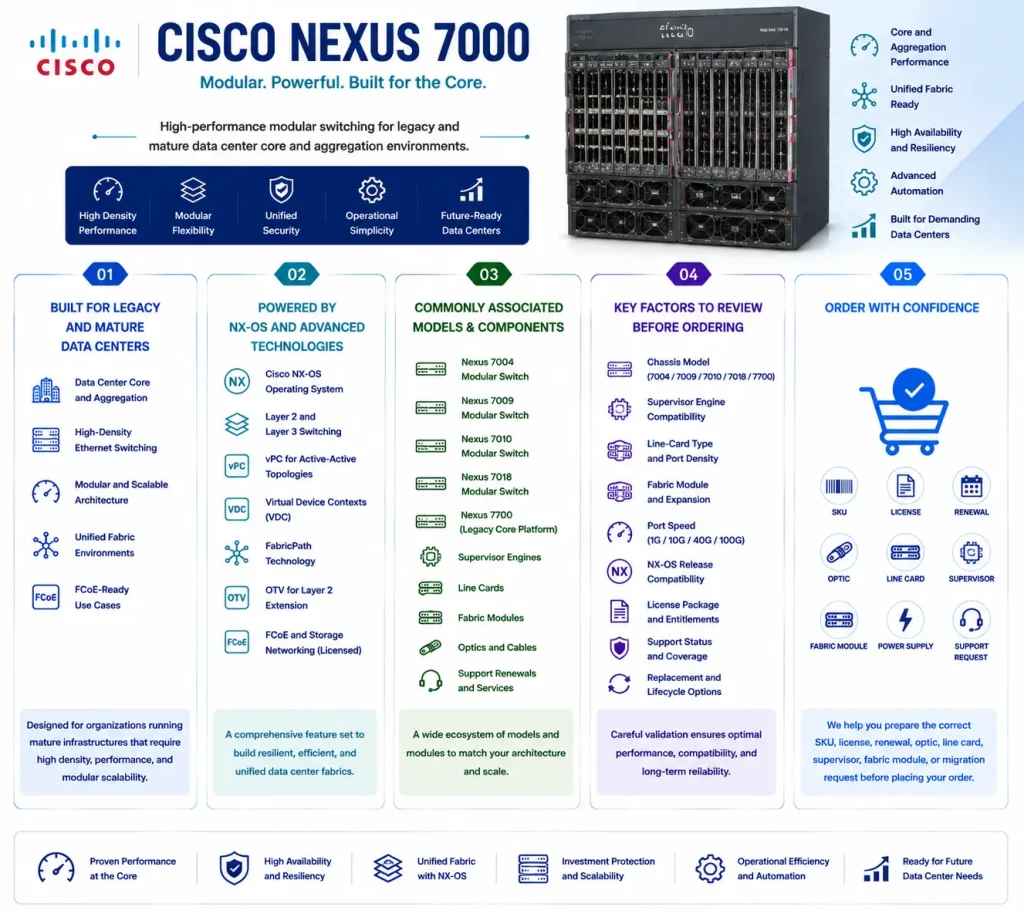
Cisco Nexus 7000 At a glance
What it is : Cisco Nexus 7000 Series is a modular Cisco Nexus data center switch family for core, aggregation, and high-scale NX-OS switching.
Product family : Cisco Nexus License
Typical use : Data center core switching, aggregation, high-density Ethernet, Layer 2 and Layer 3 services, VDC segmentation, vPC, FabricPath, OTV, unified fabric, and data center refresh planning.
License or ordering scope : Chassis model, supervisor engine, fabric module, line card, NX-OS release, LAN Enterprise license, VDC license, Storage Enterprise license, optics, support renewal, and migration planning.
Who needs it : Data center teams maintaining Nexus 7000 or Nexus 7700 environments that need the correct Cisco Nexus 7000 part number, license, line card, supervisor, fabric module, optic, renewal, or replacement item.
Series Overview
Designed for mission-critical data centers, the Nexus 7000 represents the modular data center segment of the wider Cisco Switch License portfolio, delivering continuous system operation and virtualized, pervasive services.
In a typical deployment, Cisco Nexus 7000 switches sit above access or aggregation switches and provide high-capacity switching, routing, redundancy, and segmentation. Depending on the installed hardware and license package, the platform may support advanced Layer 3 routing, VDCs, vPC, FabricPath, OTV, FCoE-related services, storage networking features, and unified fabric designs.
The value of Cisco Nexus 7000 is its modular architecture. Buyers can plan around chassis size, supervisor engines, line cards, fabric modules, optics, redundancy, and software feature requirements. However, this also makes ordering more sensitive than a fixed-switch purchase.
Today, Cisco Nexus 7000 is often part of maintenance, support renewal, license validation, hardware replacement, line-card expansion, and migration planning. Many customers need to confirm whether they should maintain an existing Nexus 7000 platform, add parts to a Nexus 7700 environment, or plan migration toward newer Nexus data center architectures.
Licensing and Part Number Guidance
Choosing the correct part number for Cisco Nexus 7000 depends on the exact chassis, supervisor engine, line card, fabric module, NX-OS release, feature requirement, support status, and activation method. Cisco Nexus 7000 licensing is different from Catalyst subscription licensing. It may involve feature-based NX-OS licenses such as LAN Enterprise, VDC licensing, Storage Enterprise licensing, FabricPath-related features, OTV-related features, FCoE requirements, or product-specific support renewal items.
Some quote requests may focus on chassis or hardware components, such as supervisors, fabric modules, I/O modules, power supplies, fan trays, optics, or spare parts. Other requests may involve a license package, renewal, software access, or migration review. The quote should clearly separate hardware SKUs from software, license, and support items. For existing environments, inventory validation is essential. The installed chassis, supervisor generation, line cards, fabric modules, NX-OS release, active license packages, and support coverage should be checked before ordering.
Common Use Cases
| Use case | Why it matters |
|---|---|
| Data center core switching | Provides modular switching and routing for large data center backbone environments |
| Aggregation-layer design | Aggregates access, server, service, and network edge layers with high-capacity Ethernet |
| VDC-based segmentation | Helps divide a physical chassis into separate logical switch contexts where supported and licensed |
| vPC and resilient connectivity | Supports redundant data center designs without traditional blocking Layer 2 limitations |
| FabricPath or OTV environments | Helps maintain legacy fabric and data center interconnect designs that depend on specific NX-OS features |
| Renewal, replacement, or migration planning | Helps validate chassis, supervisor, line card, license, optics, support, and lifecycle requirements before ordering |
Models, Licenses, and Ordering Scope
| Area to check | What to confirm |
|---|---|
| Chassis model | Exact Cisco Nexus 7004, 7009, 7010, 7018, Nexus 7700, or related chassis requirement |
| Supervisor | Supervisor model, redundancy requirement, supported NX-OS release, and performance requirement |
| Line cards | Required Ethernet speed, port density, M-Series, F-Series, F2/F3, or supported module type |
| Fabric modules | Fabric generation, chassis compatibility, switching capacity, and redundancy design |
| Deployment role | Data center core, aggregation, VDC design, vPC pair, FabricPath domain, OTV edge, or replacement system |
| License type | LAN Enterprise, VDC, Storage Enterprise, FabricPath, OTV, FCoE-related feature, support renewal, or product-specific entitlement |
| Hardware scope | Chassis, supervisor, line card, fabric module, optics, power supplies, fans, cables, or spare components |
| Quantity | Number of chassis, supervisors, line cards, fabric modules, optics, licenses, support renewals, or spare units |
| Activation method | Classic License, license-key file, honor-based NX-OS licensing where applicable, Smart License review, or Cisco-supported workflow |
| Part number | Correct Cisco Nexus 7000 hardware SKU and related license, module, optic, accessory, renewal, or support item |
What to Check Before Requesting a Quote
Before requesting a quote for Cisco Nexus 7000, confirm the exact chassis model, supervisor type, line-card requirement, fabric module status, NX-OS release, license package, support coverage, and deployment role.
You should also define whether the request is for a line-card expansion, supervisor replacement, fabric module, license package, optic bundle, support renewal, spare component, VDC requirement, Storage Enterprise feature, FabricPath, OTV, or migration planning. Each request can change the final part number and delivery path.
For existing systems, prepare the current inventory first. This should include chassis serial number, supervisor model, installed line cards, fabric modules, optics, NX-OS release, active licenses, power design, fan status, and support contract details.
Activation and Delivery Notes
After the correct Cisco Nexus 7000 part number is selected, activation depends on the chassis model, NX-OS release, license package, and Cisco-supported licensing workflow. Some Nexus 7000 environments use traditional license-key files or feature-based NX-OS licensing. In other cases, honor-based licensing behavior or support validation may be part of the review depending on the software release and installed platform.
For hardware delivery, compatibility should be checked before shipment. Chassis type, supervisors, line cards, fabric modules, optics, power supplies, fans, and NX-OS release must match the planned data center design. For renewal, replacement, or migration projects, reviewing the current license and support status first helps prevent ordering delays and keeps the selected SKU aligned with the real data center core or aggregation requirement.
Cisco Nexus Series pricing depends on your Switch series, license type, deployment model and support requirements.