

Proofpoint License provides organizations with access to a comprehensive cybersecurity platform focused on email protection, advanced threat detection, information security, and compliance management. Through its cloud-based security solutions, Proofpoint helps businesses protect users, communication channels, and sensitive data against phishing, malware, targeted attacks, and data exposure risks.
Quick Benefits
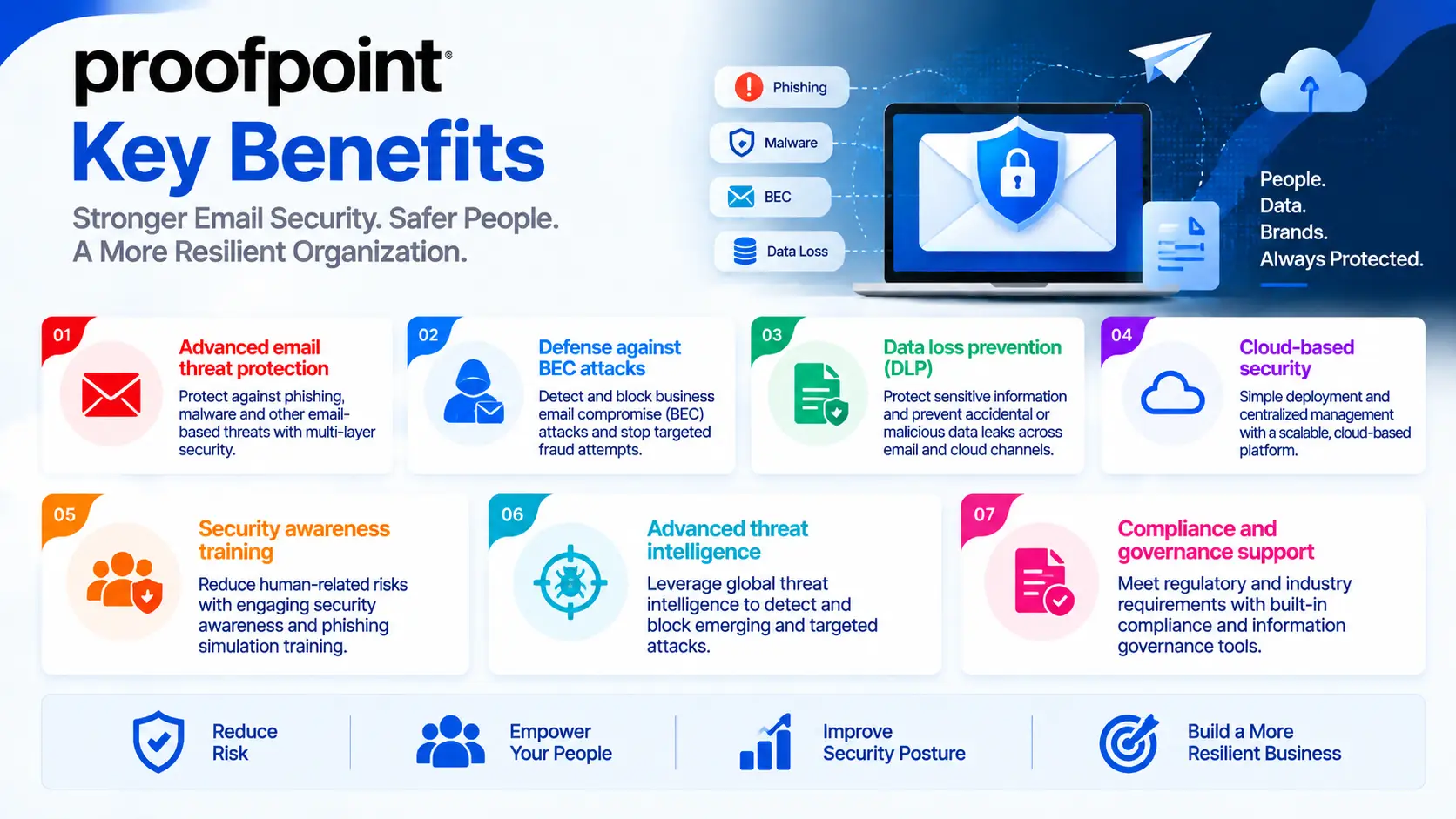
- Advanced email threat protection against phishing and malware
- Defense against business email compromise (BEC) attacks
- Protection of sensitive information through DLP capabilities
- Cloud-based security management and deployment
- Security awareness training for reducing human-related risks
- Advanced threat intelligence and attack detection
- Support for compliance and information governance requirements
Proofpoint License At a Glance
What it is: Enterprise cybersecurity licensing portfolio
Main platform: Proofpoint Security Platform
License type: Subscription-based security licensing
Primary licensing metrics: Users, mailboxes, domains, data volume, modules, and protected assets
Deployment models: Cloud, hybrid, and enterprise security environments
Main users: Enterprises, security teams, SOC teams, compliance departments, and IT administrators
Security areas: Email Security, Advanced Threat Protection, Data Loss Prevention, Information Protection, Security Awareness, and Identity Security
Typical environments: Microsoft 365, enterprise email systems, regulated industries, and organizations requiring advanced cybersecurity controls

License Overview
A Proofpoint License provides access to different cybersecurity capabilities designed around protecting communication, users, and sensitive business information. Unlike traditional security products that focus on a single protection layer, Proofpoint licensing covers multiple security domains, allowing organizations to select solutions according to their specific risk profile and operational requirements.
Proofpoint follows a subscription-based licensing approach where the final configuration depends on the selected product family, number of protected users, mailboxes, required security modules, and deployment model. Because Proofpoint provides solutions across email security, data protection, compliance, and user awareness, licensing requirements can vary significantly between different implementations.
For example, email security solutions are commonly evaluated based on protected mailboxes or users, while security awareness solutions are typically based on the number of users participating in training and simulation programs. Data protection solutions may require additional consideration around users, policies, information sources, and compliance requirements.
Organizations selecting a Proofpoint License should first identify their main security objectives. A company dealing primarily with phishing risks may require advanced email protection, while organizations handling sensitive information may prioritize DLP and information governance capabilities.
How Proofpoint Licensing Works
Proofpoint licensing begins with identifying the security challenges that need to be addressed, such as email threats, data leakage, identity compromise, or employee security awareness. After selecting the required Proofpoint solutions, organizations determine the number of protected users, mailboxes, domains, or assets that will be covered under the subscription.
Once the subscription is activated, administrators configure Proofpoint services according to business requirements, including email policies, threat detection rules, data protection controls, or awareness programs. Additional modules can be added when organizations need broader protection or more advanced security capabilities. This licensing approach allows organizations to build a security environment that matches their infrastructure instead of purchasing unnecessary capabilities.
Proofpoint Security Portfolio Overview
| Solution Family | Purpose |
|---|---|
| Proofpoint Email Protection | Protects enterprise email environments against spam, phishing, malware, and unwanted communication threats |
| Proofpoint Targeted Attack Protection (TAP) | Detects and analyzes advanced phishing campaigns, malicious links, attachments, and targeted attacks |
| Proofpoint Enterprise DLP | Helps organizations identify and prevent unauthorized sharing or leakage of sensitive information |
| Proofpoint Information Protection | Provides controls for securing sensitive data across communication channels and business workflows |
| Proofpoint Security Awareness Training | Reduces human-related security risks through phishing simulations and employee education |
| Proofpoint Insider Threat Management | Detects and investigates risky user behavior and potential insider security issues |
| Proofpoint Identity Threat Defense | Helps protect identities against account compromise and identity-based attacks |
| Proofpoint Cloud Security Solutions | Provides protection for cloud-based communication and collaboration environments |
Licensing Models and Options
| License Model | Description | Suitable For |
|---|---|---|
| User-Based Subscription | Licensing based on protected users or accounts | Email security and user-focused protection |
| Mailbox-Based Licensing | Security coverage calculated according to protected mailboxes | Enterprise email environments |
| Module-Based Licensing | Adds specific security capabilities based on organizational requirements | Businesses requiring customized security architecture |
| Awareness User Licensing | Covers employees participating in security awareness programs | Organizations improving human security readiness |
| Data Protection Licensing | Designed around sensitive information protection requirements | Companies implementing DLP strategies |
| Enterprise Subscription | Broader security coverage combining multiple capabilities | Large organizations with complex security needs |
| Multi-Year Subscription | Provides longer-term licensing coverage and planning flexibility | Enterprises requiring predictable security investment |
Features and Benefits
Proofpoint License enables organizations to create a layered cybersecurity strategy by combining protection against external threats with controls for internal information security. One of the strongest capabilities of the platform is email protection, where Proofpoint helps organizations detect phishing attempts, malicious attachments, impersonation attacks, and other communication-based threats.
Beyond email security, Proofpoint supports organizations that need stronger control over sensitive information. Data Loss Prevention capabilities help identify and protect confidential data while supporting compliance requirements across different industries. Another important advantage is addressing the human element of cybersecurity. Through security awareness solutions, organizations can improve employee readiness against phishing and social engineering attacks.
For security teams, Proofpoint provides visibility into threats, user behavior, and communication risks through centralized security management and threat intelligence capabilities. This allows organizations to move from reactive security responses toward more proactive risk management.
Compatibility and Requirements
Before selecting a Proofpoint License, organizations should evaluate their existing infrastructure and security requirements.
Important considerations include:
- Current email platform and architecture
- Microsoft 365 or Exchange environment
- Number of users and mailboxes
- Required security modules
- Data protection requirements
- Compliance obligations
- Existing security integrations
- Identity and directory services
Proofpoint solutions are commonly deployed in enterprise email environments, including Microsoft 365 and other business communication platforms. Organizations should review their current security architecture to determine which Proofpoint capabilities provide the highest value. A proper assessment helps prevent selecting insufficient protection or unnecessary modules.
Activation and Deployment
Proofpoint deployment begins after selecting the appropriate subscription and activating the required services.
Typical deployment steps include:
- Activating the Proofpoint subscription
- Configuring organizational domains and users
- Connecting email or security environments
- Creating protection policies
- Enabling selected security modules
- Monitoring security events and reports
Pricing and Quote Process
Pricing for a Proofpoint License depends on the selected security solutions, number of protected users or mailboxes, required modules, subscription duration, and deployment requirements.
Before requesting a quote, organizations should define:
- Number of users and mailboxes
- Required Proofpoint solutions
- Email platform and deployment model
- Data protection requirements
- Compliance requirements
- Security awareness needs
- Subscription term
- Integration requirements
Because Proofpoint provides multiple security products, accurate sizing is important to ensure organizations receive the appropriate protection level without unnecessary licensing costs. A detailed evaluation of security requirements also helps determine whether a company needs only email protection or a broader security architecture including DLP, identity protection, and awareness capabilities.
Proofpoint pricing depends on your security solution, email protection features, data security requirements, deployment model, license term, and support needs.