

Cisco Nexus 9000 Series is a Cisco data center switching family designed for modern leaf-spine fabrics, top-of-rack connectivity, data center aggregation, high-density Ethernet, Cisco ACI, Cisco NX-OS fabrics, VXLAN EVPN, automation, and cloud-scale network operations. Unlike Cisco Catalyst switches that are mainly used in campus networks, Cisco Nexus 9000 platforms are built for data centers where fabric design, software mode, port speed, optics, licensing, and operational tools must be selected carefully. This page helps buyers understand Cisco Nexus 9000 ordering considerations, review licensing and part-number requirements, and move to the related Cisco Nexus 9000 part numbers for accurate quote planning.
Series Highlights
- Suitable for data center leaf-spine fabrics, top-of-rack switching, aggregation, cloud networks, and high-density Ethernet
- Supports Cisco NX-OS, Cisco ACI, VXLAN EVPN, vPC, Layer 2, Layer 3, automation, telemetry, and policy-based fabric designs
- Commonly associated with Nexus 9200, Nexus 9300, Nexus 9500, Nexus 9800, line cards, supervisors, optics, and DCN software subscriptions
- Requires careful review of switch model, fabric role, software mode, port speed, optics, license tier, support term, and activation method
- Helps buyers prepare the correct SKU, license, renewal, optic, line card, chassis, support item, or migration request before ordering
Review Cisco Nexus 9000 Price List and request a quote tailored to your licensing needs.
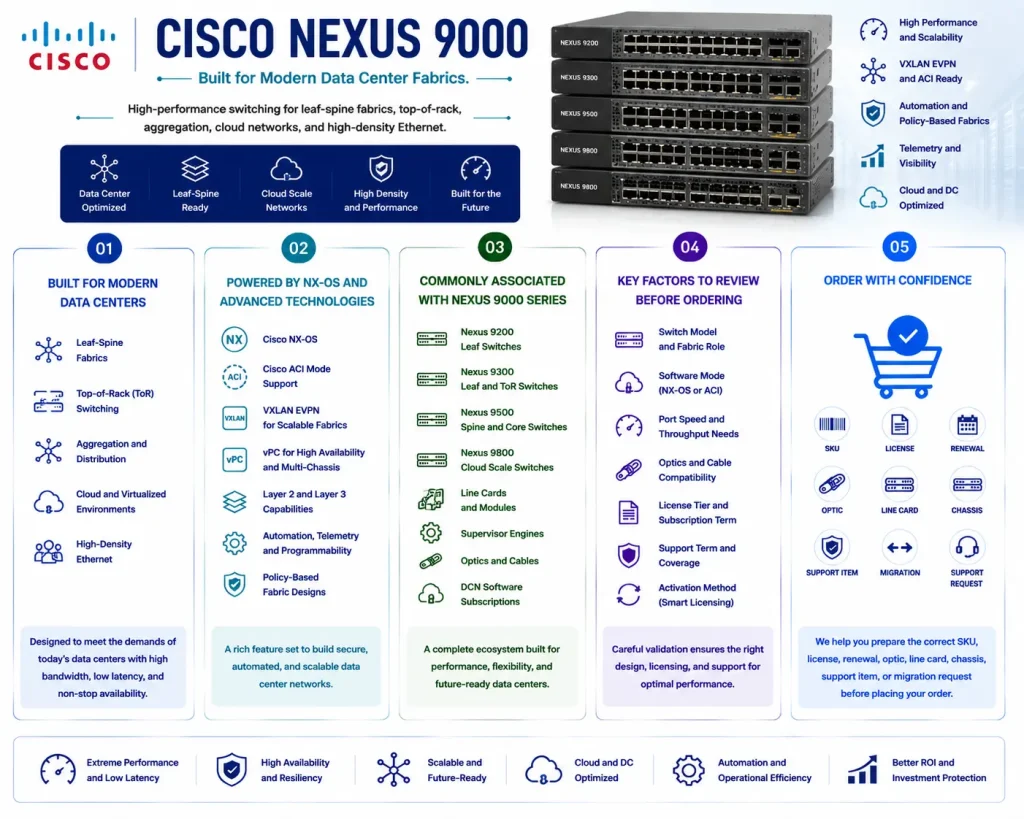
Cisco Nexus 9000 At a glance
What it is : Cisco Nexus 9000 Series is a data center switch family for fixed and modular leaf, spine, border leaf, aggregation, and fabric roles.
Product family : Cisco Nexus License
Typical use : Top-of-rack switching, leaf-spine architecture, Cisco ACI fabric, Cisco NX-OS fabric, VXLAN EVPN, data center aggregation, cloud networking, and high-speed Ethernet connectivity.
License or ordering scope : Switch model, fabric role, ACI or NX-OS mode, DCN license tier, NX-OS license package, Nexus Dashboard requirement, optics, support renewal, software subscription, and activation method.
Who needs it : Data center teams, cloud operators, enterprises, service providers, and colocation environments that need the correct Cisco Nexus 9000 part number, license, optic, line card, subscription, renewal, or support item.
Series Overview
Cisco Nexus 9000 Series is one of Cisco’s main data center switching families for modern fabric-based networks. It is commonly used in enterprise data centers, private clouds, service-provider facilities, hosting environments, financial networks, and large-scale application infrastructure.
In a typical design, Cisco Nexus 9000 switches may operate as top-of-rack leaf switches, spine switches, border leaf nodes, aggregation switches, or modular core components. Depending on the software mode, they can support traditional Cisco NX-OS switching and routing designs, VXLAN EVPN fabrics, or Cisco ACI policy-based fabrics.
The value of Cisco Nexus 9000 is the flexibility it brings to data center environments within the wider Cisco Switch License range. A customer may use fixed Nexus 9300 platforms for leaf or spine roles, modular Nexus 9500 platforms for larger fabric or aggregation roles, or newer high-capacity Nexus platforms where higher bandwidth and expansion are required. This makes part-number selection more detailed than a simple switch purchase. Buyers should confirm the exact platform, fabric role, software mode, license tier, optics, management platform, and support coverage before ordering.
Licensing and Part Number Guidance
Choosing the correct part number for Cisco Nexus 9000 depends on the exact switch model, fabric role, software mode, license package, port-speed requirement, optics, support term, and activation method. Cisco Nexus 9000 licensing may involve Cisco Data Center Networking license packages, NX-OS Essentials, NX-OS Advantage, DCN Essentials, DCN Advantage, DCN Premier, ACI-related licensing, Nexus Dashboard Controller consumption, support renewal, or product-specific software entitlement. The correct license path depends on whether the switch is running in NX-OS mode or ACI mode.
Hardware selection is equally important. Buyers should confirm whether the requirement is for a fixed switch, modular chassis, supervisor, line card, fabric module, optics, power supply, fan, cable, or spare component. Nexus 9000 models can differ significantly by port speed, platform generation, airflow, breakout support, software support, and fabric role. For existing environments, the current inventory should be reviewed before selecting the final SKU. This helps avoid mismatched optics, incorrect license tiers, unsupported NX-OS or ACI releases, or renewal items that do not match the installed switch.
Common Use Cases
| Use case | Why it matters |
|---|---|
| Leaf-spine data center fabric | Supports scalable east-west traffic, predictable design, and high-speed application connectivity |
| Cisco ACI deployment | Enables policy-based data center fabric when used with APIC, ACI software, and the correct license tier |
| NX-OS VXLAN EVPN fabric | Supports modern overlay networking, segmentation, and multi-tenant data center designs |
| Top-of-rack switching | Connects servers, storage-facing Ethernet, hypervisors, and application infrastructure at the rack level |
| Data center aggregation | Aggregates leaf switches, service nodes, firewalls, routers, and external network connectivity |
| Renewal, expansion, or migration planning | Helps validate model, software mode, optics, license tier, support coverage, and upgrade path before ordering |
Models, Licenses, and Ordering Scope
| Area to check | What to confirm |
|---|---|
| Switch model | Exact Cisco Nexus 9200, 9300, 9500, 9800, or related Nexus 9000 requirement |
| Fabric role | Leaf, spine, super spine, border leaf, top-of-rack, aggregation, or replacement switch |
| Software mode | Cisco NX-OS mode, Cisco ACI mode, VXLAN EVPN fabric, or traditional data center switching |
| Port requirement | Required 1G, 10G, 25G, 40G, 100G, 400G, optics, breakout, copper, or fiber interface need |
| License type | NX-OS Essentials, NX-OS Advantage, DCN Essentials, DCN Advantage, DCN Premier, ACI license, or support renewal |
| Hardware scope | Fixed switch, chassis, supervisor, line card, fabric module, optics, power supplies, fans, or spare parts |
| Software version | NX-OS release, ACI release, APIC compatibility, Nexus Dashboard requirement, and feature support |
| Quantity | Number of switches, chassis, line cards, optics, licenses, support renewals, or spare units |
| Activation method | Smart License, SLP, Cisco licensing portal workflow, PLR License, SLR License, or supported activation path where applicable |
| Part number | Correct Cisco Nexus 9000 hardware SKU and related license, subscription, optic, module, renewal, or support item |
What to Check Before Requesting a Quote
Before requesting a quote for Cisco Nexus 9000, confirm the exact switch model, software mode, fabric role, port-speed requirement, optics, license tier, subscription term, software version, and support coverage. You should also define whether the request is for a new ACI fabric, NX-OS fabric, VXLAN EVPN deployment, leaf expansion, spine expansion, replacement switch, line card, optic bundle, support renewal, or migration project. Each use case can change the final part number and license package. For existing deployments, prepare the current inventory first. This should include model number, serial number, installed NX-OS or ACI release, active license tier, APIC or Nexus Dashboard relationship, optics, modules, airflow direction, and support coverage.
Activation and Delivery Notes
After the correct Cisco Nexus 9000 part number is selected, activation depends on the platform model, software mode, license package, Smart Account, and deployment environment. Many Nexus 9000 deployments use Smart Licensing or Smart Licensing Using Policy for entitlement visibility and reporting. ACI and NX-OS deployments may require different license packages, so the operating mode should be confirmed before delivery.
For hardware delivery, compatibility should be checked before shipment. Switch model, optics, breakout cables, line cards, supervisors, fabric modules, airflow direction, and software release must match the planned data center design. For renewal, expansion, replacement, or migration projects, reviewing the current license and support status first helps prevent ordering delays and keeps the selected SKU aligned with the real data center fabric requirement.
Cisco Nexus Series pricing depends on your Switch series, license type, deployment model and support requirements.