

The Cisco ISE license defines how Cisco Identity Services Engine can enforce identity-based network access, authentication, authorization, posture, segmentation, guest access, and device administration across the enterprise. Licensing is usually planned around active endpoint count, selected tiers such as Essentials, Advantage, or Premier, Device Administration needs, virtual appliance requirements, support level, and the Smart Licensing activation model used for connected, controlled, or air-gapped deployments. Cisco describes ISE as a Network Access Control platform for visibility, authentication, authorization, and policy enforcement across wired, wireless, VPN, and 5G access domains.
Key Benefits
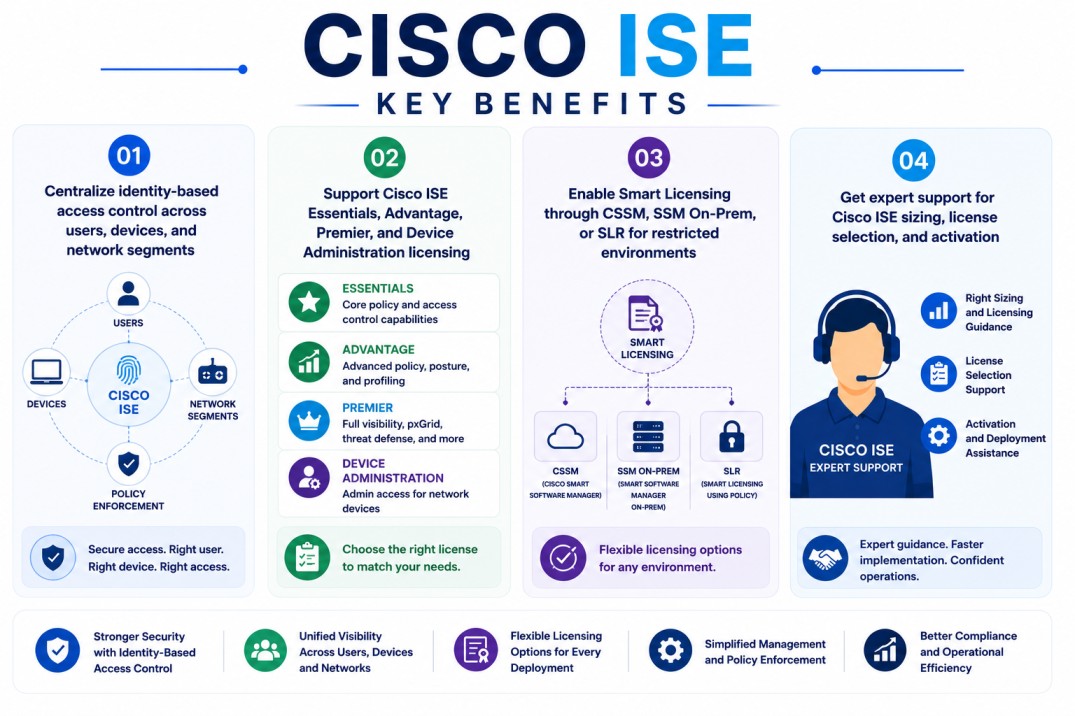
- Centralize identity-based access control across users, devices, and network segments
- Support Cisco ISE Essentials, Advantage, Premier, and Device Administration licensing
- Enable Smart Licensing through CSSM, SSM On-Prem, or SLR for restricted environments
- Get expert support for Cisco ISE sizing, license selection, and activation
Review Cisco ISE Price List and request a quote tailored to your licensing needs.
The Cisco ISE At a glance
What it does : Cisco ISE provides identity-based network access control, authentication, authorization, endpoint visibility, segmentation, policy enforcement, guest access, posture, and device administration capabilities.
Product category : Cisco Security
License type : Subscription-based licensing for Cisco ISE software, with Essentials, Advantage, and Premier tiers; Device Administration and Virtual Appliance licensing may also be required depending on deployment scope. Cisco’s licensing guide lists subscription licenses, Device Admin licenses, and Virtual Appliance licenses as Cisco ISE software license types.
Typical term : 1 year · 3 years · 5 years, depending on order model and subscription requirements. Cisco states that a-la-carte ISE subscription licenses are available in 1-, 3-, and 5-year terms.
Activation method : Cisco Smart Licensing through CSSM, Smart Software Manager On-Prem, or Specific License Reservation for selected air-gapped deployments.
Who needs it : Organizations that need centralized network access control, identity policy enforcement, secure segmentation, guest access, posture assessment, TACACS+ device administration, or Zero Trust access control using Cisco ISE.

License Overview
Organizations deploying Cisco ISE usually need licensing that reflects the number of active endpoints, the required security capabilities, and the deployment model used across the network. The Cisco ISE license is generally aligned with concurrent active endpoint requirements and the selected licensing tier. Cisco states that ISE subscription licenses are based on the number of active endpoints and are available in Essentials, Advantage, and Premier tiers, with higher tiers including the capabilities of lower tiers.
Across the wider Cisco License portfolio, Cisco ISE environments may include wired, wireless, VPN, guest, BYOD, posture, segmentation, and device administration use cases, so licensing should be planned around actual access-control workflows rather than only the number of users. A properly aligned license helps organizations avoid endpoint overconsumption, select the right feature tier, support policy enforcement, and maintain compliance with the intended Cisco ISE deployment design.
Product Overview
Network access risk increases when users, devices, guests, contractors, and unmanaged endpoints connect across different access layers without consistent identity and policy control.
Cisco ISE is designed to reduce this risk by acting as a centralized policy platform for identity-based access decisions across enterprise networks.
In practice, Cisco ISE integrates with network infrastructure to authenticate users and devices, apply authorization policies, support segmentation, manage guest access, and provide visibility into connected endpoints.
One of the key strengths of Cisco ISE is policy consistency. Instead of managing access decisions separately across different parts of the network, teams can define centralized access rules and enforce them across supported wired, wireless, VPN, and secure access environments.
For organizations building Zero Trust or segmentation strategies, Cisco ISE provides the identity and policy foundation needed to control who and what can access network resources.
Core technical flow
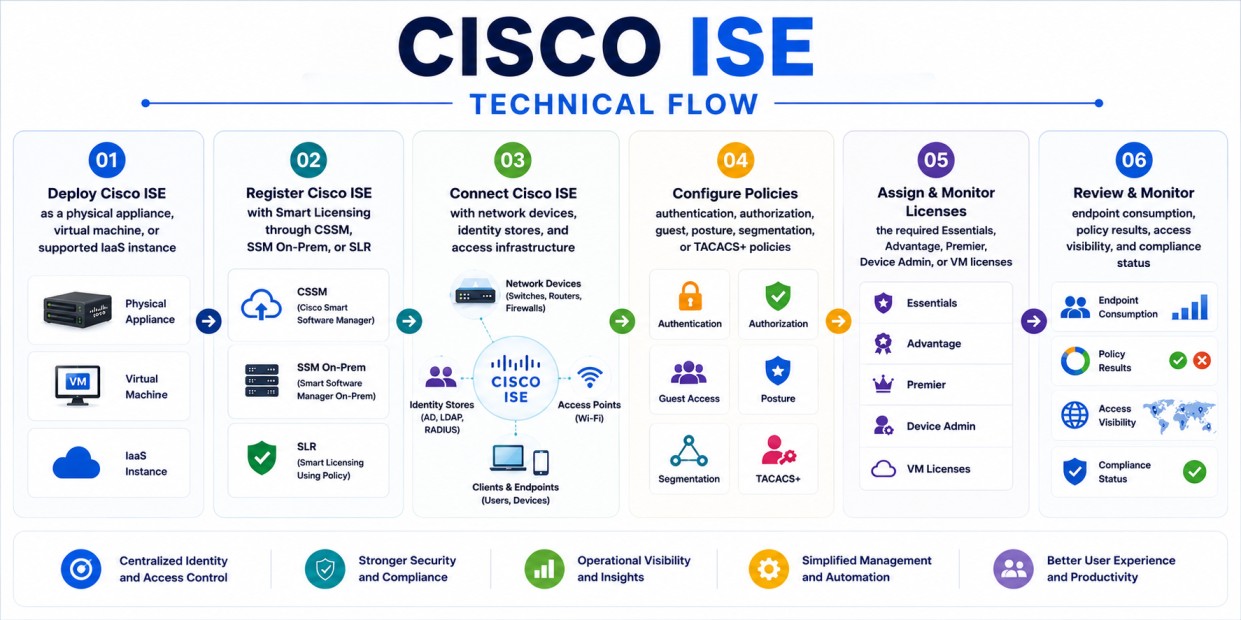
- Deploy Cisco ISE as a physical appliance, virtual machine, or supported IaaS instance
- Register Cisco ISE with Smart Licensing through CSSM, SSM On-Prem, or SLR
- Connect Cisco ISE with network devices, identity stores, and access infrastructure
- Configure authentication, authorization, guest, posture, segmentation, or TACACS+ policies
- Assign and monitor the required Essentials, Advantage, Premier, Device Admin, or VM licenses
- Review endpoint consumption, policy results, access visibility, and compliance status
Options & Tiers
| Licensing Model | Best for | Typical Scope | What affects pricing |
|---|---|---|---|
| Essentials | Core NAC and identity access control | Foundational authentication, authorization, and visibility | Active endpoint count |
| Advantage | Advanced access and segmentation use cases | Includes Essentials plus broader security and segmentation capabilities | Endpoint count and feature needs |
| Premier | Full-featured Cisco ISE deployments | Includes lower-tier capabilities with advanced functionality | Endpoint count and advanced use cases |
| Device Administration | TACACS+ device administration | Network device admin control and audit workflows | PSN/device admin requirements |
| Virtual Appliance License | Virtual or IaaS ISE deployments | Appliance licensing for VM/IaaS form factors | Deployment architecture |
Features & Benefits
As access environments expand across users, devices, branches, wireless networks, VPN users, and cloud-connected operations, maintaining consistent identity policy becomes increasingly important.
Cisco ISE helps organizations centralize this control by combining access policy, endpoint visibility, segmentation, guest access, posture, and device administration workflows into one identity services platform.
One of the major benefits is stronger access governance. Security teams can define who is allowed to connect, what level of access they receive, and how endpoint context affects access decisions.
The platform also supports advanced segmentation and security workflows. Cisco notes that ISE Advantage and Premier unlock capabilities beyond Essentials, including stronger network value, operational optimization, and protection against emerging threats.
Over time, Cisco ISE helps organizations improve access control consistency, reduce unauthorized access risk, and support scalable identity-based network security.
System Requirements
Common environments
- Enterprise NAC and identity-based access control environments
- Wired, wireless, VPN, guest, BYOD, and secure access deployments
- Cisco switch, wireless, firewall, and network infrastructure environments
- Zero Trust, segmentation, compliance, and device administration use cases
Technical requirements
- Cisco ISE appliance, virtual appliance, or supported IaaS deployment
- Cisco Smart Account and access to the correct Virtual Account
- Network device integration and required policy enforcement points
- CSSM connectivity, SSM On-Prem design, or SLR workflow for restricted environments
Cisco states that ISE can be deployed on physical hardware, virtual platforms, and IaaS instances in AWS, Microsoft Azure, and Oracle Cloud Infrastructure.
How activation works
Activating Cisco ISE usually starts after the ISE deployment is installed and the required Cisco Smart Account, Virtual Account, and license entitlements are ready. In connected environments, Cisco ISE can use Smart Licensing through Cisco Smart Software Manager. Cisco states that CSSM is a cloud-based platform used to manage and track Smart Software licenses, group them into virtual accounts, and monitor license usage across an organization.
For controlled environments, Cisco ISE can use Smart Software Manager On-Prem. Cisco explains that SSM On-Prem is recommended for air-gapped ISE deployments that can connect to a local SSM On-Prem server instead of connecting directly to Cisco’s cloud licensing services. For highly secured air-gapped environments, Specific License Reservation can be used. Cisco describes SLR as a method that allows Cisco ISE licenses to be activated without sending usage information to Cisco, making it useful for highly secured air-gapped networks.
After activation, administrators should validate license consumption, endpoint usage, PAN registration, Device Administration requirements, and feature availability. For high-availability deployments, license planning should also consider primary and secondary PAN behavior, especially when using SLR or restricted licensing workflows.
Pricing factors + quote process
Organizations usually size Cisco ISE licensing according to the maximum number of active endpoints expected to connect concurrently and the feature tier required for the deployment. Cisco states that ISE subscription license quantity is determined by the maximum number of active endpoints expected to connect concurrently on any given day.
Environments requiring advanced segmentation, posture, guest access, threat integrations, Premier capabilities, or TACACS+ Device Administration may require broader licensing and more careful tier selection.
Additional considerations, such as virtual appliance licensing, deployment architecture, support level, Smart Licensing method, SSM On-Prem requirements, SLR needs, and subscription term, can also influence the final quote.
During the quote process, endpoint scope, access-control use cases, deployment model, licensing tier, and activation method are reviewed first so the licensing approach can match the organization’s Cisco ISE strategy more accurately.
After you request a quote
- We review your Cisco ISE deployment and endpoint scope
- Recommend the suitable Essentials, Advantage, Premier, Device Admin, or VM licensing model
- Provide official pricing and delivery details
- Share Smart Licensing and activation guidance
Cisco ISE pricing depends on your license type, deployment model and support requirements.