

The Cisco Talos License should be understood as licensing or enabling Cisco security products and services that are powered by Cisco Talos threat intelligence, rather than a traditional standalone software license for a separate Talos appliance. Cisco Talos is Cisco’s threat intelligence and security research organization, and Cisco states that Talos intelligence powers Cisco security products with automated protection, updated detections, and threat context across malware, email, web, DNS, and network security workflows.
Key Advantages
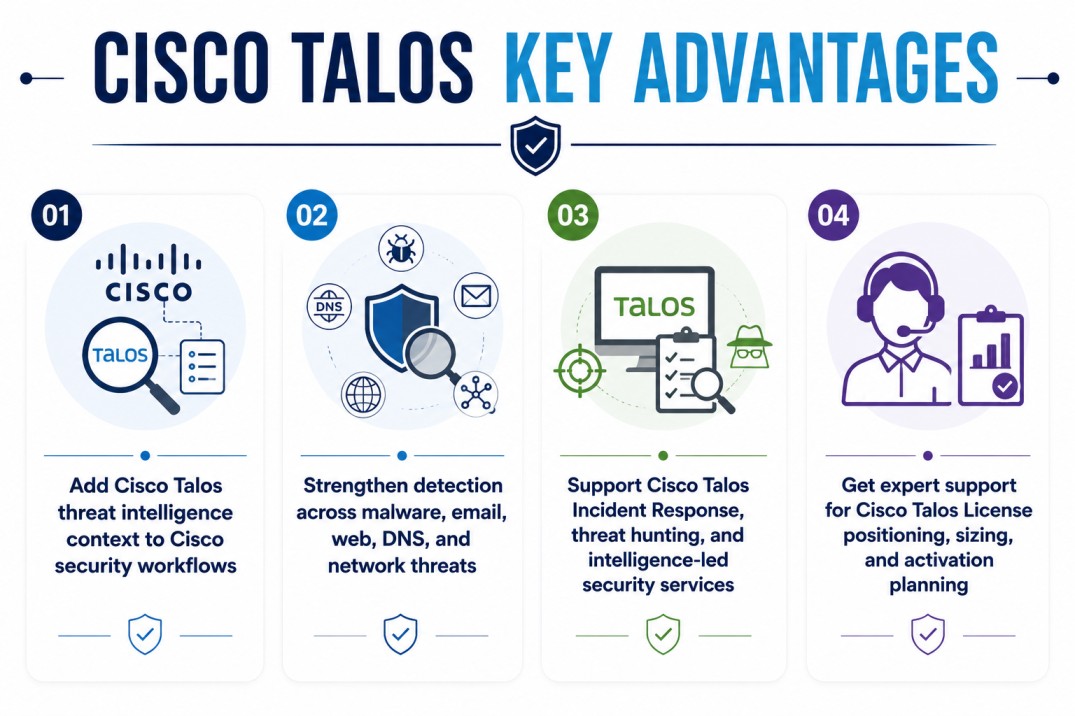
- Add Cisco Talos threat intelligence context to Cisco security workflows
- Strengthen detection across malware, email, web, DNS, and network threats
- Support Cisco Talos Incident Response, threat hunting, and intelligence-led security services
- Get expert support for Cisco Talos License positioning, sizing, and activation planning
Cisco Talos License At a glance
What it does : Cisco Talos delivers threat intelligence, research, detection content, incident response expertise, and security intelligence integrations that support Cisco security products and services. Cisco describes Talos as its threat intelligence organization made up of researchers, analysts, incident responders, threat hunters, and engineers.
Security category : Cisco Security
License type : Service- or product-dependent. Cisco Talos is not normally licensed like a single standalone product; access is usually tied to Cisco security products, Talos Intelligence Integrations, Cisco Talos Incident Response services, or other Cisco security subscriptions that consume Talos intelligence.
Typical term : Depends on the purchased Cisco security product, subscription, service engagement, or incident response retainer. Cisco describes Talos Incident Response retainer as a flexible subscription service with access to incident responders and threat intelligence experts.
Activation method : Activation depends on the Cisco product or Talos service being purchased. Talos-powered protection may be enabled through Cisco security product licensing, while Cisco Talos Incident Response or threat intelligence services are usually delivered through service access, retainer, or engagement workflows rather than local software activation.
Who needs it : Organizations that need threat intelligence, incident response support, threat hunting, security research context, automated detections, and stronger protection across Cisco security products.
License Overview
Cisco Talos licensing should be planned carefully because Talos itself is best understood as Cisco’s threat intelligence and security research organization, not as a simple standalone software product. A Cisco Talos License page should therefore focus on how organizations access Talos-powered intelligence through Cisco security services, Cisco security subscriptions, and Talos-related response or integration offerings.
In practical terms, Cisco Talos intelligence may be consumed through products and services such as Cisco Secure Firewall, Secure Email, Umbrella, Secure Endpoint, Secure Network Analytics, Talos Intelligence Integrations, and Cisco Talos Incident Response. Cisco states that Talos Intelligence Integrations power Cisco security with up-to-date threat detection across malware, email, web, DNS, and network security areas.
Because each Cisco security product has its own licensing model, the right licensing approach depends on what the customer actually needs: threat intelligence enrichment, email threat prevention, network detection, incident response retainer, threat hunting, malware prevention, or integration with existing Cisco security controls. Within the broader Cisco License portfolio, a properly aligned Cisco Talos licensing approach helps organizations avoid purchasing the wrong security entitlement, understand where Talos intelligence is applied, and match the service scope with their actual threat detection, investigation, and response requirements.
Product Overview
Threat intelligence becomes difficult to use effectively when security teams only receive isolated alerts without enough context about attacker behavior, malware activity, infrastructure reputation, phishing patterns, or emerging vulnerabilities. Cisco Talos is designed to reduce this gap by turning global threat research, telemetry, incident response knowledge, and detection engineering into security intelligence that supports Cisco products and customers. Cisco’s Talos Threat Intelligence Services data sheet describes Talos as delivering threat research, intelligence, proactive security services, and incident response to help defend organizations against evolving cyber threats.
In practice, Cisco Talos supports multiple security workflows. It can provide detection intelligence for Cisco products, reputation intelligence for email and web security, network intrusion prevention context, malware prevention intelligence, and expert incident response support.
One of the key strengths of Cisco Talos is that its intelligence is operationalized across Cisco’s security ecosystem. Instead of treating threat research as a separate reference source, Talos intelligence can become part of automated detection, blocking, investigation, and response workflows. For organizations already using Cisco security products, Cisco Talos can improve the practical value of those tools by adding current threat context, stronger detections, and expert-backed security intelligence.
Core technical flow
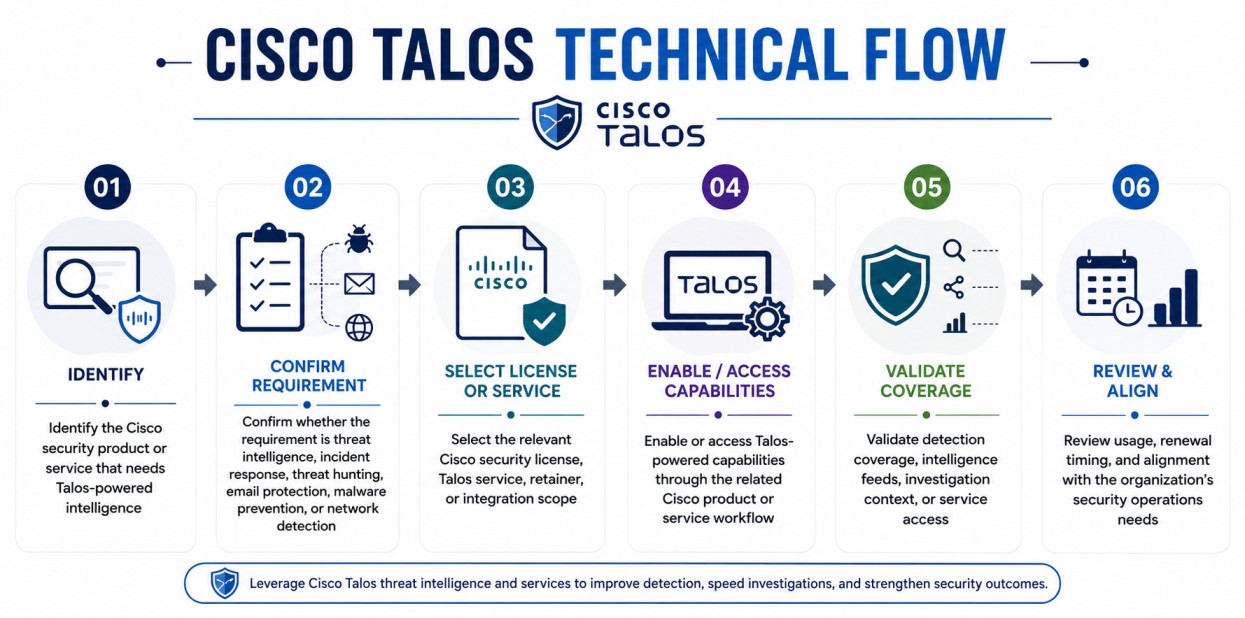
- Identify the Cisco security product or service that needs Talos-powered intelligence
- Confirm whether the requirement is threat intelligence, incident response, threat hunting, email protection, malware prevention, or network detection
- Select the relevant Cisco security license, Talos service, retainer, or integration scope
- Enable or access Talos-powered capabilities through the related Cisco product or service workflow
- Validate detection coverage, intelligence feeds, investigation context, or service access
- Review usage, renewal timing, and alignment with the organization’s security operations needs
Options & Tiers
| Licensing / Service Model | Best for | Typical Scope | What affects pricing |
|---|---|---|---|
| Talos Intelligence Integrations | Cisco security product protection | Automated detections across malware, email, web, DNS, and network security | Product scope and integration needs |
| Cisco Talos Incident Response | Breach response and readiness | Emergency response, proactive services, expert guidance | Retainer or engagement scope |
| Talos Threat Hunting | Proactive security investigation | Analyst-led hunting for hidden threats | Environment size and telemetry access |
| Email Threat Prevention | Phishing, BEC, and impersonation defense | Email security detection and prevention | User or email security scope |
| Cisco security product subscriptions | Talos-powered protection inside Cisco tools | Firewall, endpoint, email, DNS, web, and network analytics | Product license and term |
Features & Benefits
Modern security teams face threats that change quickly across email, web, DNS, endpoint, network, and cloud-connected environments. Static detection rules or isolated product alerts are often not enough without current threat intelligence. Cisco Talos helps improve this visibility by feeding Cisco security products and services with current research, detections, reputation intelligence, and threat context. Cisco describes Talos Intelligence Integrations as supporting automated, up-to-date threat detection across multiple security domains.
One major benefit is faster threat detection. Talos intelligence can help Cisco products identify malicious infrastructure, suspicious files, phishing attempts, malware behavior, and network-based attacks more effectively. Another benefit is expert incident response support. Cisco Talos Incident Response provides proactive and reactive services, and Cisco describes the retainer as a subscription service that gives clients access to experienced incident responders and threat intelligence experts. Over time, Cisco Talos helps organizations strengthen detection quality, improve response readiness, and connect threat research more directly with day-to-day security operations.
System Requirements
Common environments
- Cisco security product ecosystems
- SOC and incident response environments
- Email, web, DNS, endpoint, firewall, and network security operations
- Threat intelligence, threat hunting, and response readiness programs
Technical requirements
- Relevant Cisco security product or Talos service selection
- Cisco licensing or service entitlement based on the selected offering
- Security telemetry, product integration, or service access depending on the use case
- Operational process for detection review, investigation, escalation, or incident response
How activation works
Cisco Talos activation depends on the type of Talos-related capability being purchased. Unlike a firewall or switch license, Cisco Talos is not usually activated as a separate device-based software module.
For Cisco security products, Talos-powered protections are generally enabled through the license and configuration of the related Cisco product. For example, Cisco Secure Email, Secure Firewall, Umbrella, Secure Endpoint, or Secure Network Analytics may use Talos intelligence as part of their detection and prevention workflows. Cisco states that customers see Talos intelligence in action through Cisco cloud-based security services and Cisco products.
For Cisco Talos Incident Response, activation is more service-oriented. Cisco describes Talos IR as offering proactive and reactive services to help organizations prepare, respond, and recover from breaches, with global 24/7 availability for incident response needs.
For intelligence integrations, activation may involve the relevant Cisco security product, cloud service, portal access, API integration, or entitlement workflow depending on the purchased service and deployment design.
After activation or service onboarding, organizations should validate that Talos-powered detection, incident response access, threat hunting scope, or intelligence integration is aligned with the intended Cisco security architecture.
Pricing factors + quote process
Pricing for Cisco Talos License requirements depends on the selected Cisco security product, Talos service type, intelligence integration scope, environment size, and subscription or service term.
A customer seeking Talos-powered protection inside a Cisco product may need the correct product license or subscription. A customer seeking incident response support may need a Talos IR retainer or service engagement. A customer seeking advanced threat intelligence integration may require a different entitlement or service model.
Additional considerations such as number of users, endpoints, protected domains, email volume, firewall environment, monitored telemetry, service level, response requirements, and support term may affect the final scope.
During the quote process, the security goal should be clarified first: product protection, threat intelligence enrichment, email threat prevention, incident response readiness, threat hunting, or broader Cisco security integration. From there, the correct Cisco Talos License approach can be mapped to the customer’s environment.
After you request a quote
- We review your Cisco security environment and Talos-related requirement
- Identify whether you need a product license, Talos service, retainer, or integration scope
- Provide official pricing and delivery details
- Share activation, onboarding, or service guidance
Cisco Talos pricing depends on your license type, deployment model and support requirements.