

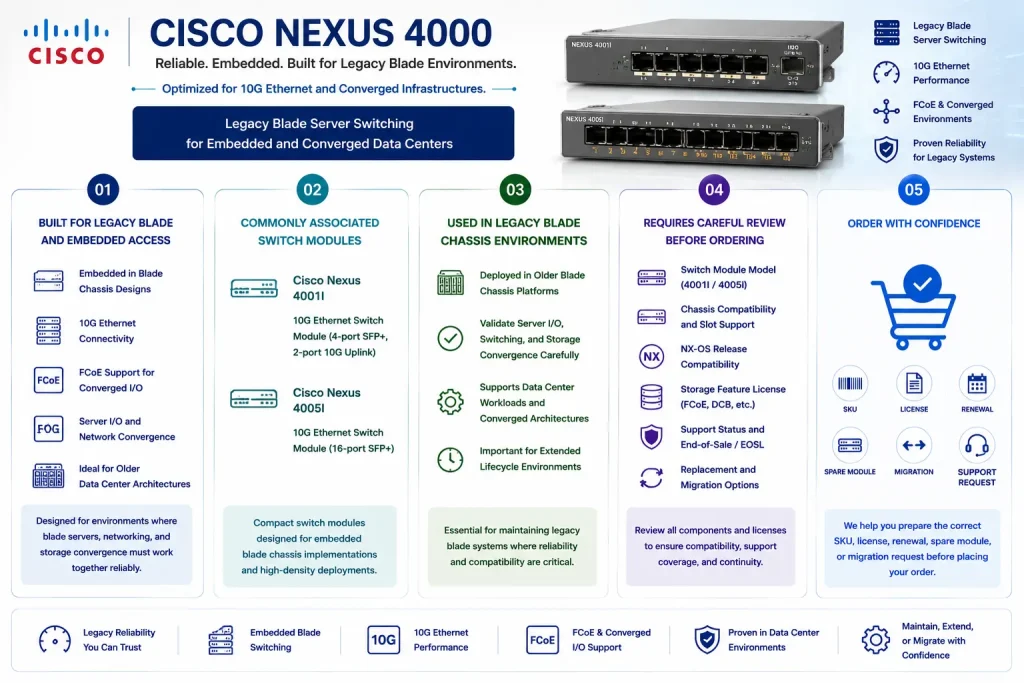
Cisco Nexus 4000 Series is a Cisco data center blade switch module family designed for legacy blade server environments, 10 Gigabit Ethernet server connectivity, Fibre Channel over Ethernet-related designs, and embedded switching inside supported blade chassis. Unlike Cisco Catalyst switches used in campus access or core networks, Cisco Nexus 4000 platforms are tied to data center server I/O and should be reviewed as legacy Nexus blade switching products. This page helps buyers understand Cisco Nexus 4000 ordering considerations, review licensing and part-number requirements, and move to the related Cisco Nexus 4000 part numbers for accurate quote planning.
Series Highlights
- Suitable for legacy blade server switching, embedded data center access, 10G Ethernet, and FCoE-related environments
- Commonly associated with Cisco Nexus 4001I and Cisco Nexus 4005I switch modules
- Used in older blade chassis designs where server I/O, switching, and storage convergence must be validated carefully
- Requires review of switch module model, chassis compatibility, NX-OS release, storage feature license, support status, and replacement options
- Helps buyers prepare the correct SKU, license, renewal, spare module, or migration request before ordering
Cisco Nexus 4000 At a glance
What it is : Cisco Nexus 4000 Series is a legacy Cisco Nexus blade switch module family for data center blade server environments.
Product family : Cisco Nexus License
Product family : Cisco Nexus License / Cisco Data Center License.
Typical use : Blade server switching, 10G server connectivity, FCoE-related designs, embedded data center access, legacy server I/O, and replacement planning.
License or ordering scope : Switch module model, Nexus 4001I or 4005I requirement, NX-OS release, Basic Storage Services Package, FIP Snooping needs, support renewal, spare module, and chassis compatibility.
Who needs it : Data center teams maintaining older blade environments that need the correct Cisco Nexus 4000 part number, storage feature license, support option, replacement module, or migration guidance.
Series Overview
Among the platforms covered by the Cisco Switch License category, Cisco Nexus 4000 serves a very specific data center role. Its main purpose is embedded switching for supported blade server chassis environments where server connectivity, data center bridging, and storage-related Ethernet features need to be handled inside the blade infrastructure.
In a typical deployment, Cisco Nexus 4000 switch modules connect blade servers to the external data center network. They may be part of environments that still rely on 10G server access, FCoE-related traffic handling, and older Cisco NX-OS operational models.
Today, Cisco Nexus 4000 is mostly important for maintenance, spare replacement, license validation, support review, and migration planning. Buyers may need a replacement switch module, a specific storage services license, a support renewal check, or confirmation that the existing blade environment can continue operating without compatibility issues. Because this is a legacy Nexus platform, part-number accuracy is critical. The exact module, installed software, chassis type, license requirement, and lifecycle status should all be checked before any quote is finalized.
Licensing and Part Number Guidance
Choosing the correct part number for Cisco Nexus 4000 depends on the exact switch module, blade chassis environment, NX-OS release, storage feature requirement, support status, and replacement or migration need.
Cisco Nexus 4000 licensing is not the same as modern Catalyst subscription licensing. It is more closely tied to legacy Nexus feature-based licensing. For example, some Nexus 4000 requirements may involve the Basic Storage Services Package and FIP Snooping functionality, especially when storage convergence or FCoE-related behavior is part of the environment.
Some quote requests may focus only on hardware replacement, such as a Nexus 4001I or Nexus 4005I switch module. Other requests may involve software entitlement, feature licensing, support validation, or migration planning from older blade switching to newer data center switching architectures.
For existing environments, the current inventory should be reviewed first. This helps avoid mismatched switch modules, unsupported software assumptions, missing feature licenses, or renewal items that do not match the installed blade chassis.
Common Use Cases
| Use case | Why it matters |
|---|---|
| Blade server switching | Provides embedded switching for supported blade server chassis environments |
| 10G server connectivity | Supports legacy high-speed server access inside older data center infrastructures |
| FCoE-related traffic handling | Helps support storage-convergence use cases where FIP Snooping or related features are required |
| Spare module replacement | Helps match the correct Nexus 4001I or 4005I module with the installed blade chassis |
| License validation | Confirms whether storage services or feature-based licensing is required before ordering |
| Migration planning | Supports refresh planning from legacy blade switching toward newer Nexus data center platforms |
Models, Licenses, and Ordering Scope
| Area to check | What to confirm |
|---|---|
| Switch module | Exact Cisco Nexus 4001I, Nexus 4005I, or related module requirement |
| Deployment role | Blade server switching, embedded data center access, storage-converged access, or replacement module |
| Chassis compatibility | Supported blade chassis, installed server environment, and module compatibility |
| Software version | Cisco NX-OS release, feature support, and upgrade or maintenance requirement |
| License type | Basic Storage Services Package, FIP Snooping requirement, feature license, support renewal, or product-specific licensing |
| Hardware scope | Switch module, spare unit, cables, optics where applicable, or replacement component |
| Quantity | Number of modules, chassis, licenses, renewal items, or spare units |
| Term | Renewal, support coverage period, software access requirement, or migration planning window |
| Activation method | Classic License, feature-based license, license file, Smart License review, or Cisco-supported workflow where applicable |
| Part number | Correct Cisco Nexus 4000 hardware SKU and related license, renewal, support, or spare item |
What to Check Before Requesting a Quote
Before requesting a quote for Cisco Nexus 4000, confirm the exact switch module, blade chassis type, current NX-OS release, feature requirement, support status, and replacement or renewal need.
You should also define whether the request is for a Nexus 4001I module, Nexus 4005I module, Basic Storage Services Package, spare replacement, support renewal, software validation, or migration project. Each request can change the final SKU and ordering path.
For existing environments, prepare the current inventory first. This should include module part number, serial number, chassis model, installed software, feature license status, cabling details, and support coverage. This is especially important because Nexus 4000 ordering is usually connected to legacy data center infrastructure.
Activation and Delivery Notes
After the correct Cisco Nexus 4000 part number is selected, activation depends on the module model, NX-OS release, license type, and Cisco-supported licensing workflow. Some Nexus 4000 deployments may use traditional feature-based licensing or license files rather than modern subscription-first licensing. If the request involves storage services, the required feature license should be validated before delivery.
For hardware delivery, compatibility should be checked before shipment. The selected module must match the installed blade chassis, software version, and operational requirement. For renewal, replacement, or migration projects, reviewing the current license and support status first helps prevent ordering delays and keeps the selected SKU aligned with the real blade switching requirement.
Cisco Nexus Series pricing depends on your Switch series, license type, deployment model and support requirements.