


A Fortinet License can cover much more than enabling a firewall. Depending on the product, an organization may need a hardware or virtual appliance entitlement, FortiGuard security services, FortiCare support, endpoint or user subscriptions, cloud services, management capacity, or a flexible consumption program such as FortiFlex.
That distinction matters when preparing an order. A FortiGate protecting a branch, a FortiAnalyzer collecting security telemetry, and a FortiClient deployment protecting thousands of endpoints all belong to the Fortinet Security Fabric, but they are not licensed or sized in the same way.
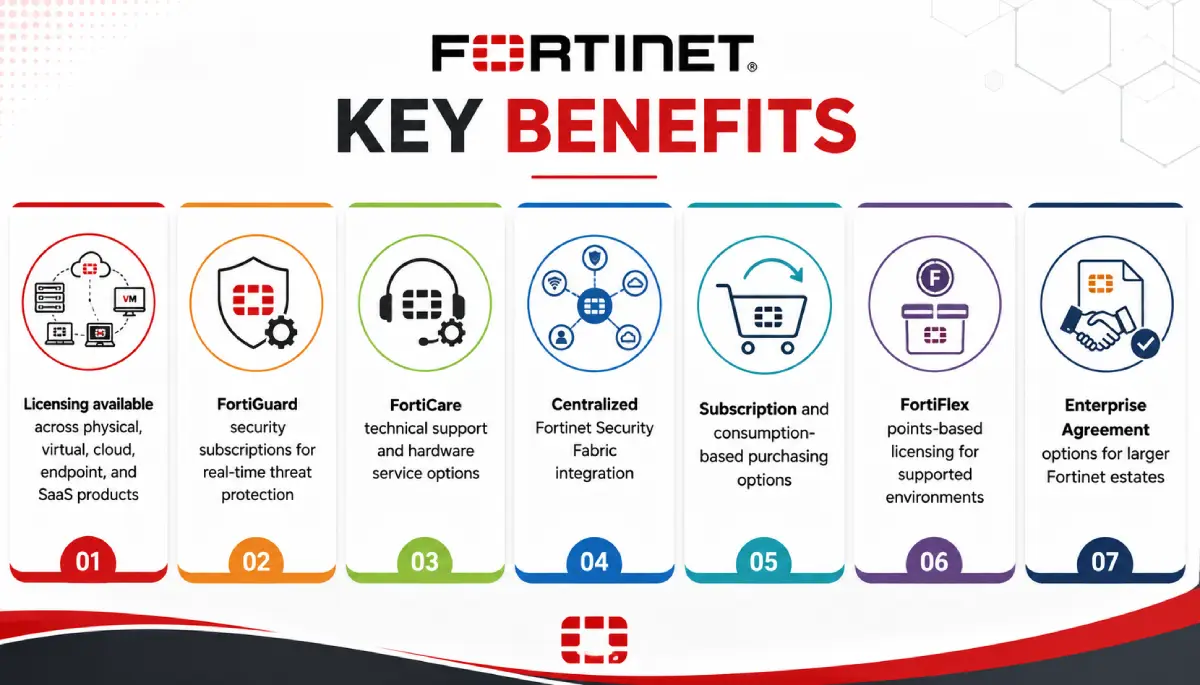
Fortinet Key Benefits
- Licensing available across physical, virtual, cloud, endpoint, and SaaS products
- FortiGuard security subscriptions for real-time threat protection
- FortiCare technical support and hardware service options
- Centralized Fortinet Security Fabric integration
- Subscription and consumption-based purchasing options
- FortiFlex points-based licensing for supported environments
- Enterprise Agreement options for larger Fortinet estates
- Product-specific licensing for endpoints, devices, users, capacity, and security services
- Support for branch, campus, data center, cloud, SOC, and remote-user environments
Fortinet License At a Glance
License Category: Security License
Primary ecosystem: Fortinet Security Fabric
Main licensing areas: Hardware, virtual appliances, subscriptions, security services, support, SaaS, endpoint/user licensing, and consumption-based licensing
Security services: FortiGuard AI-Powered Security Services
Technical support: FortiCare
Flexible consumption option: FortiFlex
Typical products: FortiGate, FortiManager, FortiAnalyzer, FortiClient, FortiWeb, FortiMail, FortiNAC, FortiEDR, FortiSIEM, FortiSOAR, FortiPAM, FortiSASE, FortiSwitch, and FortiAP
Fortinet License Overview
There is no single Fortinet licensing rule that applies to every product.
For a physical FortiGate, for example, the appliance can be combined with FortiGuard services and FortiCare support. A virtual Fortinet product may instead be licensed according to virtual resources or a defined subscription model. Endpoint and cloud products can introduce user, endpoint, workload, storage, or service-capacity considerations.
This is why the product should be identified before discussing price.
Fortinet also separates security services from technical support. FortiGuard provides threat-protection services, while FortiCare provides support services such as technical assistance, firmware access, and eligible hardware replacement options. Current FortiCare service levels include Essential, Premium, and Elite with different response and RMA conditions.
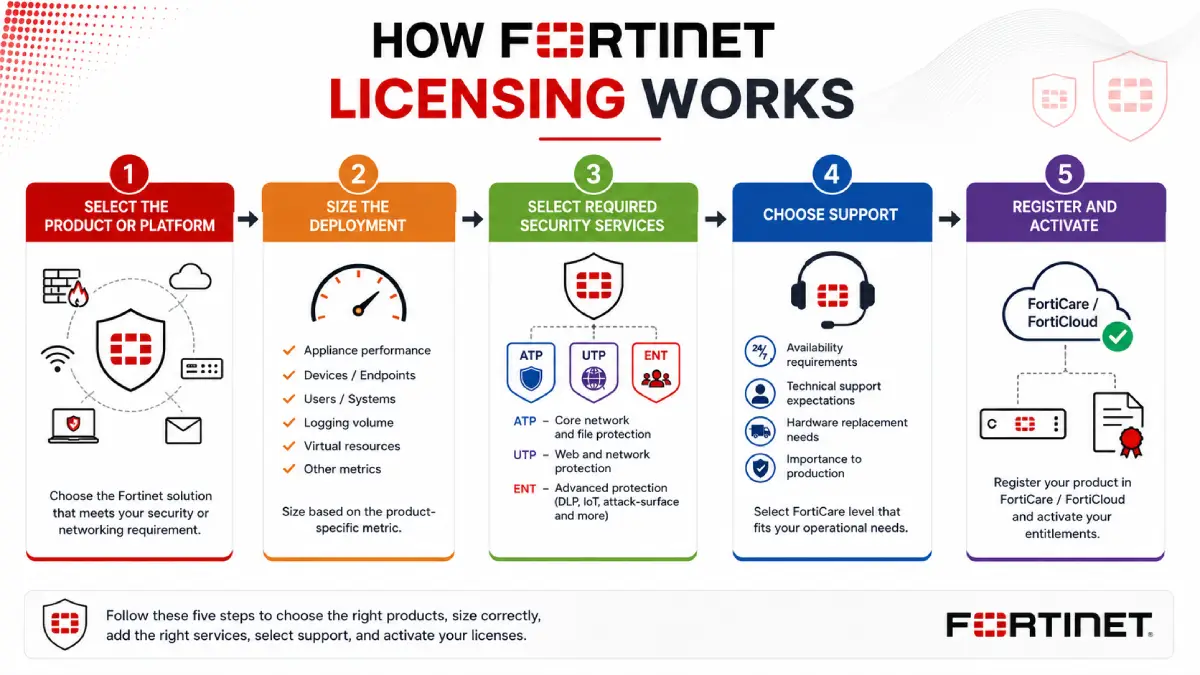
How Fortinet Licensing Works
A typical Fortinet deployment can be viewed in several layers.
1. Select the product or platform
Start with the actual security or networking requirement: firewall, endpoint security, WAF, email protection, centralized management, SIEM, NAC, PAM, SASE, wireless, switching, or another Fortinet solution.
2. Size the deployment
The sizing metric depends on the product. This could involve appliance performance, number of devices, endpoints, users, managed systems, logging volume, virtual resources, or another product-specific metric.
3. Select required security services
FortiGate customers, for example, can purchase FortiGuard services individually or through current ATP, UTP, and Enterprise Protection (ENT) bundles. ATP provides foundational network/file protection; UTP adds broader web and network protection; ENT adds services such as DLP, IoT visibility, attack-surface capabilities, and additional advanced protection.
4. Choose support
FortiCare should be selected according to availability requirements, technical support expectations, hardware replacement needs, and the importance of the system to production operations.
5. Register and activate
Fortinet products and entitlements are normally associated with a FortiCare/FortiCloud account. Fortinet’s current FortiOS documentation states that a FortiCare/FortiCloud account is required for product registration.
Main Fortinet Product Families
| Fortinet category | Primary role | Key licensing consideration |
|---|---|---|
| FortiGate License | NGFW, SD-WAN, network security | Appliance/VM + FortiGuard + FortiCare |
| FortiManager License | Centralized network/security management | Managed estate and deployment model |
| FortiAnalyzer License | Logging, analytics, SOC visibility | Logging/device capacity and platform |
| FortiClient License | Endpoint, VPN and ZTNA | Endpoint/user requirements |
| FortiWeb License | Web Application Firewall | Deployment and protected application requirements |
| FortiMail License | Email security | Deployment type and protected mail environment |
| FortiNAC License | Network Access Control | Endpoint/device scale and required capabilities |
| FortiEDR License | Endpoint detection and response | Endpoint quantity and service tier |
| FortiSIEM License | SIEM and event monitoring | Event/logging and infrastructure scale |
| FortiSOAR License | SOC orchestration and automation | SOC deployment and automation requirements |
| FortiSandbox License | Malware analysis | Capacity and deployment architecture |
| FortiPAM License | Privileged access management | Users/accounts/assets being protected |
| FortiAuthenticator License | Identity and authentication | Users and authentication architecture |
| FortiToken License | Multi-factor authentication | Number and type of token users |
| FortiSASE License | Cloud-delivered SASE | User and service requirements |
| FortiSwitch / FortiAP | LAN and WLAN | Hardware family, management, and service requirements |
Fortinet Licensing and Ordering Models
FortiGuard Security Services
FortiGuard is Fortinet’s security-subscription layer. More than 20 security services are integrated across the Fortinet Security Fabric, and services may be sold individually or in bundles depending on the product.
For current FortiGate environments, the main bundled levels are:
- ATP – Advanced Threat Protection
- UTP – Unified Threat Protection
- ENT – Enterprise Protection
The right level should be selected according to the actual security policy rather than automatically choosing the largest bundle.
FortiCare
FortiCare covers the support side of the deployment. Service level affects areas such as TAC access, response targets, firmware access, and hardware-replacement eligibility.
For a production firewall cluster, support requirements may be quite different from those of a lab appliance.
FortiFlex
FortiFlex provides a points-based, usage-oriented licensing model. Fortinet positions it for environments that need to dynamically scale supported security products and services without repeatedly sizing and purchasing fixed entitlements. Points can be used across supported physical, virtual, cloud, and hybrid deployments.
This can be particularly useful where VM instances or security capacity frequently changes.
Enterprise Agreements
Large Fortinet estates can also be covered through Enterprise Agreements. Fortinet offers account-level entitlement approaches designed to reduce individual licensing complexity and accommodate organizational growth.
Features and Benefits
A well-planned Fortinet license design provides more than product activation.
It can simplify renewal management, ensure required threat-intelligence services remain available, align technical support with business-critical systems, and prevent unnecessary spending on services that the environment does not use.
Centralization is another advantage. Products such as FortiManager provide unified management across FortiGate and other FortiOS-based networking infrastructure, while FortiAnalyzer consolidates security and network telemetry for analysis and response.
The practical benefit is that licensing can be planned around the actual network architecture rather than treated as an isolated SKU exercise.
Compatibility and Requirements
Before ordering a Fortinet License, check:
- Exact Fortinet product and model
- Hardware, VM, cloud, or SaaS deployment
- Software/FortiOS version
- Existing serial number for renewal requests
- Number of devices, users, endpoints, or workloads
- Required FortiGuard services
- FortiCare support level
- HA or cluster design
- Central management requirements
- FortiManager/FortiAnalyzer integration
- License duration
- Cloud marketplace or FortiFlex requirements
- Existing FortiCloud/FortiCare ownership
The sizing inputs should change with the product. Do not quote FortiNAC from firewall throughput, for example, or size FortiAnalyzer only from the number of FortiGates.
Activation and Delivery
Fortinet licenses are typically delivered electronically and associated with the customer’s Fortinet account or registered product. For FortiGate, Fortinet documents product registration through a FortiCare/FortiCloud account, with the registered product then appearing in the customer’s product inventory. Some current FortiGate releases and models also require FortiCare registration during initial setup before full GUI configuration. For renewals, confirm that the serial number and Fortinet account ownership are correct before processing the order. This helps avoid assigning an entitlement to the wrong device or customer account.
Fortinet License Pricing and Quote
There is no useful single price for a Fortinet License because pricing changes significantly according to the product and entitlement.
For an accurate quote, provide:
- Fortinet product name
- Hardware model where applicable
- Required quantity
- New purchase or renewal
- Existing serial number for renewals
- Required subscription/services
- Support level
- Number of users/endpoints/devices where applicable
- Preferred subscription term
- HA requirement
- Virtual or cloud deployment details if relevant
Fortinet pricing depends on your product edition, FortiGate model, security services, license term, deployment model, and support requirements.