

SolarWinds Hybrid Cloud Observability (HCO) helps organizations centralize monitoring, visibility, and performance analysis across hybrid infrastructure, applications, networks, databases, and cloud-connected environments.
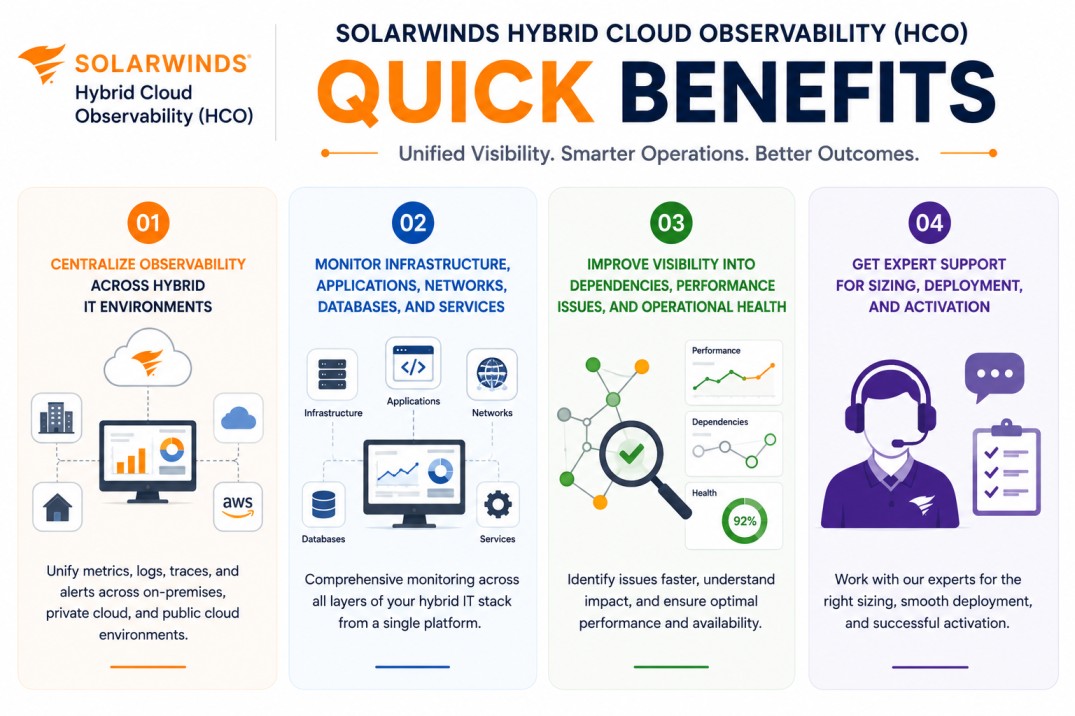
Quick benefits
- Centralize observability across hybrid IT environments
- Monitor infrastructure, applications, networks, databases, and services
- Improve visibility into dependencies, performance issues, and operational health
- Get expert support for sizing, deployment, and activation
SolarWinds Hybrid Cloud Observability (HCO) At a glance
What it does : SolarWinds Hybrid Cloud Observability (HCO) is an observability service bundle that brings together monitoring and visibility capabilities across hybrid infrastructure, applications, cloud services, networks, databases, and operational systems.
License type : Subscription-based, node-focused licensing depending on edition and monitored scope. SolarWinds documentation describes its self-hosted observability licensing as node-based with editions such as Essentials and Advanced tiers.
Typical term : 1 year · 3 years
Activation method : Online activation through SolarWinds License Manager or offline/manual activation using a Machine ID and license activation workflow.
Who needs it : Organizations that need unified observability across hybrid infrastructure, distributed applications, networks, databases, and cloud-connected operational environments.

License Overview
Organizations deploying observability services usually need licensing that reflects monitored infrastructure scope, platform edition, and the level of visibility required across hybrid environments. The SolarWinds Hybrid Cloud Observability (HCO) license is generally aligned with monitored nodes and the selected observability tier. Depending on the environment, this may include servers, network devices, applications, databases, cloud resources, virtual infrastructure, and supporting operational systems. SolarWinds documentation describes SolarWinds Observability Self-Hosted as using node-based licensing with Essentials, Essentials Enterprise, Advanced, and Advanced Enterprise editions.
Because HCO is closer to a service bundle than a single isolated product, licensing should be planned around the complete monitoring environment rather than one tool or one system type. A deployment that includes network monitoring, server visibility, application monitoring, database visibility, and hybrid infrastructure analytics may require broader observability capacity.
A properly aligned license helps organizations avoid monitoring gaps, maintain visibility across infrastructure dependencies, and support long-term observability growth as hybrid environments expand. Some teams may refer to the same observability deployment internally as SolarWinds (HCO) when discussing monitoring architecture, licensing scope, or hybrid visibility planning.
Service Bundle Overview
Hybrid IT environments often include on-prem infrastructure, cloud-connected services, distributed applications, network devices, databases, and virtual systems. When these layers are monitored separately, identifying the real cause of performance issues can become slow and fragmented.
SolarWinds Hybrid Cloud Observability is designed to bring these visibility layers into a more unified observability service bundle. Instead of treating network health, application performance, server monitoring, and database visibility as disconnected areas, HCO helps teams understand how these components interact.
In practice, the platform collects monitoring and telemetry data from multiple parts of the environment, then helps administrators analyze availability, performance, dependency behavior, and operational health from a centralized workflow.
One of the key advantages is cross-domain visibility. IT teams can investigate whether a service issue is related to the network, application, database, server resource, or another supporting component.
For organizations running hybrid or distributed environments, this service-bundle approach helps reduce tool fragmentation and supports more scalable operational monitoring. SolarWinds (HCO) can also be positioned as a broader observability layer for teams that already use SolarWinds monitoring tools.
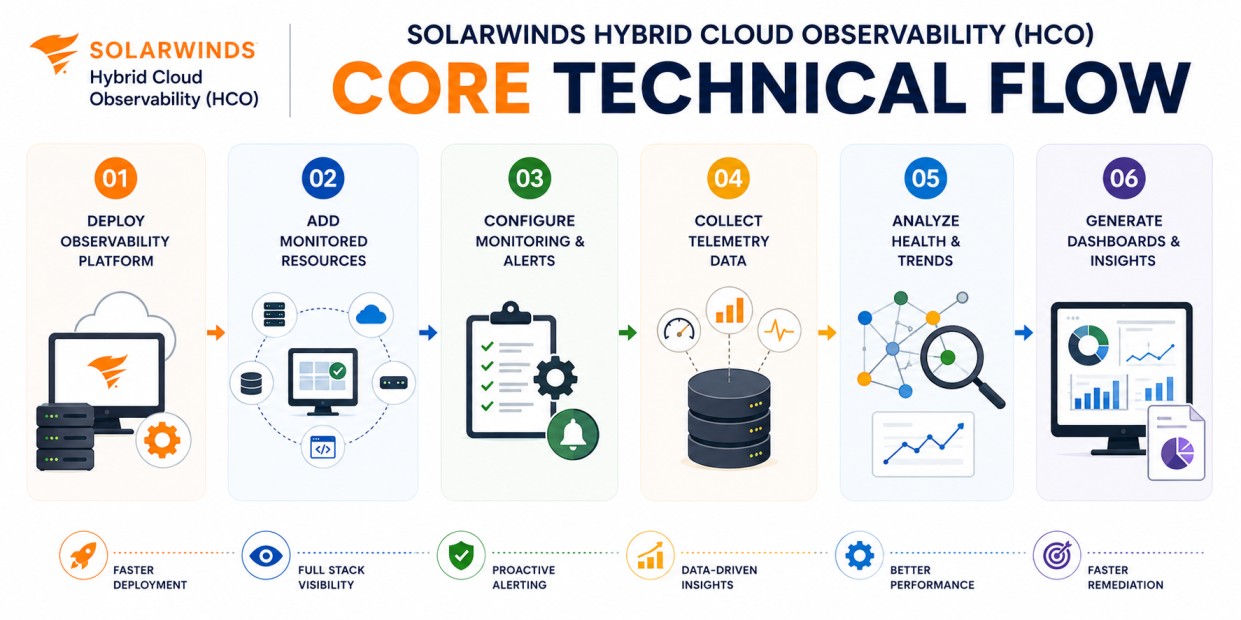
Core technical flow
- Deploy the SolarWinds observability platform and monitoring services
- Add monitored nodes, applications, databases, cloud services, and network devices
- Configure polling, thresholds, alerts, dashboards, and dependency views
- Collect performance, availability, and operational telemetry data
- Analyze infrastructure relationships, service health, and performance trends
- Generate dashboards, reports, and observability insights for remediation
Options & Tiers
| Licensing Model | Best for | Typical Scope | What affects pricing |
|---|---|---|---|
| Essentials tier | Core hybrid monitoring | Foundational infrastructure visibility | Node count |
| Advanced tier | Deeper observability needs | Broader analytics and visibility | Observability scope |
| Enterprise editions | Large environments | Higher-scale monitoring and management | Environment size |
| Subscription licensing | Current HCO deployments | Term-based observability usage | Term and support |
Features & Benefits
As organizations expand across hybrid infrastructure, maintaining clear visibility across applications, servers, networks, databases, and cloud-connected systems becomes increasingly important. SolarWinds Hybrid Cloud Observability helps simplify this challenge by centralizing monitoring and observability workflows into one service bundle.
One of the main benefits is improved operational correlation. Teams can better understand how network performance, application behavior, server health, and database activity affect service delivery. The bundle also supports scalable monitoring operations by helping teams standardize alerts, dashboards, reports, and observability workflows across distributed environments. Over time, this helps reduce troubleshooting delays, improve service reliability, and give IT teams a clearer view of hybrid infrastructure health.
System Requirements
Common environments
- Hybrid infrastructure environments
- Enterprise monitoring and observability platforms
- Cloud-connected applications and services
- Distributed network, server, and database environments
Technical requirements
- Supported SolarWinds deployment infrastructure
- Connectivity to monitored systems and observability sources
- Access to network, application, server, database, and cloud monitoring targets
- Internet access or offline/manual activation support
How activation works
Activating SolarWinds Hybrid Cloud Observability usually starts after the observability platform is installed in the customer environment and the purchased entitlement is ready to be applied. In connected environments, activation is typically completed through the SolarWinds Platform Web Console and License Manager. SolarWinds documentation describes activation for self-hosted observability through Settings > All Settings > License Manager, where the license can be selected and activated.
For restricted or offline environments, the activation process is more controlled. After installation, the system generates a unique Machine ID for that specific deployment. The Machine ID is then used to obtain the correct license activation file, which is imported back into the SolarWinds environment to complete activation without direct internet access. SolarWinds documentation also notes that offline activation starts by copying the Machine ID from License Manager.
This license is typically tied to the specific installed environment and observability module or entitlement. In practical terms, the license file is not a generic file that can be freely reused across unrelated deployments. After activation, the platform validates licensed capacity, such as monitored nodes, enabled observability tier, modules, reporting features, and hybrid monitoring scope. Organizations should review license usage after activation to confirm that SolarWinds (HCO) remains aligned with the purchased entitlement and future monitoring growth.
Pricing factors + quote process
Organizations usually size SolarWinds Hybrid Cloud Observability according to monitored node count, observability tier, infrastructure complexity, and hybrid monitoring requirements.
Environments with distributed infrastructure, cloud services, business-critical applications, databases, and larger network environments may require broader observability capacity and more detailed deployment planning.
Additional considerations, such as edition selection, enterprise scale, reporting needs, high availability requirements, support coverage, and subscription term, can also influence pricing.
During the quote process, monitoring goals, node scope, infrastructure architecture, and observability requirements are reviewed first so the licensing approach can match the organization’s hybrid monitoring strategy more accurately.
After you request a quote
- We review your hybrid observability environment
- Recommend the most suitable HCO licensing model
- Provide official pricing and delivery details
- Share activation and deployment guidance
Pricing depends on your license edition, quantity, term, and deployment needs.