



A Paessler License gives your organization access to PRTG infrastructure monitoring. Selecting the right PRTG license means matching sensor capacity, deployment architecture, and operational responsibilities. GoLicense helps you evaluate Paessler licensing for locally managed networks, distributed enterprise environments, hosted monitoring, and managed services.
Quick Benefits
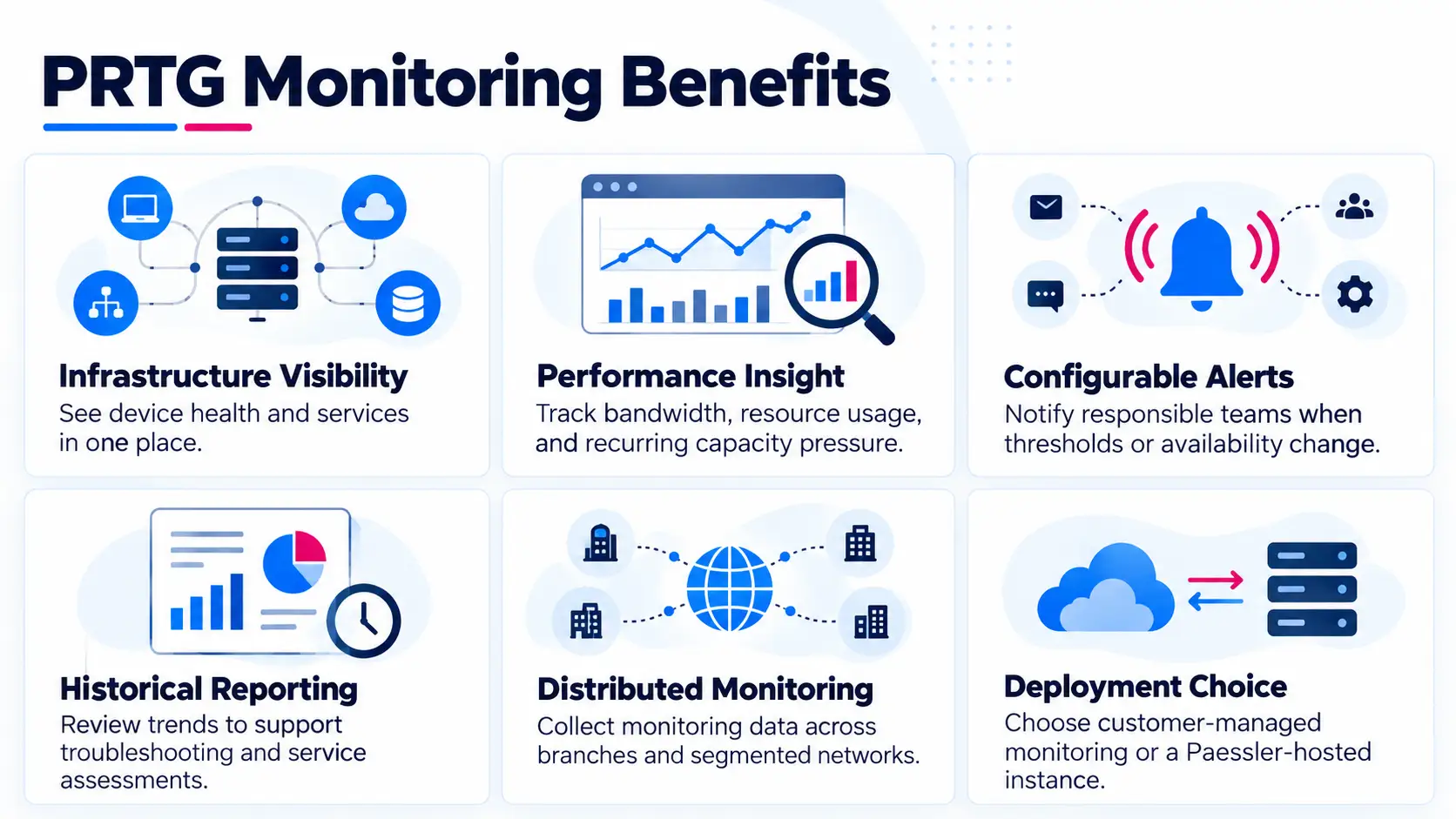
- Monitor network, server, and application health together
- Identify bandwidth pressure and service availability problems
- Configure thresholds, notifications, and escalation workflows
- Extend monitoring across branches through remote probes
- Choose customer-managed or Paessler-hosted deployment
At a Glance
- Vendor: Paessler
- Product family: PRTG
- Parent category: Network License
- Products: Network Monitor, Enterprise Monitor, Hosted Monitor, and MSP Edition
- Commercial model: Subscription, with product-specific terms
- Primary capacity metric: Sensors
- Selection factors: Monitoring scope, sites, hosting, and growth
Features & Benefits
Infrastructure Visibility and Capacity Planning
PRTG collects measurements from network equipment, servers, applications, and infrastructure services. Administrators can examine interface traffic, resource utilization, and availability through dashboards and historical reports. These measurements help distinguish recurring capacity constraints from isolated incidents and support more informed upgrade decisions.
Alerting and Service-Level Monitoring
Configurable limits and notification triggers help teams detect failures and performance degradation. Dependencies can reduce unnecessary alarms when an upstream system becomes unavailable. Reports provide historical context, while Enterprise Monitor adds consolidated visibility and SLA reporting across larger monitoring environments.
Distributed Coverage and Deployment Control
Remote probes collect measurements from branch offices and separated network segments. Customer-managed deployments give administrators control over monitoring servers and data. Hosted Monitor transfers responsibility for hosting the monitoring instance to Paessler, while Enterprise Monitor supports monitoring across multiple PRTG servers.
License Overview
PRTG uses sensors to measure monitoring capacity. A sensor monitors a particular aspect of a device or service, such as interface traffic, processor load, or an HTTP response. One device may therefore require several sensors; device inventory alone does not establish the license size.
New commercial Network Monitor purchases use subscription packages. Existing perpetual licenses require a separate assessment when discussing maintenance, expansion, or migration. Confirm the entitlement being quoted rather than assuming historical purchasing terms apply to a new order.
PRTG Product Family
PRTG Network Monitor is the customer-managed option for organizations that want local control over configuration, monitoring data, and updates. Select it when a conventional on-premises monitoring installation matches the operational scope.
PRTG Enterprise Monitor serves larger, distributed environments using multiple PRTG servers. Centralized oversight and enterprise reporting make it relevant when different sites or administrative boundaries need a consolidated operational view.
PRTG Hosted Monitor provides a monitoring instance hosted by Paessler. It reduces server hosting and maintenance responsibilities. Monitoring private infrastructure still requires a suitable probe and connectivity to the hosted instance.
PRTG MSP Edition addresses managed service providers monitoring customer environments. Evaluate its multi-tenant capabilities and commercial terms against your customer portfolio and service-delivery model.
How Licensing Works
Start with a monitoring inventory that identifies the checks required for each asset. A switch with 24 monitored interfaces plus availability and processor checks consumes more sensors than a switch monitored only for reachability.
Use a pilot to measure actual consumption, then allow capacity for additional interfaces, applications, and sites. Sensor types, polling intervals, and probe placement also affect server workload. License capacity and infrastructure sizing should therefore be assessed together.
Licensing & Deployment Options
Choose the deployment model first, then confirm sensor capacity and the applicable subscription terms.
| Product | Licensing Basis | Deployment | Typical Fit |
|---|---|---|---|
| PRTG Network Monitor | 500, 1,000, 2,500, 5,000, or 10,000 sensor subscription packages | Customer-managed | Local monitoring with administrative control |
| PRTG Enterprise Monitor | Sensor-based enterprise subscription | Multiple customer-managed PRTG servers | Large, distributed monitoring environments |
| PRTG Hosted Monitor | Sensor-based hosted subscription | Paessler-hosted instance with suitable probes | Reduced monitoring-server administration |
| PRTG MSP Edition | MSP-specific commercial terms | Architecture validated for customer monitoring | Managed monitoring services |
Compatibility & Requirements
Customer-managed PRTG core servers require supported Windows systems. Classic remote probes and multi-platform probes differ in operating-system and sensor support. Validate the intended sensor types before choosing probe platforms.
Monitoring can use SNMP, WMI, HTTP, flow technologies, and other supported interfaces. Confirm credentials, firewall rules, polling load, storage, and server resources. Hosted deployments also need connectivity between probes and the hosted instance.
Activation & Deployment
Confirm the product, sensor allowance, customer details, and subscription terms before provisioning. Customer-managed installations require license activation followed by probe configuration, discovery, sensor selection, and notification testing.
For isolated environments, Enterprise Monitor supports offline sublicenses assigned to individual installations. Arrange the required activation data through an approved connected workflow; monitoring servers do not need to be opened to the internet merely to obtain that data.
Pricing & Quote Process
Paessler license pricing depends on product selection, sensor capacity, subscription terms, and separately required extensions. Provide GoLicense with device types, estimated checks, site count, deployment preference, and growth expectations. Identify whether the request covers a new installation, renewal, or expansion so the quotation addresses the correct entitlement.