

ManageEngine ADSelfService helps organizations simplify password management, self-service identity workflows, and authentication operations across Active Directory environments.
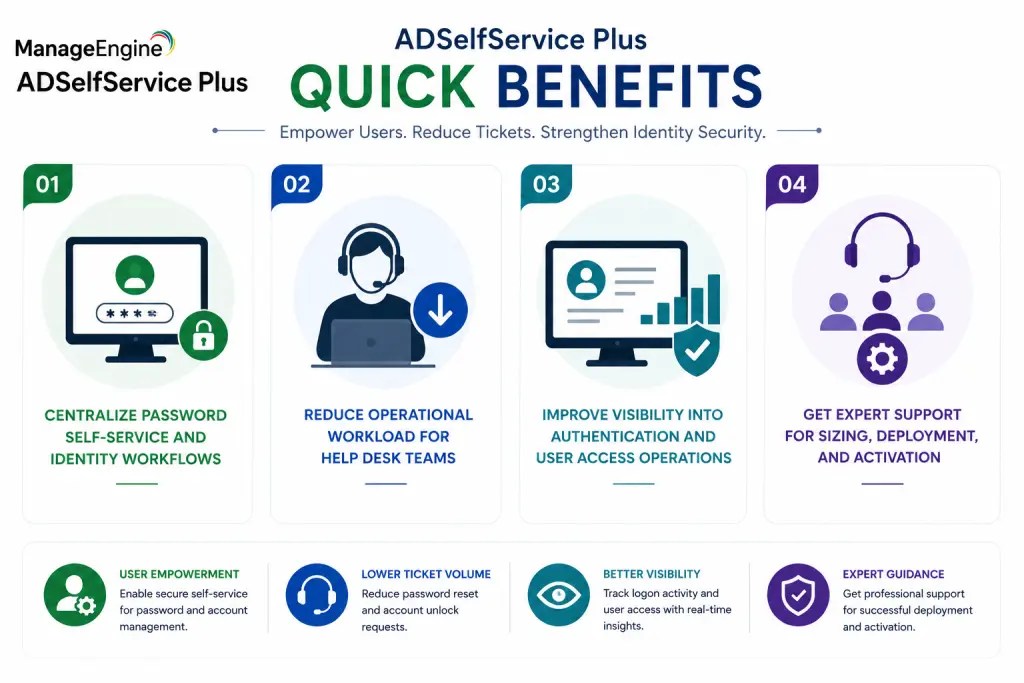
Quick benefits
- Centralize password self-service and identity workflows
- Reduce operational workload for help desk teams
- Improve visibility into authentication and user access operations
- Get expert support for sizing, deployment, and activation
ManageEngine ADSelfService At a glance
What it does : ManageEngine ADSelfService provides self-service password management, account unlock workflows, authentication features, and identity access visibility across enterprise environments.
License type : Subscription or perpetual licensing (user-based)
Typical term : 1 year · 3 years · perpetual options
Activation method : Online activation or offline XML-based activation
Who needs it : Organizations requiring centralized self-service password management and identity workflow visibility across Active Directory environments

License Overview
Organizations implementing self-service identity platforms often require licensing that aligns with managed user scope, authentication workflows, and operational identity requirements rather than basic password administration alone. The ManageEngine ADSelfService license is generally aligned with the number of managed users, enabled authentication features, and operational identity workflows included within the environment.
Because enterprise identity environments commonly operate across distributed teams and remote access scenarios, deployment planning typically focuses on maintaining scalable identity self-service visibility and centralized authentication management operations. A properly aligned license helps organizations simplify password management processes while supporting broader identity access and authentication workflows across enterprise environments.
Product Overview
As enterprise identity environments continue to grow, password management and account access operations can become increasingly difficult to manage consistently across distributed users and operational teams.
Over time, manual password reset processes, fragmented authentication workflows, and limited visibility into account access activity may increase operational overhead and reduce identity management efficiency.
ManageEngine ADSelfService is designed to help organizations reduce these operational challenges through centralized self-service password management and authentication workflows.
In practice, the platform helps users perform password resets, account unlock requests, and identity verification tasks through controlled self-service operations while giving administrators greater visibility into authentication activity.
For organizations operating large or distributed identity environments, this centralized approach supports more scalable authentication operations and improved user access management consistency.
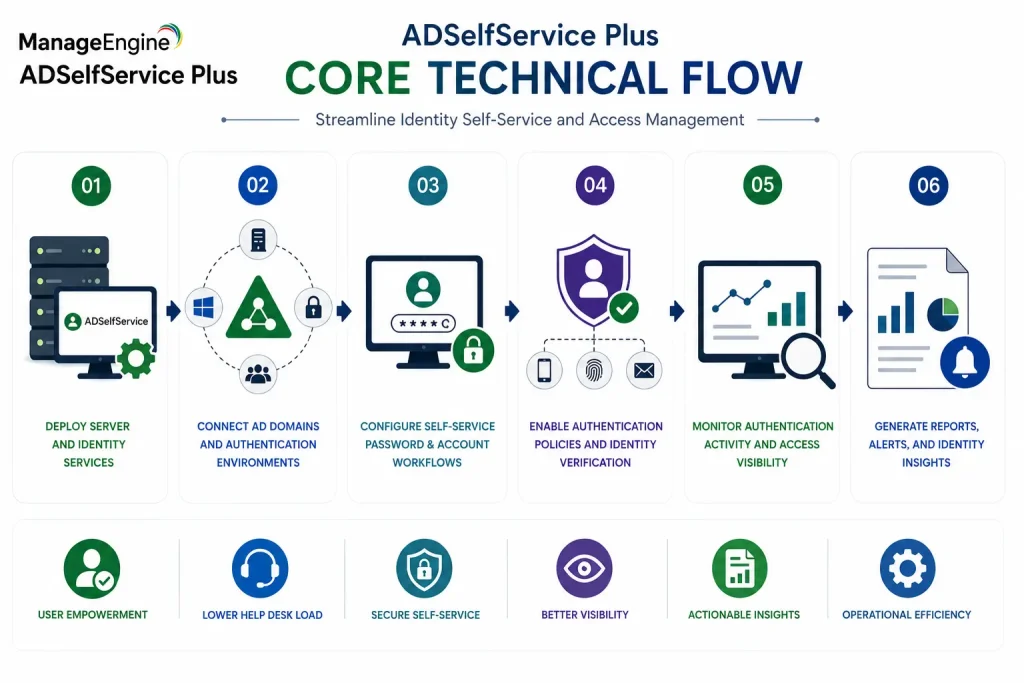
Core technical flow
- Deploy the ADSelfService server and identity services
- Connect Active Directory domains and authentication environments
- Configure self-service password and account workflows
- Enable authentication policies and identity verification methods
- Monitor authentication activity and operational access visibility
- Generate reports, alerts, and identity workflow insights
Options & Tiers
| Licensing Model | Best for | Typical Scope | What affects pricing |
|---|---|---|---|
| Standard edition | Core password self-service | Basic identity workflows | User count |
| Professional edition | Enterprise identity environments | Advanced authentication capabilities | Operational scale |
| Subscription or perpetual | Flexible deployment models | Annual or permanent usage | Term and maintenance |
| MFA-enabled deployment | Security-focused environments | Extended authentication visibility | Authentication scope |
Features & Benefits
As organizations continue to expand across remote users and distributed operational environments, maintaining efficient password management and authentication workflows becomes increasingly important. ManageEngine ADSelfService helps organizations simplify these operations by centralizing password self-service, authentication visibility, and identity workflow management from a unified platform.
One of the major operational advantages is reduced administrative workload. Help desk teams can minimize manual password reset requests while users manage approved self-service identity tasks more efficiently. The platform also supports broader authentication visibility by helping organizations monitor password operations, account access activity, and identity verification workflows across enterprise environments. Over time, this centralized identity management approach helps improve operational efficiency while supporting more scalable authentication and user access operations.
System Requirements
Common environments
- Enterprise Active Directory environments
- Identity and authentication ecosystems
- Remote and distributed user infrastructures
- Centralized user access management environments
Technical requirements
- Supported Windows deployment infrastructure
- Connectivity to Active Directory domains and identity services
- Internet connectivity or offline XML activation support
How activation works
Activating a ManageEngine ADSelfService license typically starts with deploying the ADSelfService server and applying the appropriate license based on the selected edition and managed user capacity. In online environments, activation can generally be completed directly through the administration interface using the provided licensing information.
For restricted or offline environments, ADSelfService also supports XML-based activation workflows. In these scenarios, administrators generate or import an XML file with the customer’s chosen name and deployment details to activate the platform manually without requiring direct internet connectivity.
Depending on the deployment architecture, activation may also validate managed user scope, enabled authentication modules, MFA capabilities, and self-service workflow components. After activation, organizations should review authentication visibility scope and operational identity coverage regularly to ensure that infrastructure growth remains aligned with the licensed identity management environment.
Pricing factors + quote process
Organizations usually size ManageEngine ADSelfService according to managed user count, authentication workflow requirements, and operational identity management scope.
Environments with distributed user infrastructures, broader MFA requirements, or more advanced authentication workflows often require expanded licensing capacity and additional operational capabilities.
Additional considerations—such as edition type, authentication modules, self-service workflow requirements, maintenance coverage, and subscription term—can also influence licensing requirements.
During the quote process, identity management goals, authentication requirements, and operational workflow complexity are typically reviewed first so the licensing and deployment approach can align more accurately with the organization’s user access strategy.
ManageEngine pricing depends on your license edition, users, devices, deployment model, term, and support needs.