

Cisco ASR 1000 Series is a high-performance Cisco aggregation services router family designed for enterprise WAN edge, data center edge, service provider edge, internet aggregation, VPN scale, and SD-WAN headend use cases. Compared with the smaller branch platforms available through the broader Cisco Router License category, Cisco ASR 1000 is selected when the network requires stronger throughput, high availability, advanced services, modular scalability, and reliable edge routing. This page helps buyers understand the Cisco ASR 1000 Series, review licensing and ordering requirements, and move to the related Cisco ASR 1000 part numbers for accurate quote planning.
Series Highlights
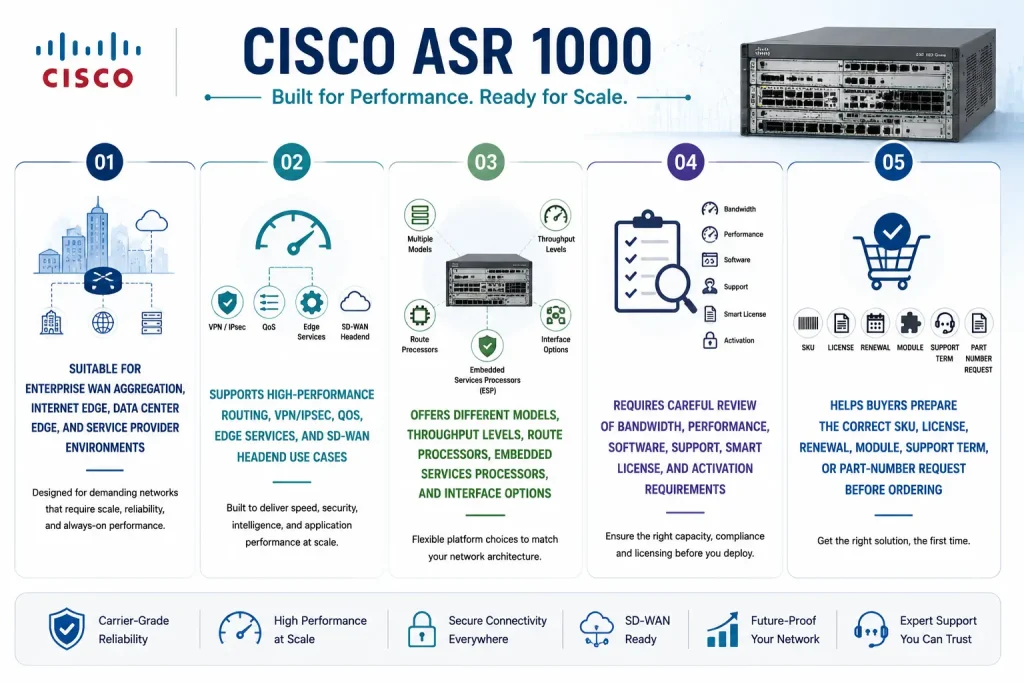
- Suitable for enterprise WAN aggregation, internet edge, data center edge, and service provider environments
- Supports high-performance routing, VPN/IPsec, QoS, edge services, and SD-WAN headend use cases
- Offers different models, throughput levels, route processors, embedded services processors, and interface options
- Requires careful review of bandwidth, performance, software, support, Smart License, and activation requirements
- Helps buyers prepare the correct SKU, license, renewal, module, support term, or part-number request before ordering
Review Cisco ASR 1000 Price List and request a quote tailored to your licensing needs.
Cisco ASR 1000 At a glance
What it is : Cisco ASR 1000 Series is a Cisco aggregation services router family for high-performance edge routing, WAN aggregation, VPN scale, and enterprise or service-edge connectivity.
Product family : Cisco Router ASR
Typical use : WAN edge, internet edge, data center edge, SD-WAN headend, VPN aggregation, high-throughput routing, service provider edge, and large enterprise connectivity.
License or ordering scope : Router model, throughput level, software license, DNA / SD-WAN routing subscription, security or encryption requirement, interface modules, support renewal, Smart License, and activation method.
Who needs it : Organizations using Cisco ASR 1000 routers that need the correct part number, license, bandwidth entitlement, renewal, module, support option, or activation guidance.
Series Overview
Cisco ASR 1000 Series is built for networks where the edge router must handle more than standard branch connectivity. It is commonly deployed in enterprise headquarters, data centers, regional hubs, service provider networks, internet edge locations, and high-scale WAN environments.
In a typical design, Cisco ASR 1000 can sit between enterprise networks and MPLS, internet, cloud, data center, SD-WAN, or service provider infrastructures. It may aggregate multiple sites, terminate VPN tunnels, support encrypted traffic, provide high-throughput routing, and help maintain reliable edge connectivity.
The strength of this series is scalability. Buyers can choose between different chassis models, throughput levels, interface options, route processors, and services processors depending on the size and role of the deployment. Because of that, the correct part number is not only about selecting a router chassis. The required bandwidth, software feature, license model, interface capacity, support term, and activation workflow should all be reviewed before ordering.
Licensing and Part Number Guidance
Choosing the correct part number for Cisco ASR 1000 depends on the exact router model, throughput requirement, interface design, software version, license tier, SD-WAN plan, encryption needs, support coverage, and activation method. Throughput is one of the most important ordering points for Cisco ASR 1000. Some deployments require a specific performance level or bandwidth entitlement based on WAN circuit size, encrypted traffic volume, SD-WAN aggregation, or internet edge demand. If the router is under-licensed for the required throughput, the deployment may not match the expected network performance.
Some environments may also require Cisco DNA or SD-WAN and routing subscriptions, especially when ASR 1000 is used in a Cisco SD-WAN design or managed routing environment. Other requests may involve Classic License history, Smart Licensing, software upgrades, support renewal, or license migration. Part-number selection should also include hardware scope. Route processors, ESP modules, interface cards, optics, power supplies, and redundancy requirements can all affect the final quote.
Common Use Cases
| Use case | Why it matters |
|---|---|
| WAN aggregation | Aggregates traffic from branches, remote sites, data centers, or service locations |
| Internet and data center edge | Supports high-performance routing between internal networks, internet links, and data center services |
| VPN and IPsec scale | Helps terminate encrypted tunnels for enterprise, remote-site, or partner connectivity |
| SD-WAN headend | Supports high-scale SD-WAN aggregation where compatible software and licensing are used |
| Service provider edge | Provides routing scale and edge services for carrier or managed service environments |
| Upgrade, renewal, or replacement | Helps validate chassis, throughput, license, support, and module requirements before ordering |
Models, Licenses, and Ordering Scope
| Area to check | What to confirm |
|---|---|
| Router model | Exact Cisco ASR 1000 model, chassis type, route processor, ESP, and interface requirement |
| Throughput need | Required bandwidth, performance level, encrypted traffic, SD-WAN scale, or internet edge capacity |
| Deployment mode | WAN aggregation, data center edge, internet edge, VPN headend, SD-WAN headend, or service provider edge |
| License type | DNA / SD-WAN routing subscription, throughput license, security feature, support renewal, or Smart License |
| Hardware scope | Interface modules, optics, route processors, ESP modules, power supplies, and redundancy requirements |
| Quantity | Number of routers, sites, headend locations, spare units, or renewal targets |
| Term | 1-year, 3-year, 5-year, renewal, subscription, or support coverage period |
| Activation method | Smart License, SLP, Classic License, PLR License, SLR License, or product-specific workflow where applicable |
| Part number | Correct Cisco ASR 1000 hardware SKU and related license, module, subscription, renewal, or support item |
What to Check Before Requesting a Quote
Before requesting a quote for Cisco ASR 1000, confirm the exact router model, current software version, required throughput, interface requirement, license type, support term, and deployment role.
You should also define whether the router is being used for WAN aggregation, VPN headend, internet edge, SD-WAN headend, data center edge, or service provider edge. Each role can change the ordering requirement because throughput, redundancy, interface density, and software licensing are not always the same.
If the environment is restricted, offline, or compliance-controlled, PLR License or SLR License options should be reviewed where supported before ordering. For upgrade or replacement projects, existing license status and support coverage should also be checked.
Activation and Delivery Notes
After the correct Cisco ASR 1000 part number is selected, activation depends on the software release, license type, and deployment mode. Some environments may use Smart Licensing or Smart Licensing Using Policy. Older deployments may involve Classic License history, license files, or migration review.
For throughput or bandwidth-related licensing, the license status should be validated after activation to confirm that the router is operating at the intended capacity. For SD-WAN or managed routing deployments, subscription status and controller compatibility should also be reviewed before delivery.
For renewal, replacement, or expansion projects, the current license status should be checked before ordering. This helps prevent activation issues and ensures that the router, software, modules, and support coverage match the real network requirement.
Cisco ASR 1000 pricing depends on your router series, license type, deployment model and support requirements.