


ARCON License provides access to enterprise Privileged Access Management (PAM) and identity security solutions designed to control, monitor, and secure privileged access to critical IT infrastructure. ARCON helps organizations manage privileged accounts, credentials, remote connections, administrative sessions, and access policies across servers, databases, network devices, applications, and cloud environments.
The ARCON portfolio addresses different stages of privileged-access security, including credential vaulting, password management, privileged session monitoring, remote access, application access, and privileged identity governance. Depending on the deployment, organizations can use ARCON to implement least-privilege access, centralized credential management, session recording, and controlled administrative workflows.
Quick Benefits
- Privileged Access Management (PAM)
- Centralized privileged credential management
- Password vaulting and rotation
- Secure remote privileged access
- Privileged session monitoring and recording
- Least-privilege access controls
- Just-in-Time privileged access
- Multi-factor authentication integration
- Privileged account discovery
- Third-party and vendor access control
- Application and database access management
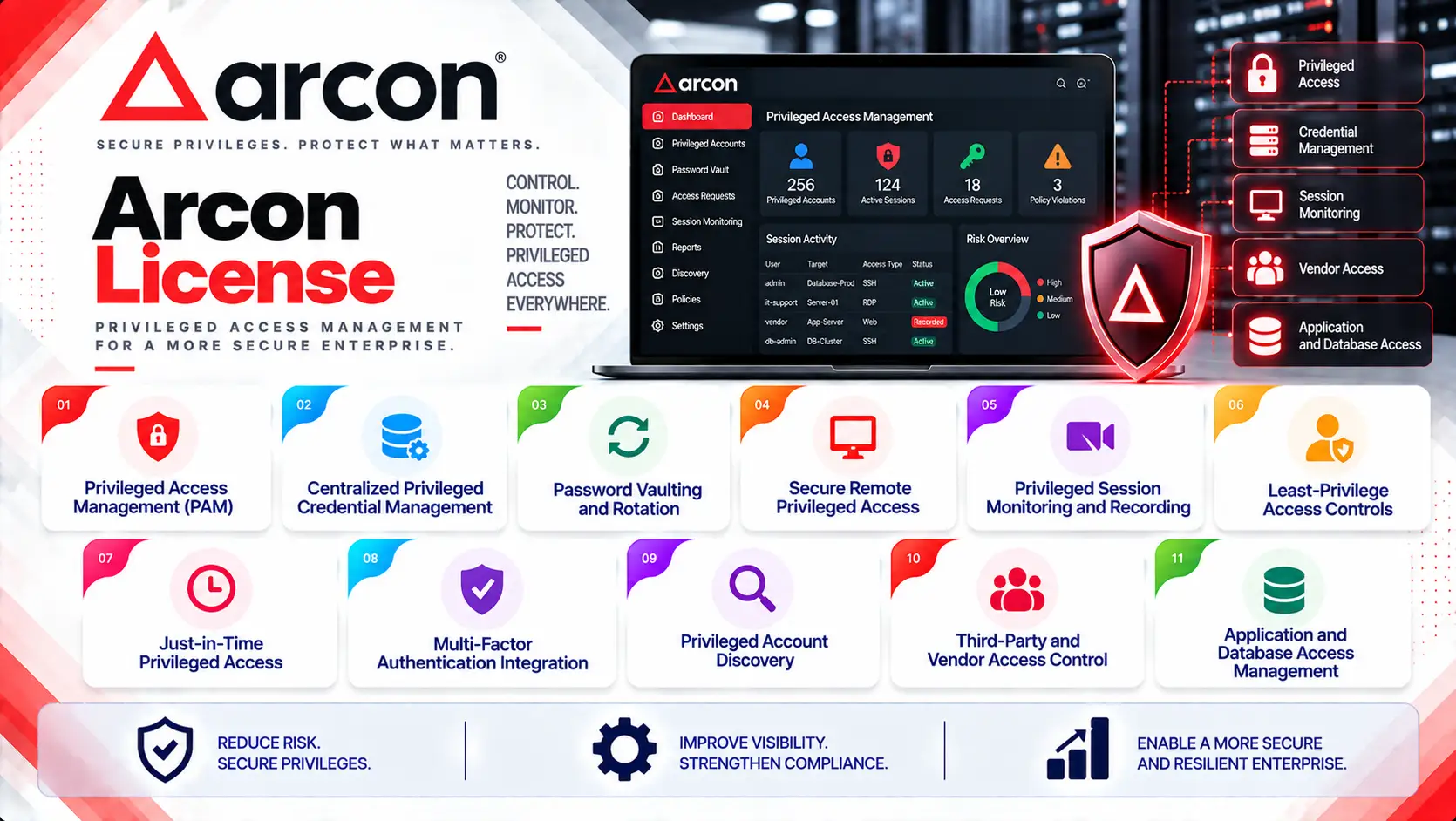
ARCON License At a Glance
What it is: Enterprise Privileged Access Management and identity security platform
Primary role: Secure and manage privileged access to critical systems
Security areas: PAM, privileged identity management, credential security, session management, remote access, and least privilege
Core technologies: Credential vaulting, password rotation, session monitoring, access governance, MFA, and Just-in-Time access
Protected assets: Servers, databases, network devices, applications, endpoints, cloud resources, and privileged accounts
Deployment models: On-premises, private cloud, public cloud, and hybrid environments
Typical users: System administrators, network administrators, database administrators, security teams, vendors, and third-party users
Management: Centralized ARCON PAM administration and reporting
License model: Product and deployment-specific licensing, commonly based on users, assets, privileged accounts, or sessions
Typical environments: Enterprise IT, banking, government, telecommunications, healthcare, manufacturing, and critical infrastructure

License Overview
An ARCON License defines the privileged-access capabilities available to an organization and the scope of systems, identities, and sessions protected by the platform.
ARCON is primarily associated with Privileged Access Management, but PAM itself covers several separate security functions. An organization may need to secure administrator passwords, control remote access, monitor privileged sessions, manage third-party access, or provide application-level privilege controls.
The licensing requirement therefore depends on the ARCON capabilities being deployed.
Important factors may include:
- Number of privileged users
- Number of managed accounts
- Number of servers
- Number of network devices
- Number of databases
- Number of applications
- Concurrent privileged sessions
- Remote-access users
- Third-party users
- Required MFA capabilities
How ARCON Licensing Works
ARCON licensing follows the organization’s privileged-access architecture.
A typical implementation includes:
Privileged Account Discovery
→ Identify administrator accounts, service accounts, and other elevated identities
Credential Protection
→ Store privileged credentials within a controlled vault
Access Request
→ Users request access to authorized systems
Authentication and Authorization
→ Verify identity and enforce access policies
Privileged Session
→ Establish controlled administrative connectivity
Monitoring and Recording
→ Capture session activity and maintain an audit trail
Credential Rotation
→ Change passwords and credentials according to policy
This workflow reduces the reliance on permanently exposed privileged credentials and provides greater visibility into administrative activity.
ARCON Security Portfolio Overview
| ARCON Capability | Primary Purpose |
|---|---|
| Privileged Access Management | Centralize and control privileged access to critical systems |
| Password Vaulting | Secure privileged credentials in a centralized repository |
| Password Management | Automate credential management and rotation |
| Privileged Session Management | Monitor, record, and audit privileged sessions |
| Remote Access | Provide controlled access to servers and infrastructure |
| Third-Party Access | Secure vendor and external administrator access |
| Application Access Management | Control privileged access to applications and resources |
| Database Access Security | Govern privileged database connections |
| MFA Integration | Add additional authentication controls to privileged access |
| Audit and Reporting | Maintain activity records and compliance evidence |
Licensing Options and Models
| Licensing Option | Description | Suitable For |
|---|---|---|
| PAM Subscription | Core privileged-access capabilities for protecting administrative identities and systems | Enterprise PAM deployments |
| Privileged User Licensing | Licensing based on users requiring privileged access | Organizations with defined administrator groups |
| Asset-Based Licensing | Licensing based on servers, network devices, databases, or other protected assets | Infrastructure-focused PAM environments |
| Concurrent Session Licensing | Licensing based on the number of simultaneous privileged sessions | Large administrator and service-desk environments |
| Password Management | Credential vaulting, management, and rotation capabilities | Organizations securing privileged credentials |
| Privileged Session Management | Monitoring and recording of privileged administrative activity | Security operations and compliance teams |
| Third-Party Access Licensing | Controlled privileged access for vendors and external users | Organizations using contractors or service providers |
| Application Access Licensing | Controls privileged access to selected applications and resources | Application and database environments |
| Multi-Year Subscription | Extended licensing coverage for a defined period | Long-term PAM programs |
Features and Benefits
Privileged Credential Management
One of the fundamental PAM requirements is protecting privileged credentials.
ARCON can centralize privileged credentials rather than leaving administrator passwords distributed across spreadsheets, scripts, documentation, or individual systems.
Credential-management workflows can include:
- Password vaulting
- Password rotation
- Credential checkout
- Access approval
- Credential expiration
- Account discovery
This reduces the number of locations where privileged credentials need to be exposed.
Privileged Session Management
Knowing who accessed a system is not always sufficient. Security teams may also need to understand what the administrator actually did.
Privileged Session Management provides visibility into administrative activity and can support:
- Session monitoring
- Session recording
- Command auditing
- User attribution
- Historical investigation
This creates an audit trail that can be used during security investigations and compliance reviews.
Least-Privilege Access
A central objective of PAM is reducing unnecessary administrative privileges.
ARCON can support policies that provide users access only to the systems and resources required for their assigned responsibilities.
This can help reduce exposure caused by:
- Shared administrator accounts
- Permanent elevated privileges
- Excessive access rights
- Uncontrolled remote administration
Just-in-Time Access
Just-in-Time access limits privileged access to the period in which it is actually required. Instead of allowing permanent administrative access, organizations can establish controlled workflows in which access is granted for a defined task or period. This can reduce the attack surface associated with continuously active privileged credentials.
Compatibility and Requirements
Before selecting an ARCON License, organizations should evaluate:
- Number of privileged users
- Number of administrator accounts
- Number of managed servers
- Number of network devices
- Number of databases
- Number of applications
- Number of endpoints
- Concurrent sessions
- Third-party access requirements
- Remote administration requirements
- MFA requirements
- Session recording requirements
- Password rotation requirements
The exact requirements depend on the ARCON products and modules included in the deployment.
Activation and Deployment
A typical ARCON deployment includes:
- Identify privileged accounts and systems
- Define users and administrator roles
- Select required PAM capabilities
- Deploy the management components
- Configure identity integration
- Onboard privileged accounts
- Configure credential vaulting
- Define access policies
- Configure session monitoring
- Enable password rotation
A phased rollout can be useful for larger organizations. Critical infrastructure and high-risk administrator accounts can be onboarded first, followed by less sensitive systems and broader user groups.
Pricing and Quote Process
Pricing for ARCON License depends on the selected PAM capabilities and the scale of the privileged-access environment.
Before requesting a quote, prepare:
- Number of privileged users
- Number of privileged accounts
- Number of servers
- Number of network devices
- Number of databases
- Number of applications
- Expected concurrent sessions
- Number of third-party users
- Remote-access requirements
- Session-recording requirements
- Password-management requirements
For example, an organization protecting 50 privileged administrators and several hundred servers may require a different licensing configuration from an enterprise with thousands of administrators, extensive third-party access, and high concurrent-session volumes. The quote should therefore be based on the actual PAM architecture rather than simply the total number of employees.
Fortinet pricing depends on your product edition, FortiGate model, security services, license term, deployment model, and support requirements.