

Cisco CUC (Cisco Unity Connection) is Cisco’s voicemail and unified messaging platform for managing voice messages, user mailboxes, message access, greetings, notifications, and integration with Cisco Unified Communications environments. Licensing for Cisco CUC follows the collaboration requirements covered across the wider Cisco License portfolio, including the number of voicemail users, enabled features, Unity Connection deployment model, Smart Licensing workflow, support coverage, and requirements for standard voicemail, unified messaging, SpeechView, or related capabilities.
Key Benefits
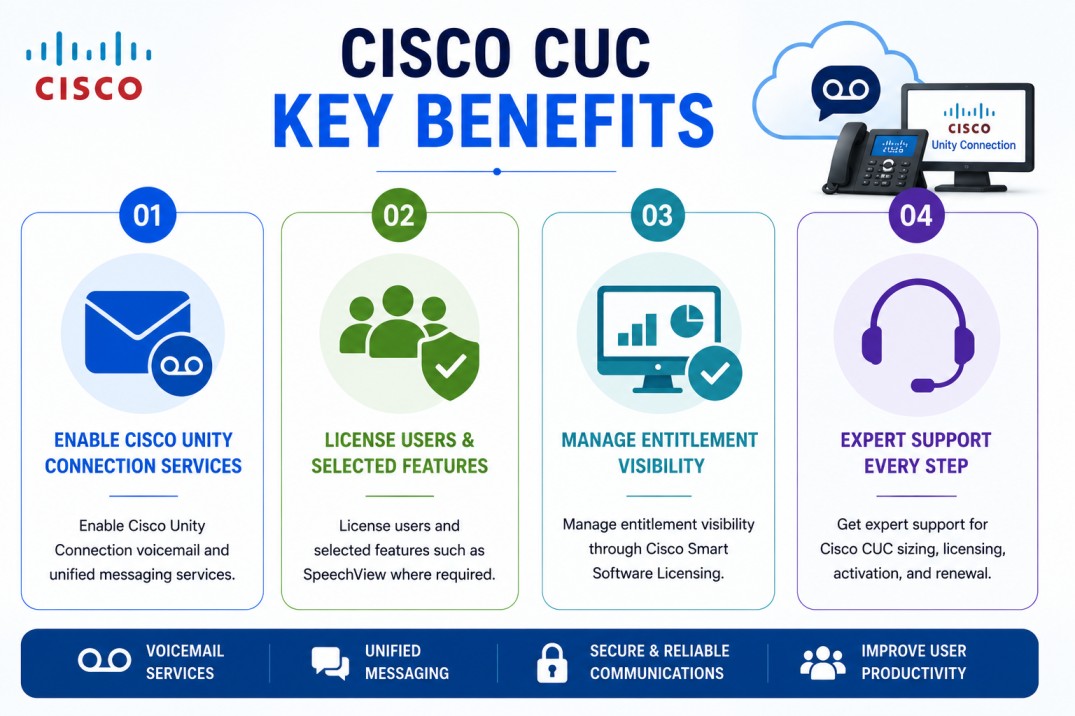
- Enable Cisco Unity Connection voicemail and unified messaging services
- License users and selected features such as SpeechView where required
- Manage entitlement visibility through Cisco Smart Software Licensing
- Get expert support for Cisco CUC sizing, licensing, activation, and renewal
Review Cisco CUC Price List and request a quote tailored to your licensing needs.
Cisco CUC At a glance
What it does : Cisco CUC, formally Cisco Unity Connection, provides voicemail, unified messaging, message access, greetings, notifications, mailbox management, and integration with Cisco Unified Communications Manager and collaboration environments.
Product family : Cisco UC License.
License type : User and feature-based licensing, managed through Cisco Smart Software Licensing. Unity Connection licensing is generally associated with users and optional features such as SpeechView or SpeechView Connect, depending on the deployment.
Typical term : Subscription or entitlement-based depending on the Cisco collaboration purchasing model, support agreement, and active Smart Licensing entitlement.
Activation method : Cisco Smart Software Licensing through Cisco Smart Software Manager, Cisco Smart Account, Virtual Account, or Cisco Smart Software Manager satellite for controlled environments.
Who needs it : Organizations that need enterprise voicemail, unified messaging, user mailbox services, message notification, call handler workflows, CUCM integration, and centralized voice messaging administration.

License Overview
Organizations deploying Cisco CUC usually need licensing that reflects the real voicemail and messaging scope of the environment. This includes voicemail users, mailbox requirements, feature usage, integration needs, and the selected Cisco collaboration licensing model.
The Cisco CUC License is commonly planned around user entitlement and feature requirements. In many environments, Unity Connection is deployed alongside Cisco Unified Communications Manager to provide voicemail and messaging services for enterprise users, shared lines, departments, and communication workflows.
Because Cisco CUC environments may include standard voicemail users, call handlers, notification features, unified messaging access, SpeechView-related services, and integration with Microsoft email environments, licensing should be planned around actual user and feature consumption rather than only server count.
Smart Licensing is also important for newer Cisco Unity Connection deployments. It helps administrators view license ownership and consumption through Cisco licensing tools, making it easier to validate whether the deployment remains aligned with the purchased entitlement.
A properly aligned license helps organizations avoid mailbox entitlement gaps, maintain voicemail availability, support user growth, and keep Cisco CUC services aligned with the broader Cisco UC environment.
Product Overview
Voicemail and messaging remain important parts of enterprise communication, especially in environments where missed calls, user greetings, department mailboxes, and message access need to be managed consistently.
Cisco CUC is designed to provide centralized voicemail and unified messaging services for Cisco collaboration environments.
In practice, administrators use Cisco Unity Connection to manage users, mailboxes, greetings, call handlers, message notification settings, voicemail access, and integration with Cisco Unified Communications Manager. This allows voice messaging to operate as part of the wider Cisco UC architecture rather than as a disconnected voicemail system.
One of the main operational advantages is centralized message control. Teams can manage voicemail policies, user access, system greetings, message routing, and notification behavior from a dedicated Unity Connection administration environment.
For organizations using Cisco CUCM, Cisco CUC adds the voicemail and messaging layer needed to complete the enterprise calling experience.
Core technical flow
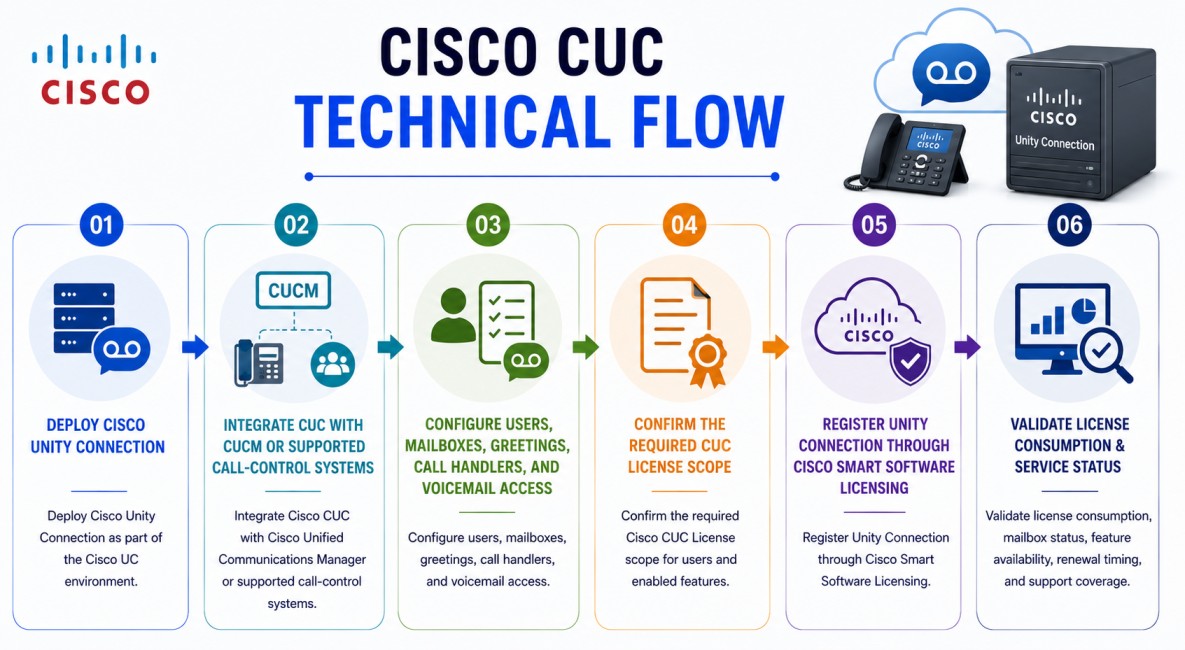
- Deploy Cisco Unity Connection as part of the Cisco UC environment
- Integrate Cisco CUC with Cisco Unified Communications Manager or supported call-control systems
- Configure users, mailboxes, greetings, call handlers, and voicemail access
- Confirm the required Cisco CUC License scope for users and enabled features
- Register Unity Connection through Cisco Smart Software Licensing
- Validate license consumption, mailbox status, feature availability, renewal timing, and support coverage
Options & Licensing Models
| Licensing Model | Best for | Typical Scope | What affects pricing |
| User-based voicemail licensing | Standard Cisco CUC deployments | Voicemail and mailbox access for users | Number of users/mailboxes |
| Feature licensing | Advanced messaging features | SpeechView, SpeechView Connect, or selected feature access | Feature requirement |
| Smart Licensing | Modern Unity Connection environments | Ownership and consumption visibility | Smart Account and deployment model |
| Satellite / controlled licensing | Restricted environments | Local license communication through satellite workflow | Connectivity and security model |
| Collaboration entitlement model | Broader Cisco UC environments | CUCM, Unity Connection, Webex, and collaboration services | User scope and service package |
Features & Benefits
As communication environments grow across offices, branches, hybrid teams, and shared departments, voicemail and message access need to remain simple, reliable, and easy to manage. Cisco CUC helps organizations centralize voicemail services so users can access voice messages, manage greetings, receive notifications, and stay connected when calls are missed or redirected.
One major benefit is user continuity. Cisco Unity Connection gives users a structured voicemail and messaging experience that works alongside Cisco Unified Communications Manager and broader Cisco UC services. Another benefit is administrative control. IT teams can manage users, mailboxes, call handlers, greetings, notifications, and voicemail behavior from a central platform instead of relying on separate voicemail systems.
The platform can also support unified messaging workflows depending on the deployment design, helping users access voice messages through more flexible communication channels. Over time, Cisco CUC licensing helps organizations keep voicemail services aligned with user growth, collaboration needs, support requirements, and renewal planning.
System Requirements
Common environments
- Cisco Unified Communications Manager deployments
- Cisco Unity Connection voicemail environments
- Enterprise IP telephony and Cisco UC architectures
- On-premises and controlled collaboration environments
- Unified messaging and voicemail access workflows
Technical requirements
- Supported Cisco Unity Connection version
- Integration with Cisco Unified Communications Manager or supported call-control platform
- Cisco Smart Account and Virtual Account access where applicable
- Smart Licensing, CSSM, or Cisco Smart Software Manager satellite workflow
- User, mailbox, feature, and support entitlement planning
How activation works
Activating Cisco CUC licensing usually starts after Cisco Unity Connection is installed and the required Smart Licensing entitlement is available in the correct Cisco Smart Account and Virtual Account.
In modern deployments, Unity Connection uses Cisco Smart Software Licensing to manage license ownership and consumption. The deployment must communicate with Cisco Smart Software Manager or Cisco Smart Software Manager satellite so license usage can be validated and managed correctly.
After a fresh installation, Unity Connection may operate in evaluation mode for a limited period. During this time, administrators should complete Smart Licensing registration and confirm that the purchased entitlement covers the required users and features.
For controlled environments, Cisco Smart Software Manager satellite may be used when direct communication with Cisco cloud licensing services is not allowed or not preferred. In this model, Unity Connection communicates with the local licensing system instead of connecting directly to CSSM.
After activation, administrators should review license status, user consumption, enabled features, mailbox configuration, and renewal timing to ensure the Cisco CUC License remains aligned with the active voicemail environment.
Pricing factors + quote process
Pricing for Cisco CUC usually depends on voicemail user count, mailbox requirements, selected features, deployment model, support coverage, and the broader Cisco UC licensing structure.
A simple voicemail deployment may only require standard user mailbox licensing, while a more advanced deployment may include unified messaging requirements, SpeechView-related features, larger mailbox scale, or controlled licensing workflows.
Additional considerations such as CUCM integration, migration from older Unity Connection versions, Smart Licensing status, support level, and renewal timing can also influence the final quote.
During the quote process, the Cisco CUC environment, user count, mailbox scope, feature requirements, and activation model are reviewed first so the licensing approach can match the organization’s voice messaging strategy more accurately.
After you request a quote
- We review your Cisco CUC deployment and voicemail user scope
- Identify the right Cisco CUC License and feature entitlement
- Validate Smart Licensing, support, and renewal requirements
- Provide official pricing, delivery details, and activation guidance
Cisco CUC pricing depends on your license type, deployment model and support requirements.