

BIG-IP 5000 Series is a legacy F5 BIG-IP Standard Series application delivery platform designed for enterprise environments requiring reliable traffic management, application availability, SSL/TLS acceleration, and integrated BIG-IP services. The family includes BIG-IP 5200 and BIG-IP 5250 models, providing a higher-performance option compared with the BIG-IP 4000 Series. These appliances were commonly deployed as enterprise ADC platforms where organizations needed more capacity for application traffic, encrypted connections, and multiple BIG-IP modules running on the same system.
Series Highlights
- Legacy F5 BIG-IP Standard Series hardware family
- Includes BIG-IP 5200 and BIG-IP 5250 models
- Enterprise application delivery platform
- 2RU rack-mount design
- Designed for medium and large application environments
- Supports BIG-IP TMOS architecture
- High-speed network connectivity options
- Hardware-assisted SSL/TLS acceleration
- Application load balancing and traffic management capabilities
Review BIG-IP 5000 Series Price List and request a quote tailored to your licensing needs.
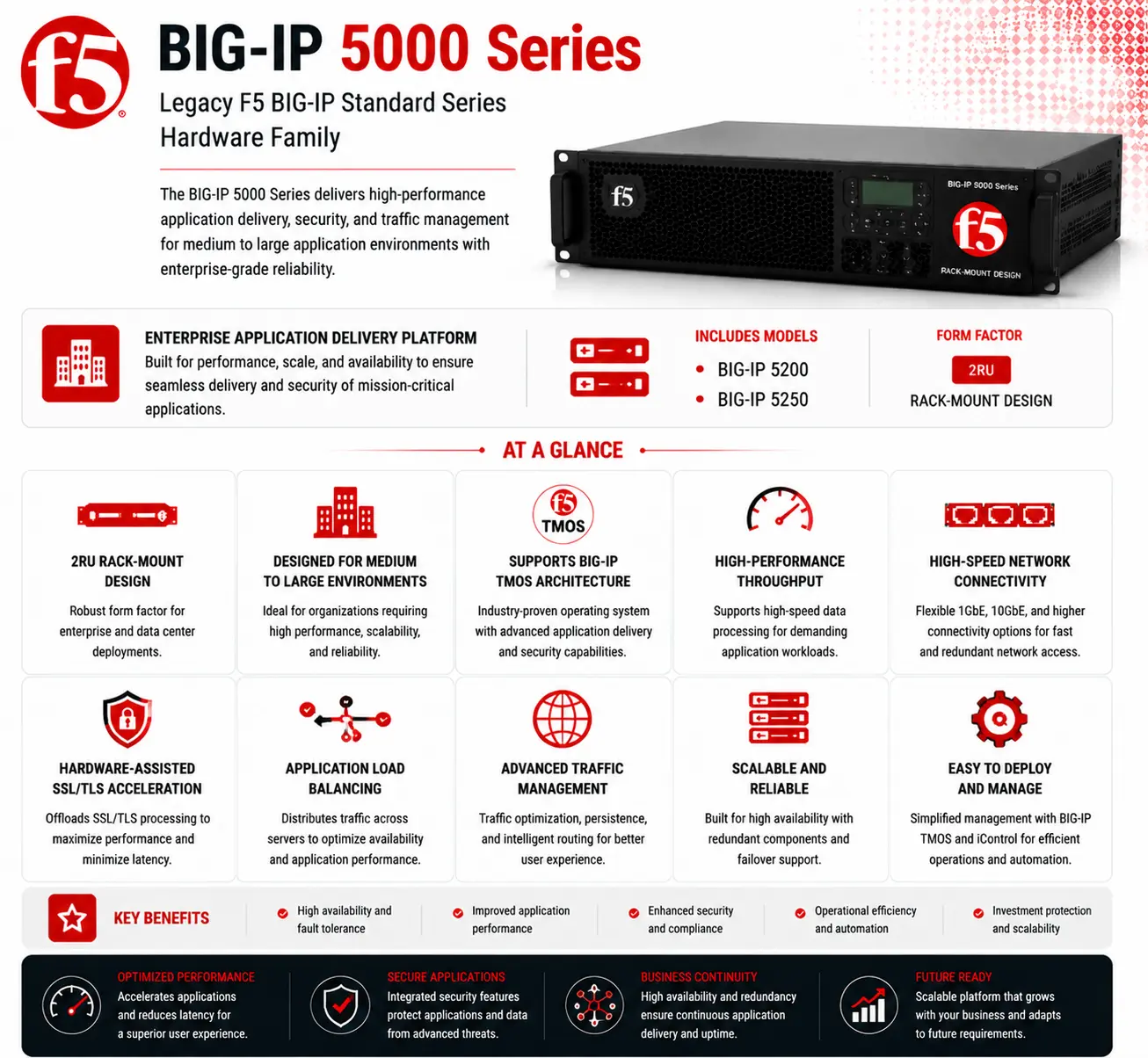
BIG-IP 5000 Series At a glance
What it is: Enterprise F5 physical application delivery platform
Product family: BIG-IP Standard Series
Models: BIG-IP 5200 and BIG-IP 5250
Software architecture: BIG-IP TMOS
Deployment type: Physical ADC appliance
Form factor: 2RU rack-mount
Typical role: Application load balancing, SSL/TLS offload, application availability, security services, and traffic management
Series Overview
The BIG-IP 5000 Series was introduced as a higher-capacity Standard Series platform for organizations that required more performance than smaller BIG-IP appliance families could provide.
The platform focused on enterprise application delivery requirements, including:
- Application load balancing
- SSL/TLS traffic processing
- Application health monitoring
- Secure application access
- Traffic optimization
- Centralized ADC management
The family includes two main models:
| Model | Position |
|---|---|
| BIG-IP 5200 | Standard enterprise performance model |
| BIG-IP 5250 | Higher-performance configuration |
Both models were designed around the same general appliance generation, while the 5250 provided additional processing capacity for larger workloads.
The BIG-IP 5000 Series was commonly deployed in organizations that needed a dedicated ADC platform but did not require the scale of higher-end chassis systems. It provided a balance between enterprise features and hardware capacity.
Licensing and Part Number Guidance
BIG-IP 5000 Series part numbers include more than the hardware appliance reference. A complete configuration may include the BIG-IP License entitlement, enabled modules, support services, and accessories.
- Hardware model
- BIG-IP software license
- Enabled modules
- Support services
- Accessories
The exact license configuration depends on the role of the appliance.
For example:
- LTM-focused deployments require traffic management capabilities.
- DNS deployments require appropriate global traffic management features.
- Security-focused deployments may require additional BIG-IP modules.
- Access environments may require APM licensing.
Before requesting a quote, confirm:
- Exact model (5200 or 5250)
- Existing BIG-IP license
- Enabled modules
- Current TMOS version
- Support status
- Traffic profile
- SSL/TLS workload
For existing installations, the license information is often more important than the physical appliance name because the same hardware family could support different service combinations.
Common Use Cases
| Use case | Typical BIG-IP 5000 Series role |
|---|---|
| Enterprise load balancing | Application traffic distribution |
| SSL/TLS offload | Encryption workload reduction |
| Web application delivery | Front-end application availability |
| Secure access | User and application connectivity |
| Data center ADC | Central traffic management layer |
| Application optimization | Traffic control and health monitoring |
| HA deployment | Active/standby ADC architecture |
| Hardware refresh | Migration toward newer F5 platforms |
Models, Licenses, and Ordering Scope
| Area | What to confirm |
|---|---|
| Model | BIG-IP 5200 or BIG-IP 5250 |
| Platform family | BIG-IP Standard Series |
| BIG-IP services | LTM, DNS, APM, security modules |
| Performance | Throughput, connections, SSL requirements |
| Software | TMOS compatibility |
| Network connectivity | Current interface requirements |
| Deployment | Standalone or HA pair |
| Support | Renewal or replacement requirements |
| Migration | Future platform strategy |
| Part numbers | Hardware, licenses, support, accessories |
What to Check Before Requesting a Quote
Before requesting pricing for a BIG-IP 5000 Series system, review the current environment instead of selecting a replacement based only on appliance naming.
Important information includes:
- Current hardware model
- Active BIG-IP modules
- Number of applications
- Traffic volume
- SSL/TLS requirements
- Connection capacity
- HA configuration
- Expected future growth
A common mistake during ADC replacement is assuming that a newer platform can be selected through direct model matching. F5 platforms have evolved significantly, especially with newer iSeries and rSeries architectures.
For migration projects, evaluate:
- Existing configuration complexity
- Application dependencies
- License transfer requirements
- Software compatibility
- Maintenance window
- Rollback planning
Activation and Delivery Notes
BIG-IP 5000 Series appliances use the traditional F5 TMOS architecture.
The deployment workflow typically includes:
- Hardware installation
- License activation
- Module provisioning
- Network configuration
- Application policy deployment
- High availability validation
For redundant deployments, both systems should maintain compatible:
- Software versions
- License configuration
- Provisioning settings
- Network design
Before delivery or replacement, verify:
- Appliance model
- Required BIG-IP modules
- Support coverage
- Network requirements
- Migration approach
F5 pricing depends on your product edition, license type, deployment model, traffic needs, term, and support requirements.