

Cisco CUCM is the core call-control platform used to manage enterprise voice, IP telephony, users, devices, dial plans, call routing, and collaboration services across Cisco Unified Communications environments. The Cisco CUCM License is usually planned around user requirements, device count, calling features, deployment model, Collaboration Flex Plan entitlement, Smart Account structure, support coverage, and renewal term.
Key Benefits
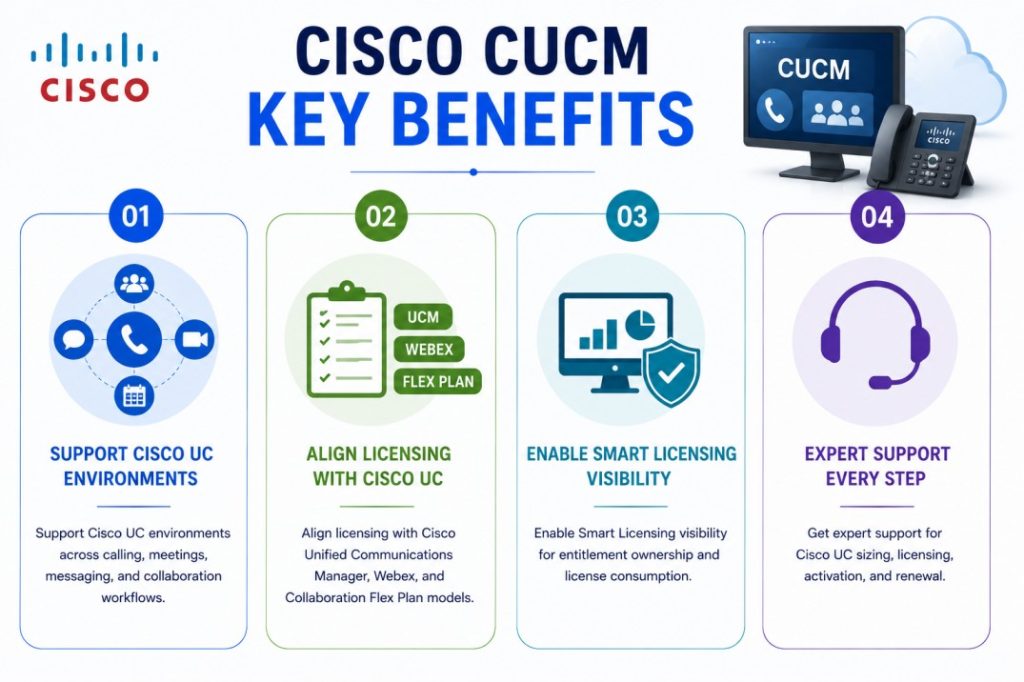
- Centralize enterprise call control for users, phones, devices, and voice services
- Support Cisco Unified Communications Manager licensing through modern Flex Plan models
- Use Cisco Smart Licensing for license ownership and consumption visibility
- Get expert support for Cisco CUCM sizing, licensing, activation, and renewal
Review Cisco CUCM Price List and request a quote tailored to your licensing needs.
Cisco CUCM At a glance
What it does : Cisco CUCM, formally Cisco Unified Communications Manager, provides centralized call processing, IP phone registration, user and device management, dial plan control, call routing, voicemail integration, SIP trunking, and collaboration service support for enterprise UC environments.
Product family : Cisco UC License.
License type : Modern Cisco CUCM licensing is generally handled through Cisco Collaboration Flex Plan 3.0 and Smart Licensing. Cisco documentation states that Cisco Unified Communications Manager software and user licenses are available through Collaboration Flex Plan 3.0, with ordering options such as A-Flex-3 and related Flex models.
Typical term : Subscription-based under modern Cisco collaboration purchasing. Cisco Collaboration Flex Plan 3.0 provides flexible subscriptions for collaboration products, including Cisco Unified Communications Manager, Webex Calling and Meetings, and Webex Suite options.
Activation method : Cisco Smart Software Licensing through Cisco Smart Account, Virtual Account, and Cisco Smart Software Manager workflows. Cisco describes Smart Software Licensing as a model that simplifies licensing across the enterprise and gives visibility into license ownership and consumption.
Who needs it : Organizations that need on-premises or hybrid enterprise calling, IP telephony, call routing, desk phones, soft clients, SIP trunks, voicemail integration, contact center integration, and centralized voice management.

License Overview
Organizations deploying Cisco CUCM usually need licensing that reflects the real communication environment, including users, devices, phones, soft clients, shared endpoints, calling features, and collaboration services.
Within the broader Cisco License portfolio, the Cisco CUCM License is commonly aligned with Cisco Collaboration Flex Plan licensing and Cisco Smart Licensing. In current Cisco documentation for CUCM Release 15, Cisco notes that Cisco Unified Communications Manager software and user licenses are available through Collaboration Flex Plan 3.0, and that Flex Plan 3.0 offers Enterprise Agreement and Named User buying models.
Because CUCM environments may include desk phones, Jabber or soft clients, shared phones, conference rooms, SIP trunks, voicemail, IM and Presence, and hybrid Webex services, licensing should be planned around actual communication usage rather than only server count.
For newer Cisco collaboration environments, legacy licensing should also be reviewed carefully. Cisco documentation notes that older perpetual license types should transition to On-Premises or Partner Hosted Smart Licensing under Collaboration Flex Plan 3.0, and that older Enhanced and Enhanced Plus license types are no longer valid under Flex Plan 3.0. A properly aligned license helps organizations avoid user entitlement gaps, maintain call-control availability, simplify renewal planning, and keep Cisco CUCM usage aligned with the active collaboration subscription.
Product Overview
Enterprise voice environments become harder to manage when phones, users, SIP trunks, routing patterns, voicemail systems, and collaboration services are handled through disconnected systems.
Cisco CUCM is designed to centralize call control and communication management across Cisco Unified Communications environments.
In practice, administrators use CUCM to manage users, register phones and soft clients, build dial plans, configure call routing, control calling privileges, integrate voicemail, and support collaboration workflows across the organization.
One of the main operational advantages is centralized voice governance. Instead of managing calling behavior separately for each site or device type, teams can control user access, phone registration, route patterns, calling search spaces, partitions, and device behavior from a unified platform.
For organizations that depend on reliable enterprise telephony, Cisco CUCM provides the call-control foundation for stable, scalable, and manageable voice operations.
Core technical flow
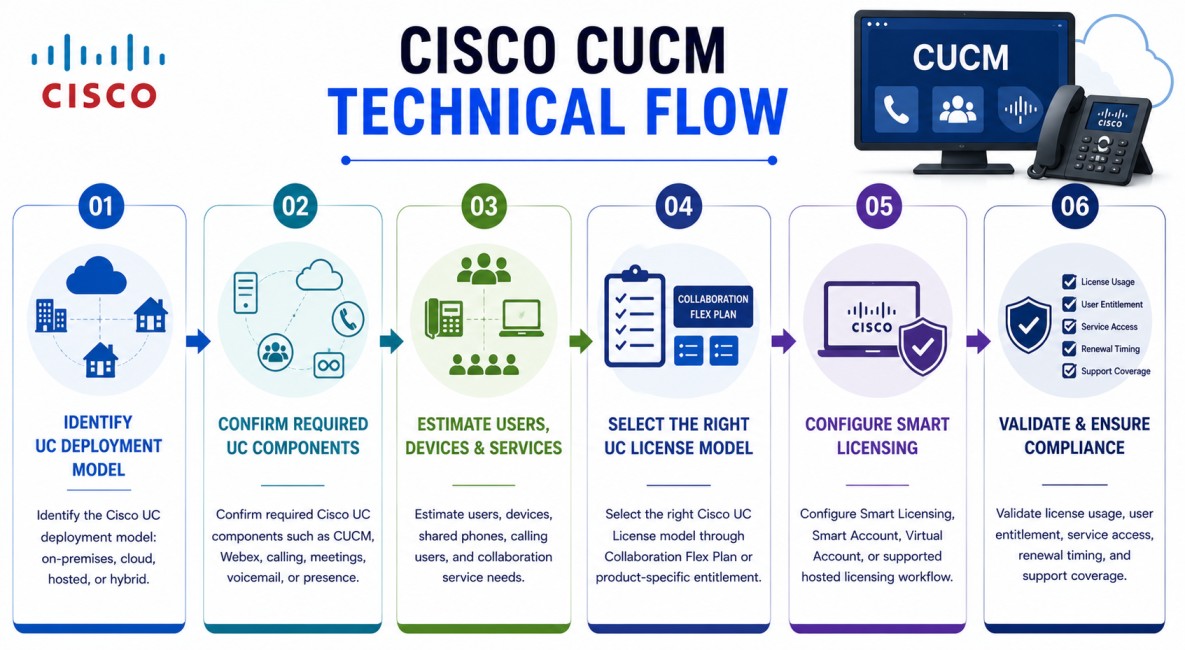
- Deploy Cisco Unified Communications Manager nodes and required UC components
- Configure users, devices, phones, soft clients, SIP trunks, and dial plan structure
- Confirm the required Cisco CUCM License scope through Collaboration Flex Plan or Smart Licensing
- Register CUCM with the correct Smart Account and Virtual Account workflow
- Assign or validate user and device entitlements based on the active licensing model
- Review license usage, call-control services, device registration, renewal timing, and support coverage
Options & Licensing Models
| Licensing Model | Best for | Typical Scope | What affects pricing |
|---|---|---|---|
| Collaboration Flex Plan 3.0 | Modern CUCM purchasing | CUCM software and user licensing through subscription | User count, buying model, term |
| Named User model | User-based UC environments | Users assigned collaboration services | Number of named users |
| Enterprise Agreement model | Larger organizations | Broad collaboration subscription coverage | Organization size and agreement scope |
| Smart Licensing | CUCM entitlement visibility | License ownership and consumption tracking | Smart Account and deployment model |
| On-Premises / Partner Hosted Smart Licensing | CUCM-based calling environments | Controlled on-prem or hosted collaboration licensing | Hosting model and user/device scope |
Features & Benefits
As organizations grow across offices, branches, remote users, and hybrid collaboration environments, centralized call-control licensing becomes important for keeping voice services aligned with user needs. Cisco CUCM helps organizations manage enterprise calling from one communication platform, covering users, devices, route plans, phone registration, SIP trunks, voicemail integration, and UC service access.
One major benefit is operational consistency. Teams can manage call routing, device behavior, user permissions, and communication policies from a centralized system instead of relying on fragmented voice administration. Another benefit is better license visibility. Cisco Smart Software Licensing provides visibility into license ownership and consumption, helping administrators understand how collaboration entitlements are being used across the environment. Over time, Cisco CUCM licensing helps organizations reduce renewal uncertainty, support migration from legacy license models, and maintain stronger control over enterprise communication services.
System Requirements
Common environments
- Cisco Unified Communications Manager deployments
- Enterprise IP telephony and voice environments
- Hybrid UC and Webex-connected collaboration architectures
- SIP trunking, voicemail, IM and Presence, and contact center integrations
- On-premises and partner-hosted Cisco UC environments
Technical requirements
- Supported Cisco CUCM version and cluster design
- Cisco Smart Account and Virtual Account access
- Correct Collaboration Flex Plan or Smart Licensing entitlement
- User, phone, device, and shared endpoint inventory
- Network, DNS, NTP, SIP, dial plan, and voice gateway readiness
How activation works
Activating Cisco CUCM licensing usually starts with confirming the CUCM version, deployment model, Smart Account, Virtual Account, and purchased Collaboration Flex Plan or Smart Licensing entitlement.
In modern CUCM deployments, Smart Software Licensing is used to manage license ownership and consumption. Cisco documentation describes Smart Software Licensing as simplifying licensing across the enterprise and providing visibility into ownership and consumption.
For CUCM 12.0 and later, Cisco moved away from older PAK-style licensing toward Smart Entitlements. Cisco’s CUCM Version 14 data sheet states that starting with CUCM 12.0 and continuing with CUCM 14, only Smart Licensing is supported.
In restricted environments, Cisco has documented Specific License Reservation for CUCM 12.5, but the availability of this option should be confirmed with Cisco licensing support before planning a restricted deployment. Cisco’s SLR document notes that the option may require opening a case with the licensing team.
After activation, administrators should review license usage, user entitlement, device registration, authorization state, Smart Account alignment, and subscription validity to ensure the Cisco CUCM License remains aligned with the active communication environment.
Pricing factors + quote process
Pricing for Cisco CUCM usually depends on user count, device count, deployment model, Collaboration Flex Plan buying model, support coverage, and subscription term.
A simple on-premises calling deployment may need a different license scope than a hybrid UC environment with Webex integration, voicemail, IM and Presence, multiple device types, or contact center integrations.
Additional considerations such as Named User versus Enterprise Agreement model, migration from legacy licenses, partner-hosted deployment, support level, renewal timing, and Smart Licensing status can also influence the final quote.
During the quote process, the Cisco CUCM environment, user/device inventory, deployment model, required communication services, and activation workflow are reviewed first so the licensing approach can match the organization’s UC strategy more accurately.
After you request a quote
- We review your Cisco CUCM deployment and user/device scope
- Identify the right Cisco CUCM License or Flex Plan model
- Validate Smart Licensing, support, and renewal requirements
- Provide official pricing, delivery details, and activation guidance
Cisco CUCM pricing depends on your license type, deployment model and support requirements.