

Cisco CUP (Cisco Unified Presence) refers to Cisco’s presence and instant messaging capability, now commonly positioned through Cisco Unified Communications Manager IM and Presence Service. The Cisco CUP License is usually planned around user access, Cisco Unified Communications Manager integration, IM and presence service requirements, deployment model, Smart Licensing workflow, support coverage, and the wider Cisco UC licensing structure.
Key Benefits
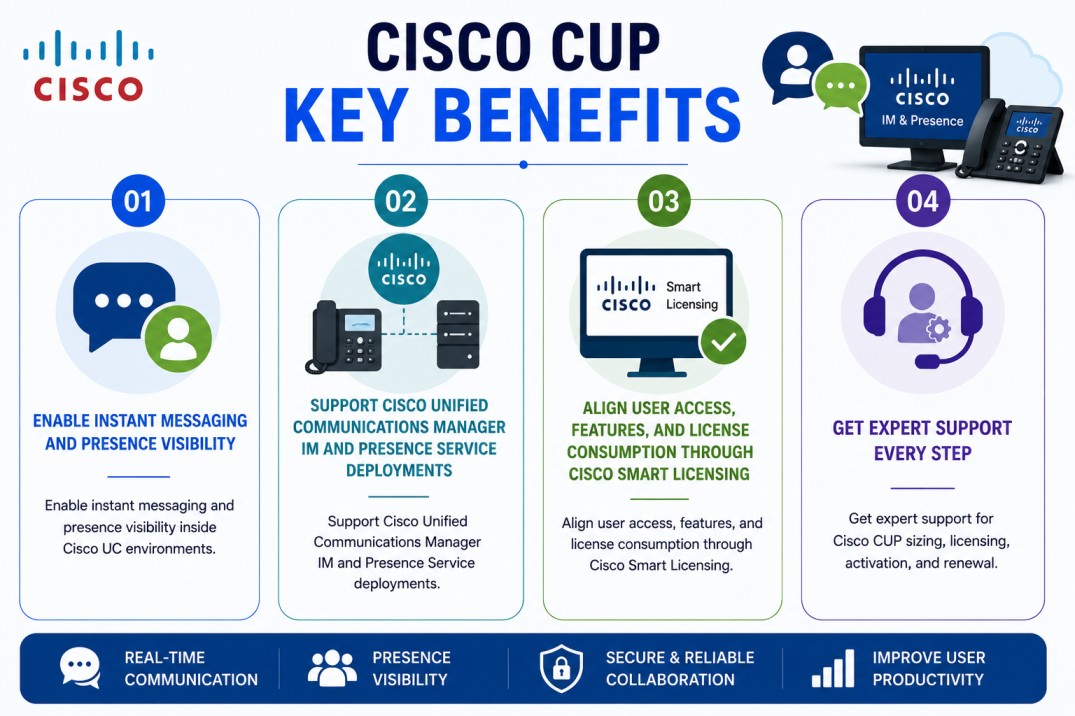
- Enable instant messaging and presence visibility inside Cisco UC environments
- Support Cisco Unified Communications Manager IM and Presence Service deployments
- Align user access, features, and license consumption through Cisco Smart Licensing
- Get expert support for Cisco CUP sizing, licensing, activation, and renewal
Review Cisco CUP Price List and request a quote tailored to your licensing needs.
Cisco CUP At a glance
What it does : Cisco CUP provides enterprise presence and instant messaging capabilities that help users see availability status, exchange messages, and collaborate more effectively inside Cisco Unified Communications environments.
Product family : Cisco UC License.
License type : Cisco CUP licensing is generally connected to Cisco UC and Cisco Unified Communications Manager licensing. Modern licensing is usually managed through Cisco Smart Software Licensing and the relevant Cisco collaboration entitlement model.
Typical term : Subscription or entitlement-based depending on the Cisco UC licensing model, Collaboration Flex Plan structure, support agreement, and deployment requirements.
Activation method : Cisco Smart Software Licensing through Cisco Smart Account, Virtual Account, Cisco Smart Software Manager, and product-specific UC licensing workflows.
Who needs it : Organizations that need enterprise instant messaging, user presence status, Cisco Jabber integration, Cisco UC collaboration services, and centralized IM and Presence administration.

License Overview
Organizations deploying Cisco CUP usually need licensing that reflects the real collaboration scope of the environment. This may include users, IM and presence access, Cisco Unified Communications Manager integration, Cisco Jabber usage, and broader Cisco UC service requirements.
Within the broader Cisco License portfolio, the Cisco CUP License should be understood as part of the Cisco Unified Communications licensing structure rather than as a completely separate standalone product license. In current Cisco environments, the older Cisco Unified Presence naming is commonly associated with Cisco Unified Communications Manager IM and Presence Service.
Because Cisco CUP is closely tied to user collaboration, licensing should be planned around user access and feature requirements instead of server count alone. A deployment that only requires basic presence visibility may have different requirements from an environment that includes instant messaging, Jabber clients, external federation, or multi-node IM and Presence design.
Smart Licensing is important because Cisco UC systems use centralized entitlement visibility to show license ownership and consumption. This helps administrators understand whether user access, device configuration, and collaboration features remain aligned with the purchased entitlement.
A properly aligned Cisco CUP License helps organizations avoid user access gaps, support collaboration growth, and keep IM and Presence services consistent with the wider Cisco UC environment.
Product Overview
Presence and instant messaging become important when users need to understand whether colleagues are available, busy, offline, in a meeting, or reachable before starting communication.
Cisco CUP is designed to support this collaboration layer inside Cisco Unified Communications environments.
In practice, Cisco IM and Presence Service works with Cisco Unified Communications Manager to provide presence status, instant messaging, contact availability, and collaboration client support. It can help users communicate faster because they do not always need to start with a phone call or email.
One of the main operational advantages is better communication awareness. Users can check availability before contacting someone, while IT teams can centrally manage IM and Presence settings, services, users, and integration behavior.
For organizations already using Cisco CUCM, Cisco CUP adds the presence and messaging layer that improves collaboration beyond traditional voice calling.
Core technical flow
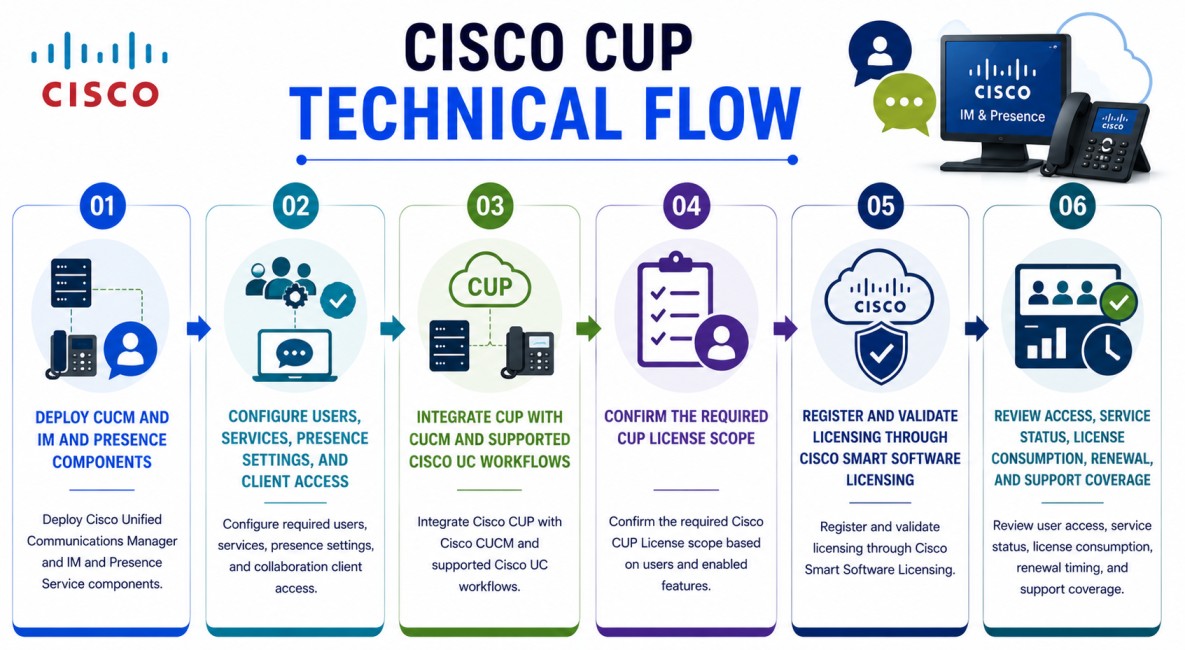
- Deploy Cisco Unified Communications Manager and IM and Presence Service components
- Configure required users, services, presence settings, and collaboration client access
- Integrate Cisco CUP with Cisco CUCM and supported Cisco UC workflows
- Confirm the required Cisco CUP License scope based on users and enabled features
- Register and validate licensing through Cisco Smart Software Licensing
- Review user access, service status, license consumption, renewal timing, and support coverage
Options & Licensing Models
| Licensing Model | Best for | Typical Scope | What affects pricing |
| Cisco UC user licensing | Standard collaboration environments | User access to UC features and services | User count and feature needs |
| IM and Presence entitlement | Presence and messaging workflows | Presence status, IM, Jabber-related collaboration | User and service scope |
| Smart Licensing | Modern Cisco UC environments | Ownership and consumption visibility | Smart Account and deployment model |
| Collaboration Flex Plan | Broader Cisco UC licensing | CUCM, Webex, calling, meetings, and collaboration services | Buying model and subscription term |
| Support and renewal coverage | Ongoing UC operations | Updates, support access, and lifecycle planning | Term and support level |
Features & Benefits
As communication environments grow across offices, branches, remote teams, and hybrid collaboration workflows, users need more than basic voice calling. They also need presence awareness, messaging access, and faster ways to connect with the right people. Cisco CUP helps organizations improve collaboration by adding presence and instant messaging capabilities to the Cisco UC environment.
One major benefit is better user availability visibility. Employees can see whether colleagues are available before calling or messaging them, which reduces communication delays and improves daily collaboration. Another benefit is centralized administration. IT teams can manage IM and Presence services, users, clients, and integration settings from the Cisco UC environment instead of maintaining a disconnected messaging platform.
Cisco CUP can also support a more complete collaboration experience when used with Cisco Jabber and Cisco Unified Communications Manager. Over time, Cisco CUP licensing helps organizations keep presence and messaging services aligned with user growth, UC strategy, support requirements, and renewal planning.
System Requirements
Common environments
- Cisco Unified Communications Manager deployments
- Cisco IM and Presence Service environments
- Cisco Jabber and enterprise collaboration workflows
- On-premises Cisco UC architectures
- Hybrid communication and presence-enabled collaboration environments
Technical requirements
- Supported Cisco CUCM and IM and Presence Service versions
- Cisco Smart Account and Virtual Account access where applicable
- Correct Cisco UC or collaboration entitlement
- User, feature, client, and service inventory
- Network, DNS, certificates, SIP/XMPP, and service configuration planning
How activation works
Activating Cisco CUP licensing usually starts with confirming the Cisco UC deployment, Cisco Unified Communications Manager version, IM and Presence configuration, Smart Account, and purchased collaboration entitlement.
In modern Cisco UC environments, licensing is handled through Cisco Smart Software Licensing. This gives administrators visibility into license ownership and consumption and helps align configured users and features with the active entitlement.
For Cisco CUP environments, activation is normally connected to the broader Cisco UC licensing workflow. Administrators should validate that Cisco CUCM licensing is active, users are configured correctly, IM and Presence services are operating, and the required collaboration entitlement is available.
After Smart Licensing is configured, the system can report usage and license status through the appropriate Cisco licensing workflow. Administrators should review license compliance, service status, user assignment, and renewal timing.
After activation, organizations should also confirm that IM and Presence users can authenticate, view presence status, use messaging functions where enabled, and access the expected collaboration client features.
Pricing factors + quote process
Pricing for Cisco CUP usually depends on user count, Cisco UC deployment model, IM and Presence requirements, collaboration client usage, support coverage, and subscription or entitlement structure.
A small Cisco UC environment with basic presence requirements may need a different licensing scope than a larger deployment with Jabber users, multi-node IM and Presence design, federation needs, or broader collaboration services.
Additional considerations such as CUCM version, Collaboration Flex Plan structure, migration from legacy licensing, support level, Smart Licensing status, and renewal timing can also influence the final quote.
During the quote process, the Cisco CUP environment, user count, CUCM integration, IM and Presence requirements, and activation workflow are reviewed first so the licensing approach can match the organization’s collaboration strategy more accurately.
After you request a quote
- We review your Cisco CUP and Cisco UC environment
- Identify the right Cisco CUP License or collaboration entitlement scope
- Validate Smart Licensing, support, and renewal requirements
- Provide official pricing, delivery details, and activation guidance
Cisco CUP pricing depends on your license type, deployment model and support requirements.