

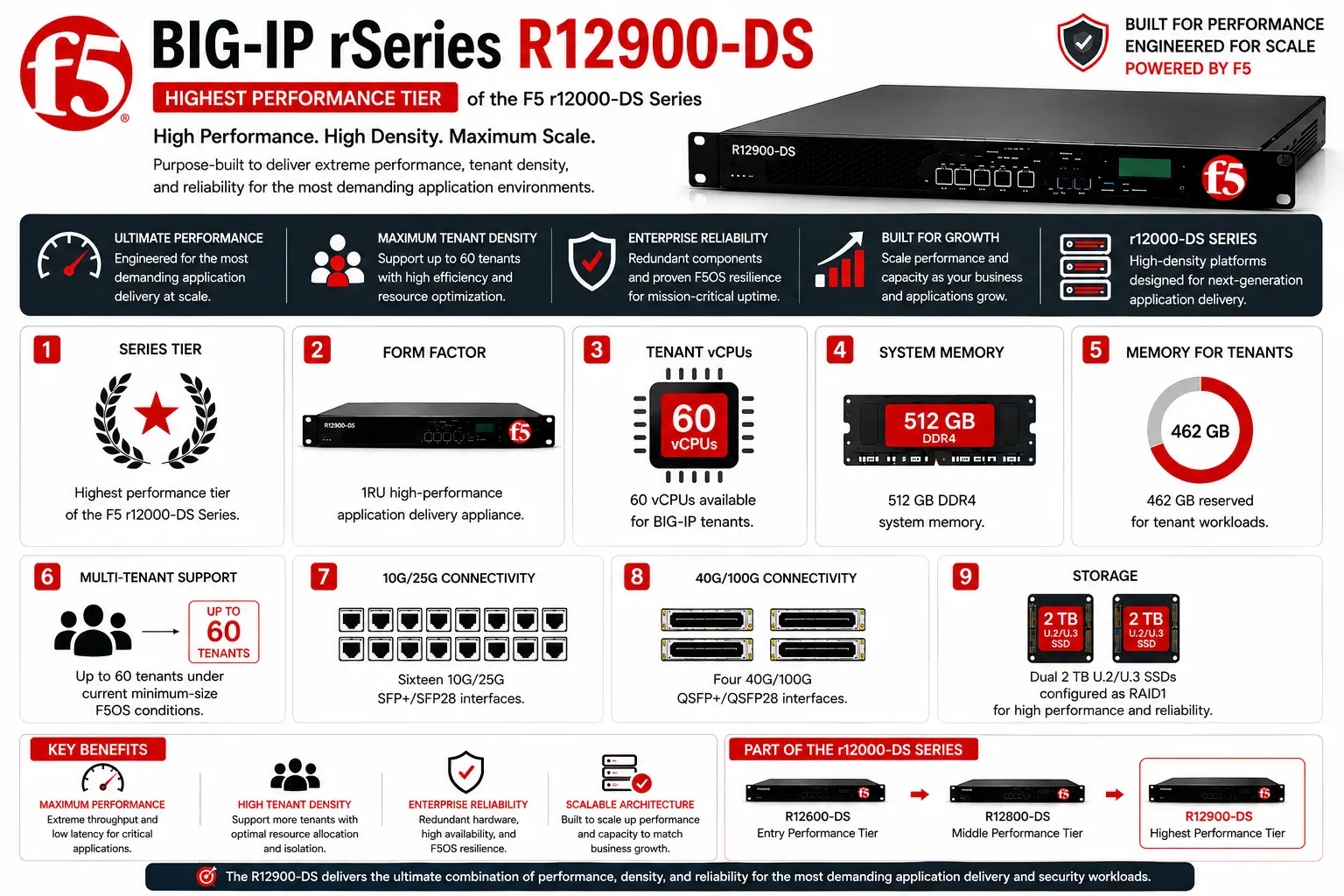
BIG-IP R12900-DS is the fully enabled performance tier of F5’s r12000-DS Series, built for high-volume application delivery, SSL/TLS processing, security inspection, and large BIG-IP consolidation projects. It combines 60 vCPUs for tenant workloads, 512 GB of memory, dense 25G/100G connectivity, redundant storage, and F5’s highest performance level within the r12000-DS fixed-appliance family.
R12900-DS shares its physical hardware with R12600-DS and R12800-DS. The difference is licensing: no additional tenant CPU resources remain disabled on R12900-DS. For buyers already expecting demanding TLS traffic or substantial multi-tenant use, this can be more practical than starting lower and consuming PAYG upgrades shortly after deployment.
Series Highlights
- Highest performance tier of the F5 r12000-DS Series
- 1RU high-performance application delivery appliance
- 60 vCPUs available for BIG-IP tenants
- 512 GB DDR4 system memory
- 462 GB reserved for tenant workloads
- Up to 60 tenants under current minimum-size F5OS conditions
- Sixteen 10G/25G SFP+/SFP28 interfaces
- Four 40G/100G QSFP+/QSFP28 interfaces
- Dual 2 TB U.2/U.3 SSDs configured as RAID1
BIG-IP R12900-DS At a glance
What it is: Fully enabled high-scale F5 appliance optimized for encrypted application delivery
Product family: BIG-IP rSeries License
Series: r12000-DS
Platform layer: F5OS
Tenant compute: 60 vCPUs
System memory: 512 GB
Memory reserved for tenants: 462 GB
Maximum tenant count: Up to 60 under current minimum-resource specifications
Storage: Dual 2 TB U.2/U.3 SSDs in RAID1
Series Overview
The r12000-DS hardware exposes 72 logical vCPUs. Twelve are reserved for the F5OS platform layer, leaving the complete remaining pool of 60 vCPUs available to BIG-IP tenants on R12900-DS. In contrast, R12600-DS and R12800-DS restrict part of this compute capacity through their respective performance licenses.
The appliance carries 512 GB of RAM, with current F5OS documentation listing 462 GB for tenant workloads. In theory, that allows up to 60 minimum-size tenants. In practice, normal BIG-IP deployments use fewer and larger instances because application-security modules, SSL processing, memory, storage, and upgrade requirements quickly increase the resource allocation per tenant.
SSL/TLS performance is where this model separates itself from the lower DS tiers. F5 publishes 400,000 RSA 2K TPS, 300,000 ECDHE-ECDSA P-256 TPS, 235,000 ECDHE P-256/RSA 2K TPS, and 110 Gbps bulk encryption. L4 and L7 throughput reach 195 Gbps under F5’s stated test conditions.
Licensing and Part Number Guidance
R12900-DS defines the maximum compute level of the r12000-DS hardware, but it does not determine which BIG-IP services are included. The final configuration still needs to reflect what the applications require.A system used primarily for LTM and TLS offload has a different entitlement and sizing profile from one combining load balancing with Advanced WAF, DNS, AFM, APM, or several application-security services.
There is also no higher PAYG tier within this chassis. R12600-DS can upgrade to R12800-DS or R12900-DS, and R12800-DS can move to R12900-DS. Once the platform reaches R12900-DS, all available tenant CPU capacity is already unlocked.
That makes growth planning especially important. If the project is expected to consume nearly all 60 vCPUs, 462 GB of tenant memory, or the available physical interfaces from the beginning, a scale-out design or F5’s modular VELOS platform should be considered rather than relying on another license upgrade.
Common Use Cases
| Use case | Why R12900-DS can fit |
|---|---|
| High-volume TLS termination | Highest SSL/TLS capacity in the r12000-DS range |
| Large enterprise ADC | Full 60-vCPU tenant compute pool |
| Application and API security | Additional headroom for encrypted security inspection |
| BIG-IP consolidation | Large memory and compute resources for multiple tenants |
| Data-center application edge | Dense 25G and 100G networking |
| Large digital services | High L7 request and concurrent-connection capacity |
| High-end appliance refresh | Modern fixed-platform option for large BIG-IP estates |
| Capacity-maximized design | No remaining PAYG restriction within r12000-DS |
R12900-DS also provides 100 Gbps hardware compression and up to 170 million SYN cookies per second for hardware-assisted DDoS protection under F5’s published test profile.
Models, Licenses, and Ordering Scope
| Area | What to confirm |
|---|---|
| Platform | BIG-IP R12900-DS |
| BIG-IP services | LTM, Advanced WAF, DNS, AFM, APM, or required combination |
| SSL/TLS workload | TPS, bulk encryption, certificates, ciphers, and key exchange |
| Tenant design | Number, vCPU, memory, image type, and service role |
| Interfaces | 10G, 25G, 40G, or 100G |
| Availability | Standalone or matched HA appliances |
| Capacity | Whether the fully enabled r12000-DS leaves sufficient growth room |
| Storage | Dual 2 TB RAID1 SSDs |
| Power | Dual AC or supported DC PSU configuration |
| Optics | SFP+, SFP28, QSFP+, or QSFP28 |
| Support | Required F5 support level and term |
| Part numbers | Hardware, BIG-IP entitlement, optics, power, support, and accessories |
What to Check Before Requesting a Quote
Start with the encrypted workload. Record peak throughput, SSL transactions per second, concurrent connections, bulk TLS traffic, security inspection, certificate requirements, and the BIG-IP services that will operate simultaneously. Then build the tenant plan. A large Advanced WAF instance processing substantial HTTPS traffic can consume far more resources than a lightweight DNS tenant. The theoretical maximum tenant count should therefore never be used as the primary sizing target.
Interface usage deserves the same attention. R12900-DS has sixteen 10G/25G ports and four 40G/100G ports, but F5 notes that adjacent high-speed QSFP ports must operate at matching 40G/100G speeds and the 40G/100G ports do not support breakout cables. Finally, consider what happens after deployment. There is no R12900-DS PAYG upgrade. If the system will start near its CPU or memory ceiling, the architecture should include another appliance, an HA/scale-out strategy, or a larger modular design rather than assuming additional local compute can later be unlocked.
Activation and Delivery Notes
Initial configuration takes place at the F5OS platform layer. Licensing, interfaces, VLANs, tenant software images, CPU allocation, memory, and shared platform resources are prepared there before the BIG-IP tenants are placed into service. Tenants inherit capabilities such as the system license and VLAN connectivity from F5OS.
The r12000-DS platform also includes two 2 TB SSDs configured as RAID1, providing mirrored internal storage. F5 documents that the usable capacity shown by the system is lower than the raw 2 TB-per-drive specification because of SSD over-provisioning.
For HA, plan corresponding BIG-IP tenants across two physical systems and allocate equivalent resources where predictable failover is required. Before shipment, confirm the BIG-IP entitlement, optics, power configuration, support term, tenant plan, software compatibility, and appliance quantity.
F5 pricing depends on your product edition, license type, deployment model, traffic needs, term, and support requirements.