

Cisco NCS 5700 Series is a Cisco Network Convergence System routing family designed for high-capacity packet transport, service-provider aggregation, distributed core routing, peering fabric, cloud edge, and scalable WAN infrastructure. Compared with older or lower-density aggregation platforms, Cisco NCS 5700 is usually selected when the network needs IOS XR software, high-speed 100G/400G interfaces, advanced routing features, programmable operations, and a stronger growth path for modern packet networks. This page helps buyers understand Cisco NCS 5700 ordering considerations, review licensing and part-number requirements, and move to the related Cisco NCS 5700 part numbers for accurate quote planning.
Series Highlights
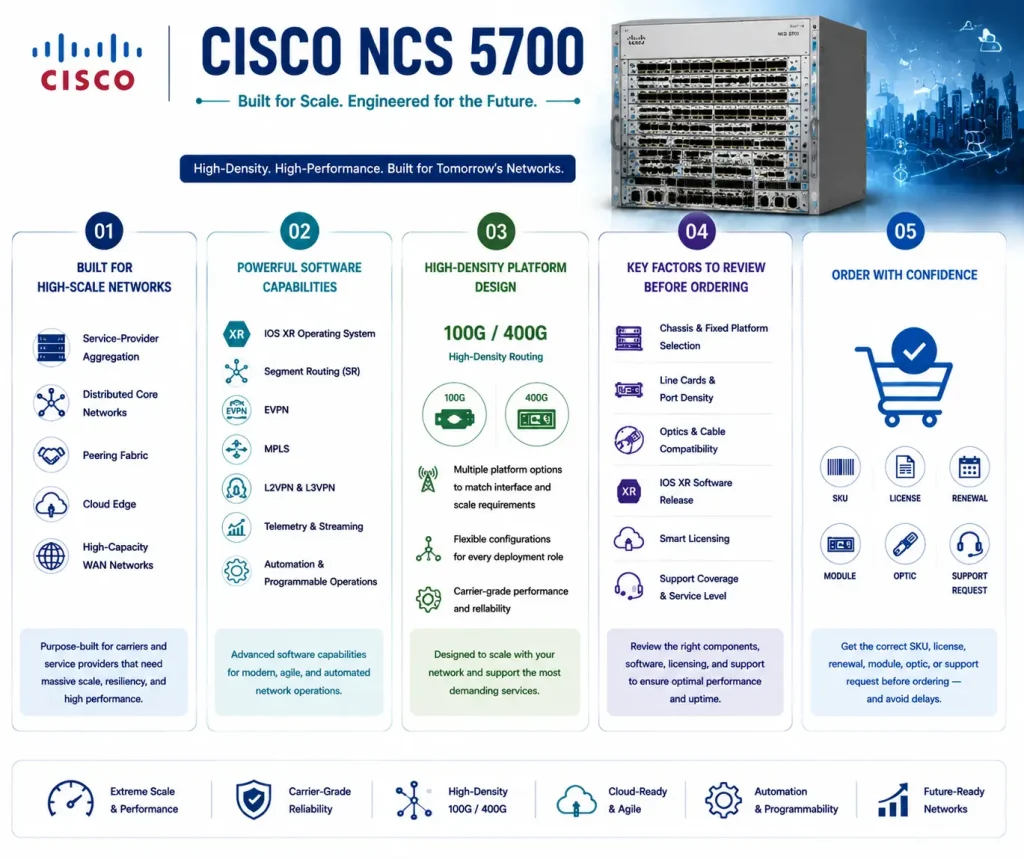
- Suitable for service-provider aggregation, distributed core, peering fabric, cloud edge, and high-capacity WAN networks
- Supports IOS XR, Segment Routing, EVPN, MPLS, L2VPN, L3VPN, telemetry, automation, and programmable operations
- Designed for high-density 100G and 400G routing, with platform options depending on interface and scale requirements
- Requires careful review of chassis, fixed platform, line cards, optics, IOS XR release, Smart Licensing, and support coverage
- Helps buyers prepare the correct SKU, license, renewal, module, optic, or support request before ordering
Review Cisco NCS 5700 Price List and request a quote tailored to your licensing needs.
Cisco NCS 5700 At a glance
What it is : Cisco NCS 5700 Series is a high-capacity IOS XR routing platform for service-provider, cloud, core, aggregation, and peering environments.
Product family : Cisco NCS License
Typical use : Distributed core routing, peering fabric, metro aggregation, cloud edge, service-provider edge, MPLS, Segment Routing, EVPN, and high-density Ethernet transport.
License or ordering scope : Fixed platform, modular line cards, IOS XR software, feature entitlement, Smart Licensing, optics, support renewal, software entitlement, and activation method.
Who needs it : Service providers, cloud operators, carriers, large enterprises, and data center network teams that need the correct Cisco NCS 5700 part number, license, line card, optic, support option, or renewal.
Series Overview
Cisco NCS 5700 Series is built for packet networks that need higher density, stronger performance, and modern routing features without losing operational control. It is commonly used in networks where operators need to scale 100G and 400G connectivity across aggregation, core, peering, and cloud-facing locations.
In a typical deployment, Cisco NCS 5700 can be used for distributed core routing, peering fabric, service-provider aggregation, cloud edge connectivity, data center edge transport, and high-capacity MPLS or Segment Routing networks. It is also useful for environments moving toward EVPN, telemetry-driven operations, and more programmable infrastructure.
The value of Cisco NCS 5700 is its combination of density, IOS XR software, and modern packet-routing capability. However, ordering should be handled carefully. The correct part number depends on the exact platform, port-speed requirement, optics, software release, service role, licensing model, support coverage, and expansion plan.
Licensing and Part Number Guidance
Choosing the correct part number for Cisco NCS 5700 depends on the exact fixed platform or line card, IOS XR release, required port speed, optics, deployment role, software feature, support term, and activation method.
Some requests may focus on fixed NCS 5700 routers for compact 400G-ready aggregation or peering roles. Others may involve NCS 5700 line cards used in compatible modular platforms, optics, software entitlement, Smart Licensing, support renewal, or replacement planning for an existing deployment.
When compared with other platforms in the Cisco Router License category, Cisco NCS 5700 should be treated as a high-capacity packet-routing request with its own platform, interface, and software requirements.
Buyers should confirm whether the platform will be used for distributed core, peering, cloud edge, EVPN, MPLS, Segment Routing, or aggregation before selecting the final SKU.
For existing environments, the current inventory and license status should be checked before ordering. This helps avoid unsupported optics, mismatched line cards, incorrect software entitlement, missing feature licensing, or support coverage gaps.
Common Use Cases
| Use case | Why it matters |
|---|---|
| Distributed core routing | Supports scalable packet core designs without always requiring a larger chassis-based architecture |
| Peering fabric | Helps connect internet exchanges, cloud networks, and service-provider peering locations with high-density interfaces |
| Metro and regional aggregation | Aggregates high-speed Ethernet traffic from access, metro, and service edge networks |
| Segment Routing and EVPN | Supports modern transport, traffic engineering, and multi-service packet network designs |
| Cloud and data center edge | Helps connect cloud, data center, and WAN environments through high-capacity routing platforms |
| Line card, optic, or renewal planning | Helps validate platform, IOS XR release, license, optics, support, and hardware compatibility before ordering |
Models, Licenses, and Ordering Scope
| Area to check | What to confirm |
|---|---|
| Platform model | Exact Cisco NCS 5700 fixed router, modular line card, or compatible platform requirement |
| Deployment role | Distributed core, peering fabric, metro aggregation, cloud edge, EVPN, MPLS, or packet transport use case |
| Port requirement | Required 10G, 25G, 100G, 400G, or supported high-speed interface density |
| Software version | Supported Cisco IOS XR release, XR7 requirement where applicable, and feature compatibility |
| License type | Smart License, IOS XR feature entitlement, software license, support renewal, or flexible consumption requirement |
| Hardware scope | Fixed platform, line cards, optics, MPAs where applicable, power supplies, fans, or spare components |
| Quantity | Number of routers, sites, line cards, ports, optics, spare units, or renewal targets |
| Term | 1-year, 3-year, 5-year, renewal, subscription, or support coverage period |
| Activation method | Smart License, SLP, Classic License review, PLR License, SLR License, or Cisco-supported workflow where applicable |
| Part number | Correct Cisco NCS 5700 hardware SKU and related license, line card, optic, renewal, or support item |
What to Check Before Requesting a Quote
Before requesting a quote for Cisco NCS 5700, confirm the exact platform model, IOS XR version, deployment role, required port speed, optics, support term, and activation method.
You should also define whether the platform will be used for peering fabric, distributed core, Segment Routing, EVPN, MPLS, cloud edge, metro aggregation, spare hardware, software entitlement, or support renewal. Each role can change the required interface density, software feature, optics, licensing scope, and support coverage.
For existing environments, prepare the current system inventory first. This should include model number, serial number, installed IOS XR release, line cards, optics, license status, and support coverage. For restricted environments, PLR License or SLR License options should be reviewed only where supported by Cisco policy and the selected licensing workflow.
Activation and Delivery Notes
After the correct Cisco NCS 5700 part number is selected, activation depends on the platform model, IOS XR release, license type, and deployment environment. Some deployments may use Smart Licensing or Smart Licensing Using Policy for entitlement and usage reporting. Other requests may involve IOS XR feature entitlement, flexible consumption review, software entitlement validation, support renewal, or product-specific Cisco licensing workflows.
For hardware delivery, compatibility should be checked before shipment. Fixed platforms, line cards, optics, MPAs where applicable, power supplies, fans, and software release requirements must match the selected Cisco NCS 5700 environment. For renewal, replacement, or expansion projects, the current license and support status should be reviewed first. This helps prevent ordering delays and keeps the selected SKU aligned with the real service-provider, cloud, or high-capacity packet-routing requirement.
Cisco NCS Series pricing depends on your router series, license type, deployment model and support requirements.