

Splunk User Behavior Analytics (UBA) helps security teams spot insider threats, compromised accounts, and unusual activity by looking at how users and systems actually behave over time.
Quick benefits
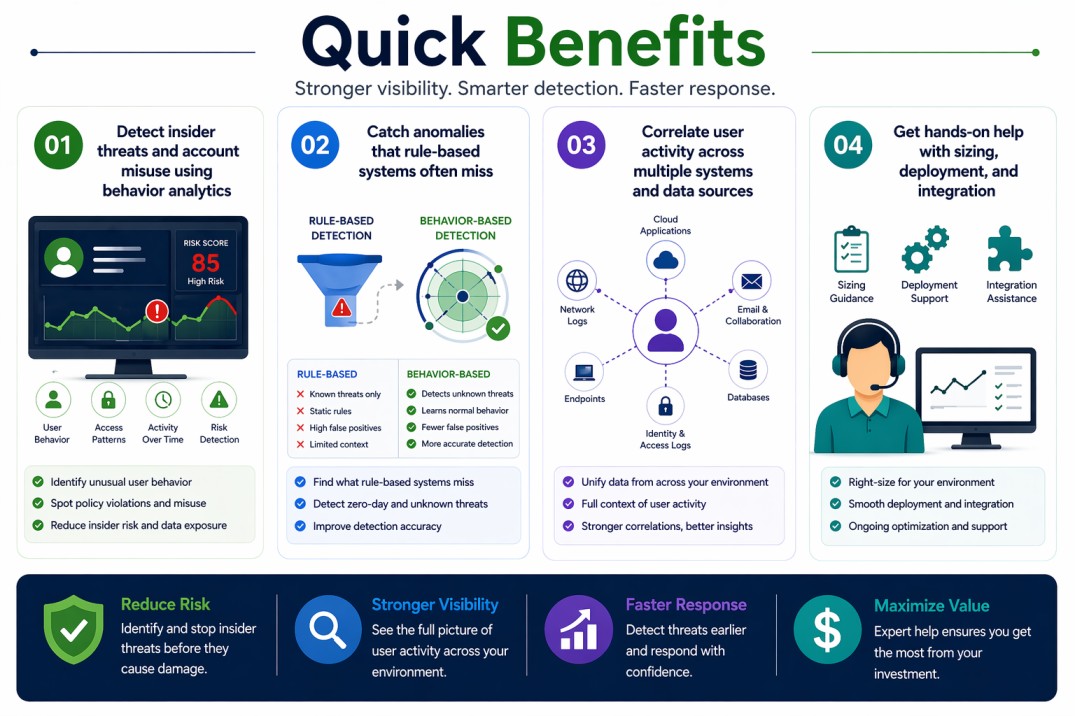
- Detect insider threats and account misuse using behavior analytics
- Catch anomalies that rule-based systems often miss
- Correlate user activity across multiple systems and data sources
- Get hands-on help with sizing, deployment, and integration
Review Splunk UBA Price List and request a quote tailored to your licensing needs.
Splunk User Behavior Analytics (UBA) At a glance
What it does: Splunk User Behavior Analytics (UBA) looks at user and system activity to detect anomalies, insider threats, and suspicious behavior patterns.
License type: Add-on to Splunk Enterprise (subscription-based)
Typical term: 1 year · 3 years · 5 years
Activation method: Deployed alongside Splunk and connected to your data sources
Who needs it: Security teams and SOC environments that want deeper visibility into user behavior and insider risk
License Overview
The Splunk License structure determines access to security analytics capabilities such as Splunk User Behavior Analytics, allowing organizations to select the right capacity based on monitored users, entities, data sources, and security requirements.Instead of relying only on predefined detection rules, Splunk UBA focuses on identifying patterns in how users and systems behave, which means its effectiveness depends heavily on the data it receives.
In practical terms, licensing is tied to the scope of what you’re monitoring, things like the number of users, systems, and data sources feeding into the platform. Because Splunk User Behavior Analytics processes large volumes of activity data, it’s important to size it correctly so it can build accurate behavioral models without running into performance issues.
Activation typically involves deploying UBA as a separate component and connecting it to Splunk Enterprise or Splunk Enterprise Security. Once that connection is in place, it starts ingesting data, building baselines, and analyzing behavior automatically.
Since UBA is often used to detect more subtle threats, like insider misuse or compromised credentials, having the right license size helps ensure consistent detection and avoids gaps as your environment grows over time.
Product Overview
Splunk User Behavior Analytics (UBA) is designed for situations where traditional detection methods fall short. Instead of just looking for known patterns or signatures, it focuses on how users and systems normally behave, and then flags anything that doesn’t fit.
In a real environment, that might mean tracking login patterns, access behavior, or how data moves between systems. If something changes, like a user suddenly accessing sensitive systems or moving large amounts of data, it stands out.
One of the useful things about Splunk UBA is that it doesn’t look at data in isolation. It pulls together activity from different sources, endpoints, identity systems, network logs, and builds a broader picture. That context makes it easier to understand whether something is actually risky or just unusual.
As more data comes in, the system adjusts and improves its understanding of what “normal” looks like. Over time, that helps reduce false positives and gives security teams more confidence in what they’re seeing.
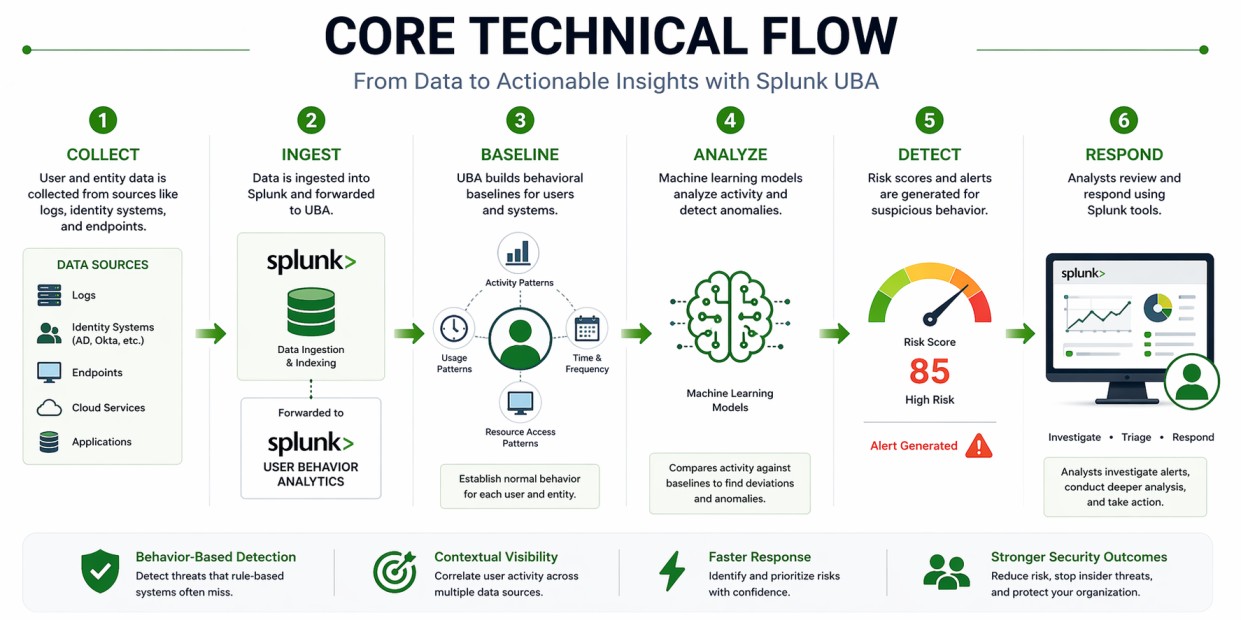
Core technical flow
- User and entity data is collected from sources like logs, identity systems, and endpoints
- Data is ingested into Splunk and forwarded to UBA
- UBA builds behavioral baselines for users and systems
- Machine learning models analyze activity and detect anomalies
- Risk scores and alerts are generated for suspicious behavior
- Analysts review and respond using Splunk tools
Options & Tiers
| Plan / Model | Best for | Key inclusions | What affects price |
|---|---|---|---|
| Splunk UBA (standard deployment) | Insider threat detection | Behavioral analytics + anomaly detection | Users, data scope, term |
| UBA + Splunk ES integration | Advanced SOC workflows | Combined SIEM + behavior analytics | Data volume, integration scope |
| Distributed deployment | Large environments | Scalable analytics processing | Architecture complexity |
| Hybrid deployment | Mixed setups | Flexible integration across systems | Deployment scope |
Features & Benefits
Splunk User Behavior Analytics is useful because it looks beyond obvious threats. Instead of relying only on rules, it focuses on behavior, which makes it better at identifying things like insider threats or compromised accounts that don’t always trigger standard alerts.
Another advantage is how it reduces noise. Rather than generating large numbers of alerts, it assigns risk scores based on context and patterns. This makes it easier for security teams to focus on what actually matters instead of sorting through false positives.
It also fits naturally into existing Splunk environments. When used alongside Splunk Enterprise Security, it adds another layer of visibility, helping analysts understand not just what happened, but why it might matter.
Compatibility & Requirements
Common environments
- Security Operations Centers (SOC)
- Organizations with large user bases
- Hybrid and multi-cloud infrastructures
Typical prerequisites
- Splunk Enterprise or Splunk ES already in place
- Access to relevant user and activity data
- Integration planning across systems
How activation works
- Set up or confirm your Splunk environment
- Deploy Splunk UBA
- Connect data sources and integrations
- Allow the system to build behavioral baselines
- Monitor alerts and refine detection over time
Pricing factors + quote process
Splunk User Behavior Analytics pricing is mainly influenced by how many users and entities you’re monitoring, along with the amount of data being analyzed. Since the platform relies on behavioral modeling, both the scale and quality of data play an important role in determining the right setup.
Integration with Splunk Enterprise or Splunk Enterprise Security can also affect the overall cost, especially in larger environments where more data sources are involved. As with most subscriptions, the term length can influence pricing, with longer commitments typically offering better value.
The most accurate way to price Splunk UBA is to align it with your actual environment and security objectives.
After you request a quote
- We review your user scope and data sources
- Recommend the most suitable deployment approach
- Provide official pricing and delivery details
- Share clear activation and integration guidance
Splunk Pricing depends on your license edition, quantity, term, and deployment needs.