

Cisco Data Center covers the networking, compute, storage networking, fabric automation, and infrastructure management technologies used to build scalable enterprise and service provider data center environments. Within the broader Cisco License portfolio, Cisco Data Center licensing is usually planned around the selected product family, switch or server platform, software tier, data center fabric design, Nexus Dashboard requirements, ACI or NX-OS deployment model, MDS storage needs, Smart Licensing method, support coverage, and renewal term.
Key Benefits
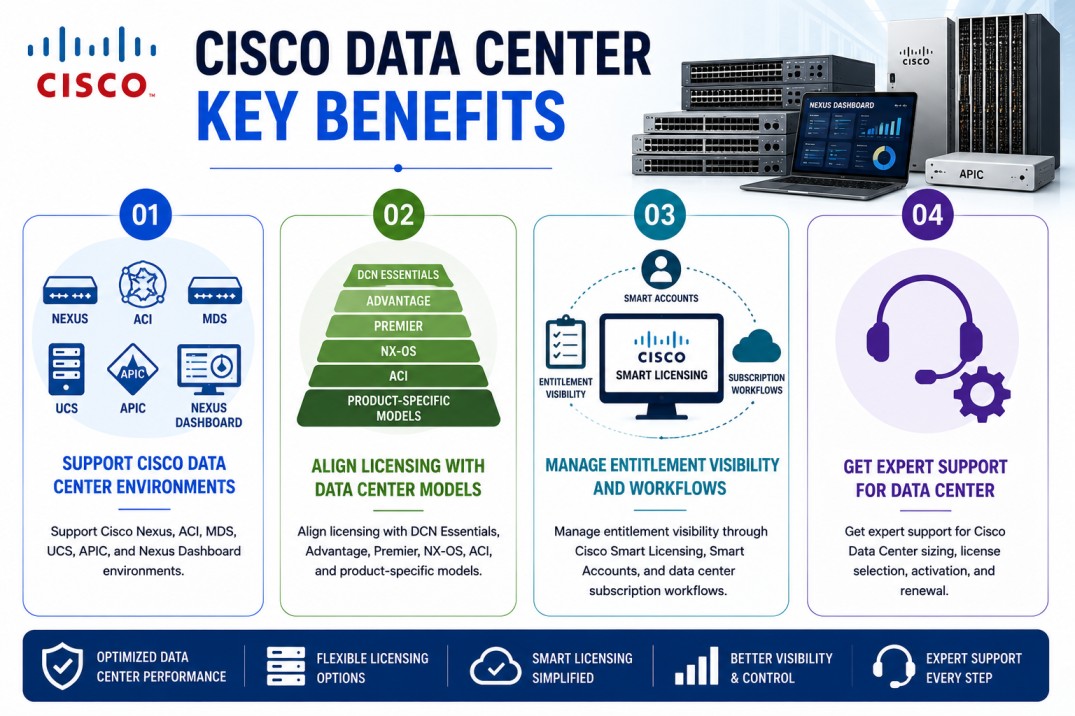
- Support Cisco Nexus, ACI, MDS, UCS, APIC, and Nexus Dashboard environments
- Align licensing with DCN Essentials, Advantage, Premier, NX-OS, ACI, and product-specific models
- Manage entitlement visibility through Cisco Smart Licensing, Smart Accounts, and data center subscription workflows
- Get expert support for Cisco Data Center sizing, license selection, activation, and renewal
Cisco Data Center At a glance
What it does : Cisco Data Center licensing enables the software, management, automation, visibility, fabric, compute, and storage networking capabilities required across Cisco data center environments.
Product family : Cisco Networking
License type : Product-dependent. Cisco Data Center licensing may include Data Center Networking subscriptions, DCN Essentials, DCN Advantage, DCN Premier, NX-OS licensing, ACI licensing, MDS licensing, Nexus Dashboard services, UCS-related software licensing, and platform-specific entitlements.
Typical term : Usually depends on the product family and licensing model. Some data center licenses may be perpetual or feature-based, while many modern Cisco data center software capabilities are managed through subscription-based or tier-based licensing models.
Activation method : Cisco Smart Licensing, Smart Licensing Using Policy, Cisco Smart Account, Virtual Account, Cisco Smart Software Manager, Smart Software Manager On-Prem, Cisco Smart Licensing Utility, or product-specific activation workflows depending on the platform.
Who needs it : Organizations that deploy Cisco infrastructure for data center switching, ACI fabrics, NX-OS networks, SAN storage networking, UCS compute environments, Nexus Dashboard operations, automation, analytics, telemetry, and multi-site data center management.
License Overview
Cisco Data Center licensing is not a single fixed license. It changes depending on whether the environment uses Cisco Nexus switches, Cisco ACI, Cisco APIC, Cisco MDS storage networking, Cisco UCS, Nexus Dashboard, Nexus Dashboard Fabric Controller, Nexus Dashboard Insights, or NX-OS standalone data center switching.
The Cisco Data Center License should therefore be planned as a broader licensing framework rather than one universal entitlement. A Cisco Nexus data center switch may require NX-OS or Data Center Networking licensing. A Cisco ACI deployment may require ACI-aligned DCN tiers. A Cisco MDS SAN environment may require storage networking feature licensing. A Nexus Dashboard deployment may require feature entitlement through onboarded fabrics and switch licensing.
Because Cisco Data Center environments can include networking, compute, storage, fabric automation, policy control, telemetry, analytics, and multi-site operations, license planning should begin with the architecture. A single-rack NX-OS deployment does not have the same licensing requirement as a multi-site ACI fabric, a SAN environment using MDS, or a Nexus Dashboard environment with advanced assurance and insights.
Smart Licensing and Smart Licensing Using Policy are also important in many modern Cisco data center deployments. They help organizations manage license usage, product instances, entitlement status, reporting workflows, and compliance visibility through Cisco licensing tools. A properly aligned Cisco Data Center licensing model helps organizations avoid missing software features, reduce renewal confusion, maintain entitlement compliance, and keep data center capabilities aligned with the real infrastructure design.
How Cisco Data Center Works
Cisco Data Center environments are usually built across several technical layers. The switching layer connects servers, storage, virtualization platforms, security appliances, and application workloads. The fabric layer provides policy, segmentation, automation, and scalable traffic forwarding. The storage networking layer connects storage systems through Fibre Channel or SAN services. The compute layer supports server and workload operations through Cisco UCS and related infrastructure.
In a typical Cisco Data Center architecture, Cisco Nexus switches may provide high-performance data center networking, Cisco ACI may deliver policy-based fabric automation, Cisco APIC may act as the policy controller for ACI, Cisco MDS may support SAN switching, Cisco UCS may provide compute infrastructure, and Cisco Nexus Dashboard may centralize operations, automation, visibility, and lifecycle workflows.
Licensing connects these layers to the software capabilities required by the environment. For example, a Nexus switch may need DCN Essentials, Advantage, or Premier depending on the fabric and operational requirements. An ACI fabric may need a licensing tier that supports the required policy, orchestration, and assurance capabilities. An MDS deployment may require SAN-focused feature packages. Nexus Dashboard services may depend on the license tier assigned to onboarded switches or fabrics.
The goal is not just to activate a device. The goal is to align the licensed Cisco Data Center capability with the architecture, fabric role, operational model, and long-term growth plan.
Core technical flow
- Identify the Cisco Data Center environment and its main infrastructure layers
- Separate requirements by category: Nexus, ACI, APIC, MDS, UCS, Nexus Dashboard, or NX-OS
- Confirm device models, fabric design, software versions, feature needs, and deployment roles
- Select the correct license model, such as DCN Essentials, Advantage, Premier, NX-OS, ACI, MDS, or product-specific tiers
- Configure Smart Licensing, Smart Licensing Using Policy, Nexus Dashboard entitlement, or the required product activation workflow
- Validate license usage, feature availability, fabric coverage, support status, renewal timing, and Smart Account alignment
Main Cisco Data Center License Categories
| Category | Typical Products | Licensing Focus |
|---|---|---|
| Cisco Nexus License | Nexus 3000, 7000, 9000 | NX-OS, DCN tiers, VXLAN EVPN, telemetry, fabric features |
| Cisco ACI License | ACI fabrics, APIC, Nexus 9000 ACI mode | Policy-based fabric, segmentation, automation, multi-site, assurance |
| Cisco APIC License | Application Policy Infrastructure Controller | ACI policy control, fabric management, tenant and application policy workflows |
| Cisco MDS License | MDS 9000 Series | SAN switching, Fibre Channel, Enterprise Package, mainframe, analytics, telemetry |
| Cisco UCS License | UCS servers and management software | Compute infrastructure, server management, automation, support, software entitlements |
| Cisco Nexus Dashboard License | Nexus Dashboard, NDI, NDFC, NDO | Centralized data center operations, insights, orchestration, fabric controller services |
| Cisco NX-OS License | Nexus standalone switching | NX-OS features, routing, switching, VXLAN EVPN, telemetry, data center operations |
| Cisco Data Center Networking License | DCN subscriptions | Essentials, Advantage, Premier tiers across ACI, NX-OS, MDS, and Nexus Dashboard services |
Options & Licensing Models
| Licensing Model | Best for | Typical Scope | What affects pricing |
|---|---|---|---|
| DCN Essentials | Foundational data center networking | Core ACI, NX-OS, MDS, and operations capabilities | Switch model, fabric size, and base requirements |
| DCN Advantage | Advanced data center fabrics | Multi-site, orchestration, broader fabric features, advanced operations | Feature depth and data center scale |
| DCN Premier | Advanced assurance and insights | Advantage capabilities plus deeper Day-2 operations and insights | Analytics, assurance, and operational visibility |
| NX-OS licensing | Standalone Nexus environments | Nexus switching, routing, VXLAN EVPN, and telemetry features | Platform and required feature set |
| ACI licensing | Policy-based fabric environments | APIC, ACI fabric policy, segmentation, orchestration, and automation | Fabric design and required tier |
| MDS licensing | Storage networking environments | SAN features, Enterprise Package, mainframe, telemetry, analytics | SAN role and required feature packages |
| Nexus Dashboard entitlement | Centralized data center operations | NDI, NDFC, NDO, orchestration, insights, and fabric management | Service scope and license tier |
Features & Benefits
As data centers expand across virtualization, hybrid cloud, storage networks, application fabrics, automation, and multi-site operations, Cisco Data Center licensing becomes important for keeping infrastructure capabilities aligned with operational requirements. A well-planned licensing approach helps organizations enable the right software capabilities for each layer. Nexus switches can be licensed for NX-OS and fabric features, ACI environments can be licensed for policy and automation, MDS platforms can be licensed for SAN capabilities, UCS environments can be aligned with compute management needs, and Nexus Dashboard can be used to improve operations and visibility.
One major benefit is structured scalability. Different Cisco Data Center environments can be licensed according to their actual role instead of using one generic model across all platforms. Another benefit is operational visibility. Cisco Smart Licensing, DCN tiers, and Nexus Dashboard-related workflows help administrators review entitlement status, feature access, fabric coverage, renewal timing, and software usage more clearly. Over time, this helps organizations reduce licensing gaps, simplify data center renewals, support multi-site growth, and maintain better control over Cisco data center infrastructure.
System Requirements
Common environments
- Cisco Nexus data center switching environments
- Cisco ACI and APIC-managed fabrics
- Cisco MDS SAN and Fibre Channel environments
- Cisco UCS compute infrastructure
- Nexus Dashboard operations and automation environments
- NX-OS standalone and multi-site data center networks
Technical requirements
- Supported Cisco data center platforms and software releases
- Cisco Smart Account and Virtual Account access where applicable
- Correct DCN, NX-OS, ACI, MDS, UCS, or Nexus Dashboard entitlement
- CSSM, SSM On-Prem, CSLU, or supported offline workflow where required
- Fabric inventory, feature requirements, support status, and renewal planning
How activation works
Activating Cisco Data Center licenses usually starts with identifying the product family, software version, selected license tier, and Cisco Smart Account where the entitlement is available.
For many modern Cisco data center platforms, Smart Licensing or Smart Licensing Using Policy is used. In connected environments, platforms or management systems can report usage to Cisco Smart Software Manager. In controlled environments, organizations may use Smart Software Manager On-Prem, Cisco Smart Licensing Utility, or mediated reporting workflows. Restricted environments may require disconnected or offline procedures depending on the platform.
The activation process is not identical for every Cisco Data Center product. Nexus switches, ACI fabrics, MDS switches, UCS management products, Nexus Dashboard services, and APIC-managed environments may each have different licensing steps. However, the general workflow is similar: confirm entitlement, configure the licensing method, assign or validate the license tier, report or register usage, validate feature availability, and monitor compliance or renewal status.
After activation, administrators should review license summary, product instance status, fabric entitlement, enabled features, subscription usage, renewal timing, Smart Account alignment, and operational impact.
This is especially important for Cisco Data Center environments with multiple product families because one missing entitlement can affect a specific fabric feature, SAN capability, insight function, or automation workflow.
Pricing factors + quote process
Pricing for Cisco Data Center licensing usually depends on product family, device model, software tier, fabric design, feature requirements, support level, subscription term, and activation method.
A Nexus standalone switching environment may be priced differently from an ACI fabric, an MDS storage networking project, a UCS compute environment, or a Nexus Dashboard operations deployment. The licensing metric can also change by product. Some licenses are tier-based, some are device-based, some are feature-based, and some are tied to fabrics, switches, services, or software subscriptions.
Additional considerations such as DCN Essentials versus Advantage or Premier, ACI multi-site requirements, NX-OS feature needs, MDS SAN analytics, Nexus Dashboard Insights, NDFC, NDO, UCS management, Smart Licensing method, support coverage, renewal timing, and fabric expansion plans can also influence the final quote.
During the quote process, the Cisco Data Center environment is reviewed by product family first. Then device inventory, fabric design, feature requirements, license tier, activation model, and support term are mapped into the correct licensing approach.
After you request a quote
- We review your Cisco Data Center environment and product scope
- Identify the right license family, tier, and activation model
- Validate fabric, feature, support, subscription, and renewal requirements
- Provide official pricing, delivery details, and activation guidance
Cisco Data Center pricing depends on your license type, deployment model and support requirements.