

Bitdefender License provides organizations with access to advanced cybersecurity solutions designed to protect endpoints, servers, cloud workloads, and enterprise environments against modern cyber threats. Through the GravityZone security platform, businesses can deploy scalable protection, threat prevention, detection, and response capabilities based on their security requirements.
Quick Benefits
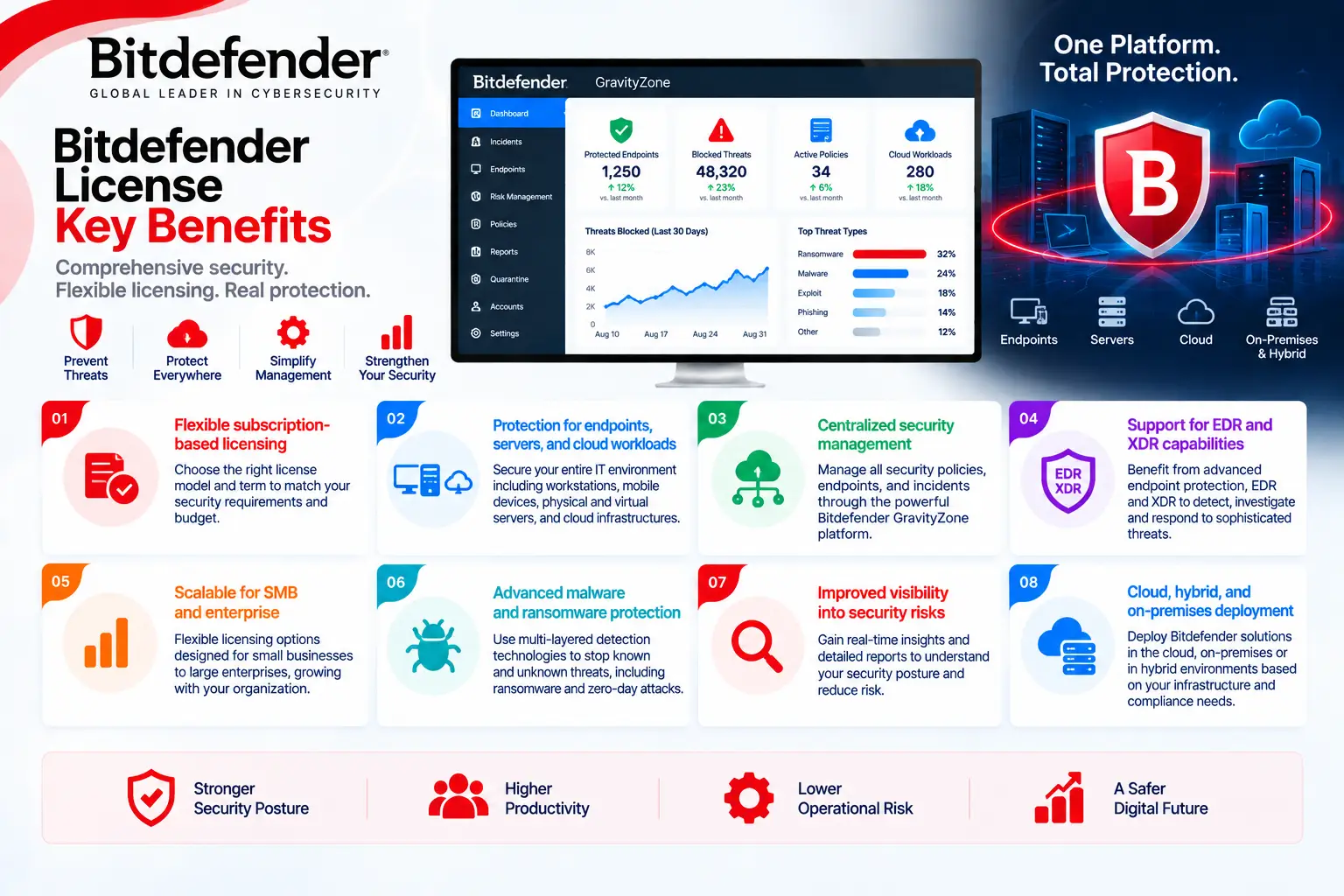
- Flexible subscription-based cybersecurity licensing
- Protection for endpoints, servers, and cloud workloads
- Centralized security management through GravityZone platform
- Support for endpoint protection, EDR, and XDR capabilities
- Scalable licensing for SMB and enterprise environments
- Advanced malware and ransomware protection
- Improved visibility into security risks and threats
- Cloud, hybrid, and on-premises deployment options
Bitdefender License At a Glance
What it is: Enterprise cybersecurity licensing model for Bitdefender security solutions
Main platform: GravityZone Security Platform
License type: Subscription-based security licensing
Primary licensing metrics: Endpoints, users, servers, workloads, and selected security modules
Deployment models: Cloud, hybrid, and on-premises
Main users: Businesses, enterprises, IT teams, security operations teams, and MSPs
License Overview
A Bitdefender License provides access to a wide range of cybersecurity capabilities through the Bitdefender GravityZone platform. Instead of purchasing separate security tools for each protection requirement, organizations can select different GravityZone editions and security modules based on their environment, risk level, and operational needs.
Bitdefender licensing is primarily based on the assets that require protection, such as endpoints, servers, virtual machines, or cloud workloads. The final license configuration depends on the selected security edition, the number of protected resources, subscription duration, and additional capabilities such as Endpoint Detection and Response (EDR), Extended Detection and Response (XDR), or advanced security analytics.
Organizations typically choose a Bitdefender subscription according to their security maturity. Smaller businesses may require endpoint-focused protection with centralized management, while larger enterprises may need advanced detection, investigation, and response capabilities integrated with security operations workflows. The licensing structure also allows organizations to expand their security coverage over time. Businesses can begin with core endpoint protection and later add advanced capabilities when their requirements grow, without replacing the entire security platform.
How Bitdefender Licensing Works
Bitdefender licensing follows a subscription-based model where organizations select the required security solution, define the number of protected assets, and activate the subscription through the GravityZone management platform. After activation, administrators can deploy security agents across endpoints, servers, or workloads and apply protection policies according to business requirements.
The selected license determines which security capabilities are available, from basic prevention and malware protection to advanced detection, investigation, and response features. Organizations can manage protected assets, monitor security events, and expand their subscription when additional users, devices, or workloads need coverage. This approach allows businesses to align cybersecurity investment with their actual infrastructure size and security objectives rather than deploying unnecessary features or capacity.
Bitdefender Security Portfolio Overview
Bitdefender provides multiple security solutions under the GravityZone ecosystem, allowing organizations to choose protection based on their operational requirements.
| Product Family | Purpose |
|---|---|
| GravityZone Business Security | Endpoint protection designed for small and medium-sized businesses requiring centralized security management |
| GravityZone Enterprise Security | Advanced protection for larger organizations with complex IT environments |
| GravityZone Premium Security | Enhanced prevention and security capabilities for organizations requiring stronger threat defense |
| GravityZone Endpoint Detection and Response (EDR) | Advanced endpoint monitoring, investigation, and response capabilities |
| GravityZone Extended Detection and Response (XDR) | Security visibility across multiple layers including endpoints, identities, networks, and cloud environments |
| GravityZone Managed Detection and Response (MDR) | Managed security services supported by security experts and threat monitoring |
| GravityZone Email Security | Protection against email-based threats such as phishing and malicious attachments |
Licensing Models and Options
| License Model | Description | Suitable For |
|---|---|---|
| Endpoint-Based Subscription | Licensing based on the number of protected endpoint devices | Businesses requiring workstation and laptop protection |
| Server Protection Licensing | Security coverage for physical and virtual servers | Data centers and enterprise environments |
| Cloud Workload Protection | Protection for cloud-based workloads and virtual environments | Organizations operating cloud infrastructure |
| EDR Add-On Licensing | Advanced detection and investigation capabilities | Security teams requiring endpoint visibility |
| XDR Licensing | Extended threat detection across multiple security layers | Enterprises with advanced security operations |
| MDR Services | Managed threat monitoring and response services | Organizations without dedicated SOC resources |
| Multi-Year Subscription | Longer licensing commitment with predictable planning | Enterprise organizations |
The appropriate licensing model depends on the organization’s infrastructure, security objectives, compliance requirements, and operational capabilities.
Features and Benefits
Bitdefender License enables organizations to build a layered cybersecurity strategy by combining prevention, detection, and response capabilities within a centralized security platform. Through GravityZone, administrators gain visibility into protected assets, security events, and policy management from a single management interface.
One of the main advantages of Bitdefender solutions is their ability to protect against advanced threats such as malware, ransomware, phishing attempts, and suspicious behavior. The platform uses multiple security technologies, including behavioral analysis, machine learning, and threat intelligence, to identify and prevent malicious activity.
For security teams, advanced licensing options such as EDR and XDR provide deeper investigation capabilities. These features help analysts understand attack patterns, identify affected systems, and respond more effectively to security incidents. Bitdefender licensing also supports operational efficiency by simplifying security management across distributed environments. Organizations can protect users, servers, and workloads while maintaining centralized control over security policies and monitoring activities.
Compatibility and Requirements
Before selecting a Bitdefender License, organizations should evaluate their infrastructure and security requirements.
Important considerations include:
- Number of endpoints and users requiring protection
- Server and workload environments
- Operating systems in use
- Cloud infrastructure requirements
- Existing security tools and integrations
- Compliance and reporting requirements
- Need for EDR, XDR, or managed security services
Bitdefender solutions support a wide range of business environments, including physical endpoints, virtual machines, servers, and cloud workloads. Organizations should select the appropriate GravityZone edition based on their technical environment and security objectives. A proper assessment helps prevent under-licensing while avoiding unnecessary security capabilities.
Activation and Deployment
Bitdefender deployment begins after selecting the appropriate subscription and activating the license through the GravityZone platform.
Typical deployment steps include:
- Activating the Bitdefender subscription
- Configuring GravityZone management settings
- Deploying security agents to protected assets
- Applying security policies
- Monitoring protection status and security events
Organizations usually begin deployment with critical systems and gradually expand protection across additional endpoints, servers, or workloads. For larger environments, planning asset groups, policies, and administrative roles before deployment helps ensure a smoother security rollout.
Pricing and Quote Process
Pricing for a Bitdefender License depends on several factors, including the number of protected assets, selected GravityZone edition, subscription duration, and additional security capabilities.
Before requesting a quote, organizations should define:
- Number of endpoints and users
- Server and workload requirements
- Required security level
- Need for EDR, XDR, or MDR capabilities
- Subscription period
- Support requirements
The final license configuration should match the organization’s security objectives, infrastructure size, and future growth plans. A proper evaluation helps businesses select the right Bitdefender solution without paying for unused capacity while ensuring sufficient protection against evolving threats.
Bitdefender pricing depends on your product edition, endpoint count, security modules, deployment model, license term, and support requirements.