

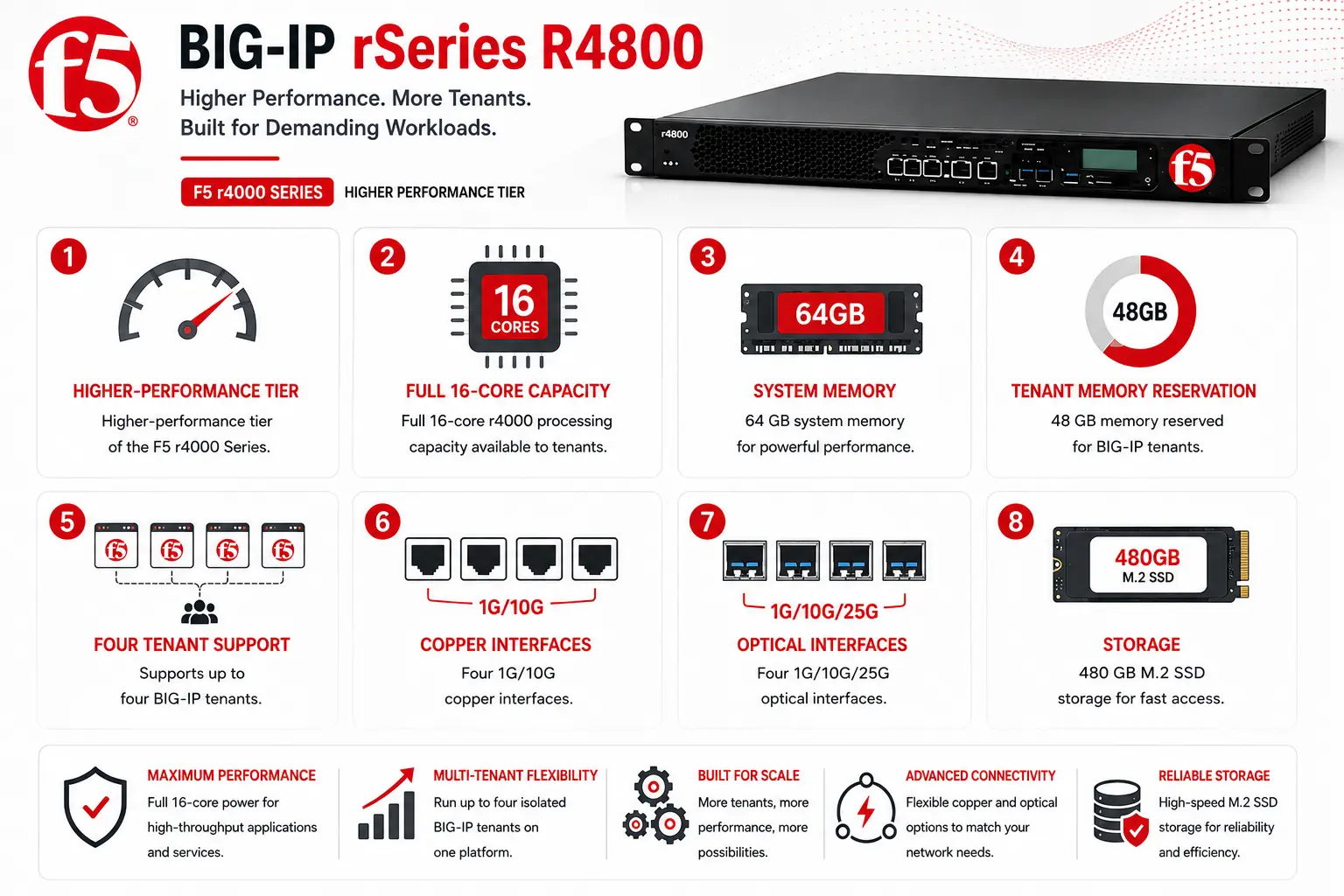
BIG-IP R4800 is the higher-performance tier of the F5 r4000 Series, built for enterprise application delivery and security environments that need the full processing capacity of the r4000 hardware platform. It combines a compact 1RU appliance with 16 CPU cores available to BIG-IP workloads, 64 GB of system memory, 25G connectivity, and support for multiple BIG-IP tenants.
R4800 uses the same physical hardware as R4600, but the licensing difference is significant. R4600 disables four CPU cores, while R4800 exposes all 16 cores to tenants. For an environment with heavier SSL/TLS processing, application security, several BIG-IP services, or a need to separate workloads into multiple tenants, starting at R4800 can be more practical than deploying R4600 and upgrading shortly afterward.
Series Highlights
- Higher-performance tier of the F5 r4000 Series
- Full 16-core r4000 processing capacity available to tenants
- 64 GB system memory
- 48 GB memory reserved for BIG-IP tenants
- Supports up to four BIG-IP tenants
- Four 1G/10G copper interfaces
- Four 1G/10G/25G optical interfaces
- 480 GB M.2 SSD storage
Review BIG-IP R4800 Price List and request a quote tailored to your licensing needs.
BIG-IP R4800 At a glance
What it is: Fully enabled F5 r4000 Series application delivery and security appliance
Product family: BIG-IP rSeries License
Platform software: F5OS
System memory: 64 GB
Memory reserved for tenants: 48 GB
Tenant capacity: Up to four
Storage: 480 GB M.2 SSD
Interfaces: Four 1G/10G RJ45 plus four 1G/10G/25G SFP/SFP+/SFP28 ports
Series Overview
BIG-IP R4800 is built on the r4000 hardware platform, which uses a 16-core Intel Atom processor without hyperthreading. Unlike F5’s larger r5000 and r10000 platforms, no CPU cores are dedicated exclusively to the F5OS layer. On R4800, all 16 cores remain available for tenant workloads.
That capacity can be assigned to one large BIG-IP tenant or divided across several workloads. Current F5 documentation lists four tenants maximum, with tenant sizes beginning at four cores. The appliance has 64 GB of RAM, of which 48 GB is available for tenant allocation. Physically, R4800 remains compact. The 1RU platform provides four copper 1G/10G interfaces and four optical interfaces that can operate at 1G, 10G, or 25G. A single 480 GB M.2 SSD is included.
Licensing and Part Number Guidance
The R4800 designation defines the platform’s available compute capacity; it does not by itself define which BIG-IP License application services are licensed. Depending on the project, the system may run BIG-IP traffic management, application and API security, access controls, DNS, network-security functions, or a combination of services. F5 BIG-IP supports application delivery and security capabilities across L4–L7 workloads, while licensing can be purchased through supported perpetual, subscription, utility, or flexible consumption models.
R4800 is also the PAYG destination for R4600. Because both models use the same r4000 hardware, F5 supports moving from R4600 to R4800 through a license change that unlocks the four CPU cores disabled on R4600. No chassis swap is required for that capacity upgrade. For a new deployment already expected to use substantial r4000 capacity, buying R4800 initially may avoid an additional licensing step later.
Common Use Cases
| Use case | Why R4800 can fit |
|---|---|
| Enterprise load balancing | Full r4000 CPU capacity for larger application environments |
| SSL/TLS processing | Greater processing headroom for encrypted application traffic |
| Application security | Supports licensed BIG-IP security services |
| Workload consolidation | Up to four isolated BIG-IP tenants |
| DNS and access services | Multiple BIG-IP service roles on one physical platform |
| Application segmentation | Separate tenants for teams, applications, or security zones |
| iSeries modernization | Current rSeries architecture for legacy hardware refresh |
| HA deployment | Matching R4800 appliances can host corresponding HA tenants |
For HA, F5 configures redundancy between BIG-IP tenants on separate rSeries systems. F5 requires identical tenant resources for seamless failover and notes that r2000/r4000 HA deployments use MAC masquerade for the applicable tenants.
Models, Licenses, and Ordering Scope
| Area | What to confirm |
|---|---|
| Platform | BIG-IP R4800 |
| BIG-IP services | LTM, security, DNS, access, or required combination |
| Performance | Traffic, SSL/TLS, connections, and inspection workload |
| Tenant design | One large tenant or up to four separated workloads |
| Interfaces | Required 1G, 10G, and 25G connections |
| Availability | Standalone or HA pair |
| Migration | New deployment or R4600 PAYG upgrade |
| Optics | SFP, SFP+, or SFP28 transceivers |
| Power | AC/DC configuration and PSU redundancy |
| Support | Required F5 support coverage and term |
| Part number | Appliance, BIG-IP services, support, optics, and accessories |
What to Check Before Requesting a Quote
The first question is whether the workload really needs the full r4000 tier.
Estimate normal and peak application traffic, SSL/TLS volume, concurrent connections, security inspection, interface bandwidth, and the BIG-IP services that will run simultaneously. Tenant design matters too. If four applications or operational domains need strong separation, R4800 provides more flexibility than R4600’s two-tenant limit.
If the project is replacing iSeries hardware, provide the existing appliance, licensed modules, BIG-IP version, traffic measurements, and HA design. Matching an old model number to a new one is less reliable than sizing the rSeries system around current workload demand.
There is also a platform boundary worth considering. If the design already approaches 16 cores, 48 GB of tenant memory, four tenants, or the r4000 interface ceiling, moving to the r5000 family may offer better long-term headroom than purchasing an R4800 with little capacity left for growth.
Activation and Delivery Notes
Initial R4800 setup begins at the F5OS platform layer. Administrators configure management networking, license the appliance, create VLANs, import the appropriate BIG-IP tenant image, and then deploy the required tenant resources.
Tenants inherit important platform capabilities including licensing, VLANs, and management-interface properties. F5 specifically advises administrators not to replace or remove the system license from inside individual tenants.
Before delivery, confirm the exact BIG-IP entitlement, software compatibility, tenant allocation, optics, power-supply configuration, support coverage, and appliance quantity. The r4000 hardware accepts one or two power supplies, while the appliance itself uses a single 480 GB SSD rather than redundant internal storage.
F5 pricing depends on your product edition, license type, deployment model, traffic needs, term, and support requirements.