

BIG-IQ License provides access to F5 BIG-IQ Centralized Management, a platform designed to simplify the administration, licensing, monitoring, configuration, and lifecycle management of F5 BIG-IP environments. Instead of managing individual BIG-IP systems separately, BIG-IQ provides a centralized management layer for F5 application delivery, security, and networking services.
Quick Benefits
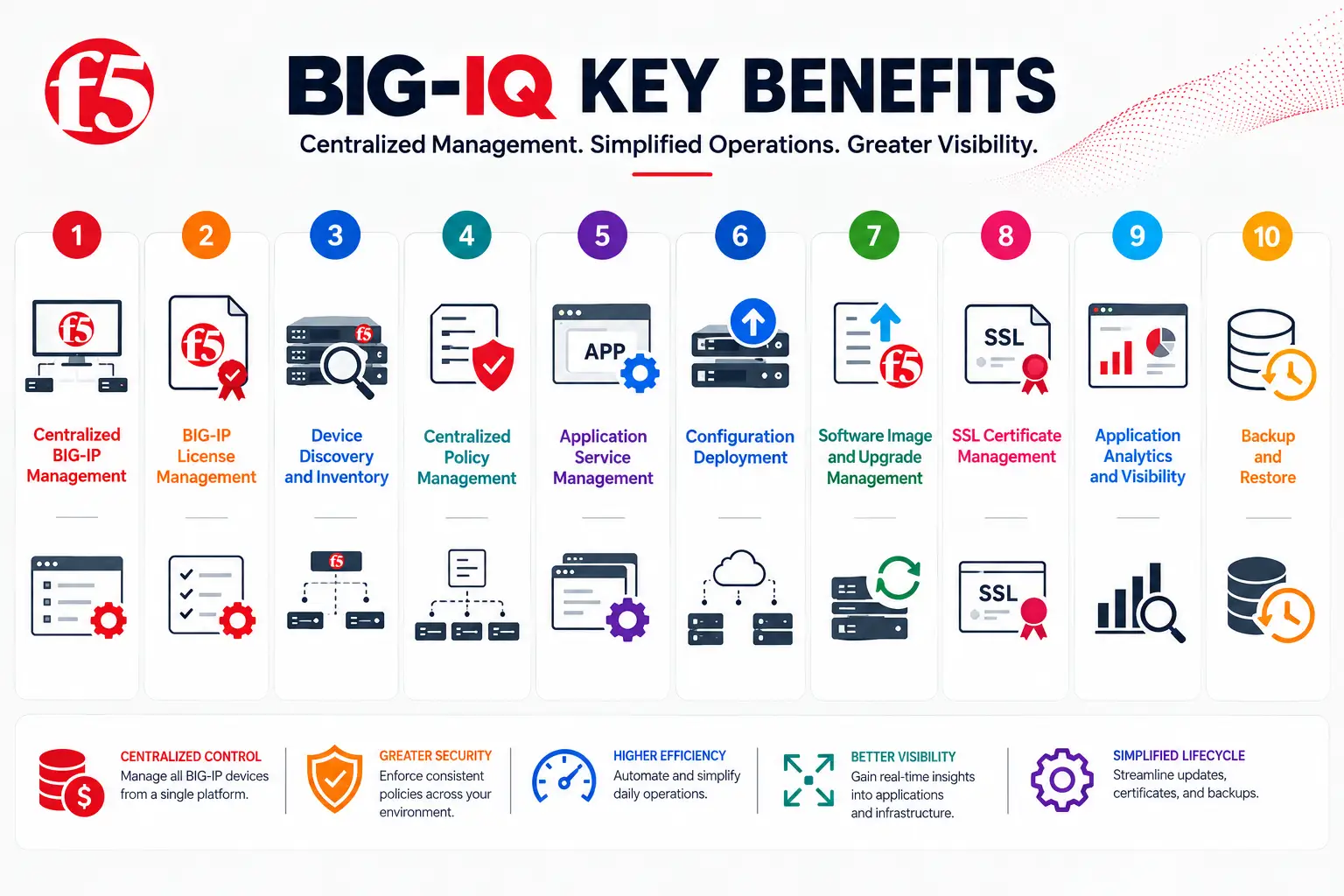
- Centralized BIG-IP management
- BIG-IP license management
- Device discovery and inventory
- Centralized policy management
- Application service management
- Configuration deployment
- Software image and upgrade management
- SSL certificate management
- Application analytics and visibility
- Backup and restore
BIG-IQ License At a Glance
What it is: Centralized management and orchestration platform for F5 BIG-IP environments
Parent product: F5 License
Primary role: Centralized administration, orchestration, monitoring, and license management of BIG-IP systems
Managed platforms: BIG-IP Virtual Edition, physical BIG-IP appliances, VELOS, and supported F5 platforms
Core management areas: Devices, configurations, policies, licenses, certificates, software images, applications, and analytics
Deployment models: Virtual and supported physical appliance deployments
License model: Product-specific subscription and license-management entitlements
License management: Purchased pools, volume pools, utility pools, and registration-key pools for applicable BIG-IP services
License Overview
A BIG-IQ License provides the rights required to deploy and use BIG-IQ Centralized Management and its applicable management capabilities.
BIG-IQ should not be confused with a BIG-IP service license. BIG-IP licenses activate services such as LTM, APM, AFM, Advanced WAF, or other BIG-IP functionality, while BIG-IQ provides centralized management and can also act as a license manager for applicable BIG-IP subscription and Enterprise License Agreement environments.
One of the important functions of BIG-IQ is its ability to organize BIG-IP service licenses into pools. Administrators can then assign, revoke, or reassign applicable licenses to BIG-IP systems from the centralized platform.
This is particularly useful when an organization operates multiple BIG-IP Virtual Edition instances and wants to avoid managing every license directly on individual devices.
How BIG-IQ Licensing Works
BIG-IQ licensing generally involves two related layers:
BIG-IQ Platform License
→ Provides the entitlement required to operate BIG-IQ Centralized Management
BIG-IP Service Licenses
→ Provide the actual application delivery or security services that BIG-IQ manages
The workflow can then look like:
BIG-IQ Deployment
→ Install and configure BIG-IQ
License Activation
→ Activate the BIG-IQ entitlement
BIG-IP Discovery
→ Add physical or virtual BIG-IP systems
License Pool Configuration
→ Add applicable BIG-IP subscription or license pools
License Assignment
→ Assign required services to BIG-IP systems
Centralized Management
→ Manage configurations, policies, certificates, software, and operational data
This distinction is important when preparing a quotation because purchasing BIG-IQ does not automatically mean that every BIG-IP service is licensed.
BIG-IQ Management Capabilities
| Capability | Primary Purpose |
|---|---|
| Device Management | Discover and centrally manage BIG-IP systems |
| License Management | Assign, revoke, and manage applicable BIG-IP service licenses |
| Configuration Management | Deploy and maintain consistent configurations |
| Policy Management | Centralize application and security policies |
| Application Management | Provision and manage application services |
| Analytics | Provide visibility into application health and performance |
| Certificate Management | Monitor and manage SSL/TLS certificates |
| Software Management | Manage software images, upgrades, and lifecycle operations |
| Backup and Restore | Protect BIG-IP configurations and software data |
| Role-Based Access Control | Restrict administrative permissions according to roles |
| Compliance Visibility | Identify configuration and policy inconsistencies |
| Automation | Simplify repetitive BIG-IP management operations |
Licensing Options and Models
| Licensing Option | Description | Suitable For |
|---|---|---|
| BIG-IQ Centralized Management | Core centralized management capability for F5 BIG-IP environments | Organizations operating multiple BIG-IP systems |
| BIG-IQ License Manager | Uses BIG-IQ to manage applicable BIG-IP subscription and ELA licenses | Organizations with centralized BIG-IP licensing requirements |
| Purchased License Pool | Prepaid pool containing a defined quantity of concurrent BIG-IP service licenses | Fixed-capacity environments |
| Volume License Pool | Prepaid subscription pool for a defined number of concurrent BIG-IP service licenses | Organizations requiring multiple BIG-IP VE licenses |
| Utility License Pool | Consumption-oriented licensing based on defined units such as hourly, daily, monthly, or yearly usage | Service providers and variable-demand environments |
| Registration Key Pool | Pool of individual BIG-IP VE registration keys managed through BIG-IQ | Environments requiring flexible license assignment |
| Enterprise License Agreement | Enterprise-oriented licensing arrangement managed through BIG-IQ | Large F5 deployments |
| BIG-IQ Virtual Edition | Virtual deployment of BIG-IQ within supported infrastructure | Virtualized data centers and cloud environments |
Features and Benefits
Centralized BIG-IP Management
Managing a large number of BIG-IP systems individually can create operational overhead.
BIG-IQ provides a centralized interface through which administrators can discover devices, manage configurations, deploy policies, review application information, and perform lifecycle tasks.
This can reduce the need to repeatedly log in to individual BIG-IP systems.
BIG-IP License Management
License management is one of the important functions associated with BIG-IQ.
Applicable BIG-IP service licenses can be organized into pools, allowing administrators to assign licenses when required and revoke them when a device no longer needs a particular service.
For environments using multiple BIG-IP VE instances, this provides a more flexible method of managing available subscription capacity.
License Pooling
BIG-IQ supports different types of license pools for applicable BIG-IP licensing models.
Depending on the agreement, organizations may work with:
- Purchased pools
- Volume pools
- Utility pools
- Registration-key pools
Each model serves a different operational and commercial requirement. For example, a registration-key pool is useful when individual BIG-IP VE registration keys need to be centrally managed, while a utility pool is designed around usage-based licensing.
Compatibility and Requirements
Before selecting a BIG-IQ License, organizations should evaluate:
- Number of BIG-IP systems
- Physical or virtual BIG-IP deployments
- BIG-IP VE requirements
- BIG-IP service modules
- License-management requirements
- Subscription or ELA structure
- Number of license pools
- Application deployment architecture
- Hybrid or multicloud requirements
- Certificate-management requirements
- Software lifecycle requirements
- Configuration-management requirements
Activation and Deployment
A typical BIG-IQ deployment includes:
- Select the BIG-IQ deployment model
- Prepare the virtual or physical infrastructure
- Install BIG-IQ
- Configure management networking
- Activate the BIG-IQ license
- Configure administrative access
- Discover BIG-IP systems
- Establish device-management relationships
- Add applicable license pools
- Activate or import subscription entitlements
BIG-IQ can also be deployed specifically as a license manager when centralized management of BIG-IP subscription or ELA licensing is the primary requirement. In environments without direct Internet connectivity, applicable license activation procedures can be performed through manual licensing workflows.
Pricing and Quote Process
Pricing for BIG-IQ License depends on the required BIG-IQ deployment, licensing scope, managed F5 environment, and applicable commercial agreement.
The quotation should distinguish between:
- The BIG-IQ management entitlement
- BIG-IP service licenses managed through BIG-IQ
- Additional subscription or ELA requirements
Before requesting a quote, prepare:
- Number of BIG-IP devices
- Number of BIG-IP VE instances
- Physical versus virtual deployments
- BIG-IP modules in use
- Number of application services
- Required license pools
- Subscription or ELA requirements
- Utility or volume licensing requirements
For example, an organization with several BIG-IP VE instances may primarily require centralized license pooling, while a large enterprise may need broader BIG-IQ capabilities for configuration, application, certificate, analytics, and lifecycle management. The licensing scope should therefore be calculated from the actual F5 architecture rather than simply the number of BIG-IP appliances.
BIG-IQ pricing depends on your product edition, license type, deployment model, traffic needs, term, and support requirements.