

Tenable Patch Management helps organizations identify missing updates, prioritize remediation, and improve patch visibility across distributed environments.
Quick benefits
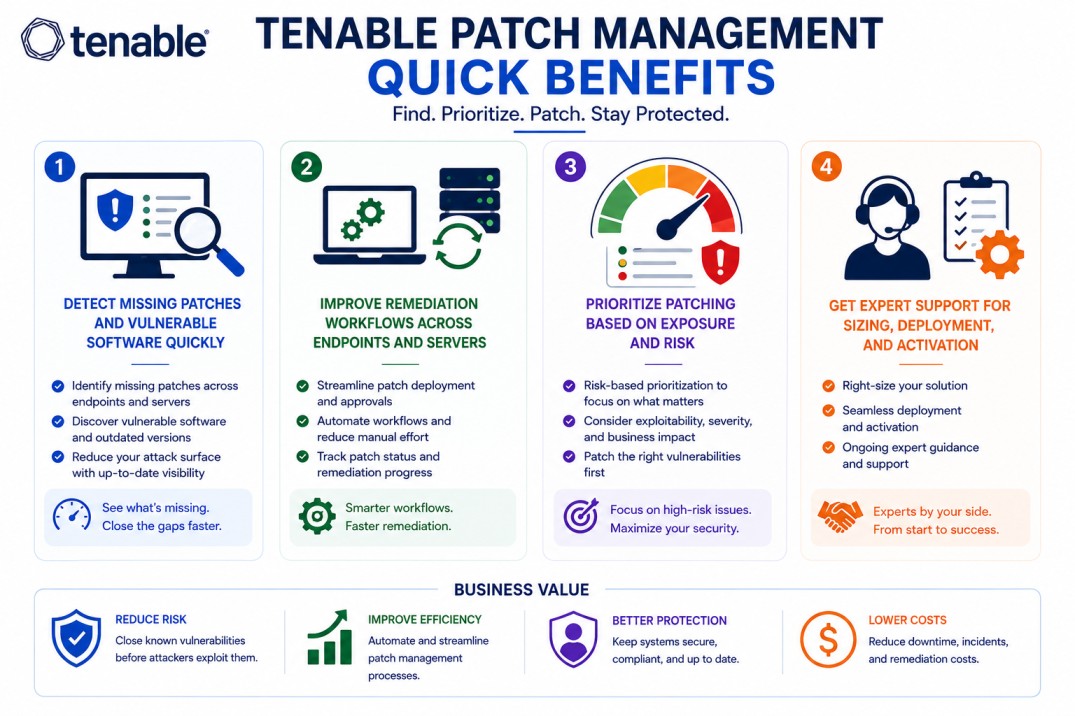
- Detect missing patches and vulnerable software quickly
- Improve remediation workflows across endpoints and servers
- Prioritize patching based on exposure and risk
- Get expert support for sizing, deployment, and activation
Tenable Patch Management At a glance
What it does : Tenable Patch Management helps security and operations teams track missing patches, monitor remediation progress, and improve endpoint visibility.
License type : Subscription-based (asset/endpoints-based)
Typical term : 1 year · 3 years · 5 years
Activation method : Cloud-managed activation via Tenable platform
Who needs it : Organizations that want centralized patch visibility and more consistent remediation workflows across their infrastructure
License Overview
The Tenable Patch Management license is generally aligned with the number of systems being monitored and assessed for missing updates. In most environments, this includes workstations, servers, virtual machines, and other managed endpoints. Because patching requirements often change as environments grow, licensing should reflect the actual operational scope rather than estimated infrastructure size. Organizations with distributed endpoints or multiple locations usually need broader visibility to maintain consistent remediation coverage.
Tenable Patch Management is commonly delivered through a cloud-managed platform, allowing teams to monitor patch status centrally without maintaining dedicated management infrastructure. A properly sized license helps ensure that critical systems remain visible within remediation workflows while avoiding unnecessary licensing overhead.
Product Overview
Tenable Patch Management is designed to help teams move beyond vulnerability detection and focus on remediation progress across the environment.
In practice, the platform continuously evaluates systems for missing patches and outdated software. Instead of treating every update equally, it helps teams prioritize remediation efforts based on exposure and operational impact.
One of the biggest operational advantages is centralized visibility. Security and IT teams can quickly identify which endpoints are missing critical updates and where remediation efforts may be delayed.
The platform also supports distributed environments well. Whether endpoints are located on-prem, remote, or across hybrid infrastructure, patch visibility remains centralized and easier to manage.
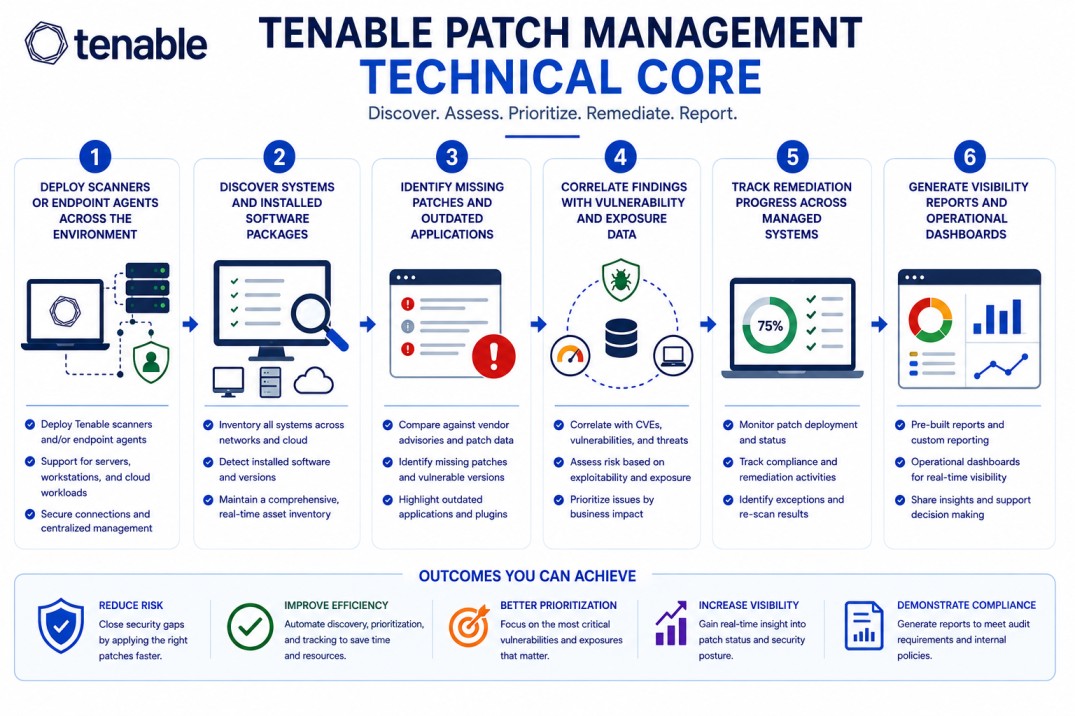
Core technical flow
- Deploy scanners or endpoint agents across the environment
- Discover systems and installed software packages
- Identify missing patches and outdated applications
- Correlate findings with vulnerability and exposure data
- Track remediation progress across managed systems
- Generate visibility reports and operational dashboards
Options & Tiers
| Plan / Model | Best for | Key inclusions | What affects price |
|---|---|---|---|
| Standard patch visibility | Most organizations | Missing patch tracking + reporting | Asset count, term |
| Agent-based deployment | Distributed endpoints | Endpoint-level visibility | Agent coverage |
| Hybrid deployment | Mixed infrastructures | Centralized remediation tracking | Scope, integrations |
| Enterprise deployment | Large environments | Scalable patch operations | Architecture size |
Features & Benefits
Tenable Patch Management helps organizations improve operational consistency around patching and remediation activities. Instead of relying on disconnected reporting or manual tracking, teams gain a centralized view of patch status across systems. One of the key benefits is prioritization. Security teams can focus on updates tied to higher-risk vulnerabilities rather than treating all missing patches equally. It also improves coordination between operations and security teams. With clearer visibility into remediation progress, organizations can reduce delays and respond faster to critical exposure risks. Over time, this leads to more structured remediation processes and better overall endpoint hygiene across the environment.
Compatibility & Requirements
Common environments
- Enterprise endpoints and servers
- Hybrid and distributed infrastructures
- Organizations with centralized remediation workflows
Technical requirements
- Endpoint agents or network scanners
- Access to managed systems
- Internet connectivity for cloud platform access
How activation works
Activating Tenable Patch Management typically begins with provisioning your Tenable cloud environment and applying the appropriate subscription license. Once the platform is active, administrators can deploy scanners or endpoint agents across the infrastructure. These components collect software inventory details and patch status information from managed systems.
As endpoints are discovered, they are counted against the licensed asset capacity. The platform then starts evaluating systems for missing updates and correlating findings with known vulnerabilities. Because the service is cloud-managed, updates and processing are handled centrally, reducing the need for local management infrastructure. After activation, teams should verify that all required endpoints are included within the licensed scope to maintain full remediation visibility and operational coverage.
Pricing factors + quote process
Pricing for Tenable Patch Management usually depends on the number of endpoints and systems included within remediation workflows. Larger environments or distributed infrastructures generally require broader licensing coverage. Deployment approach can also affect pricing. Organizations using agent-based visibility across remote systems may have different operational requirements compared to centralized network-based deployments.
Other factors, such as integration requirements, infrastructure scale, and subscription term, can also influence overall licensing scope. The quote process starts with reviewing your current endpoint environment, patch visibility requirements, and deployment preferences. From there, the appropriate licensing model and operational approach can be recommended.
After you request a quote
- We review your endpoint inventory and deployment model
- Recommend the most suitable licensing approach
- Provide official pricing and delivery details
- Share activation and deployment guidance
Tenable Pricing depends on your license edition, quantity, term, and deployment needs.