

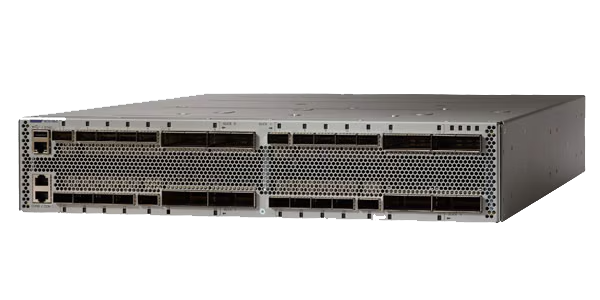
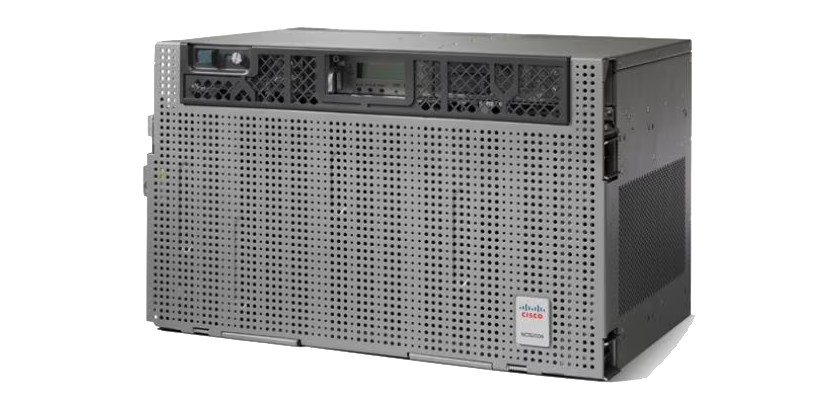



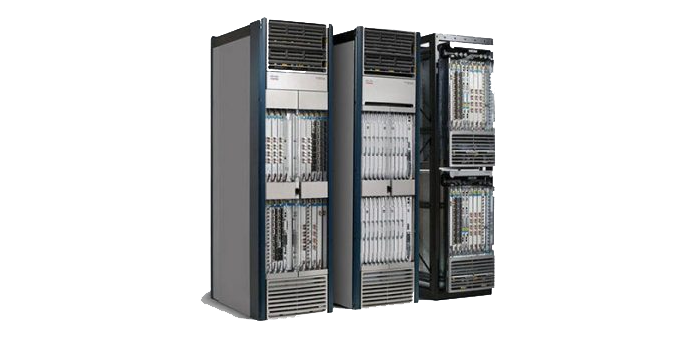
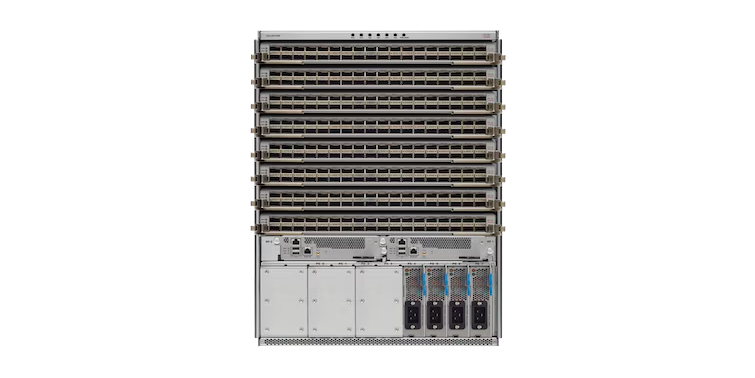
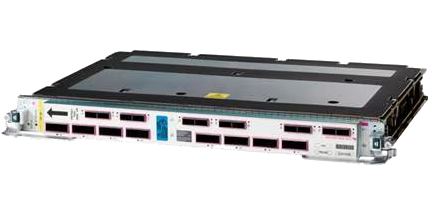
The Cisco NCS License defines how Cisco Network Convergence System platforms enable routing, aggregation, transport, service provider, data center interconnect, and IOS XR software capabilities across high-scale network environments. Licensing is usually planned around the NCS platform family, IOS XR release, feature requirements, bandwidth or port needs, Smart Licensing method, software model, support coverage, and whether the deployment is used for access, aggregation, core, optical transport, or service provider routing.
Key Benefits
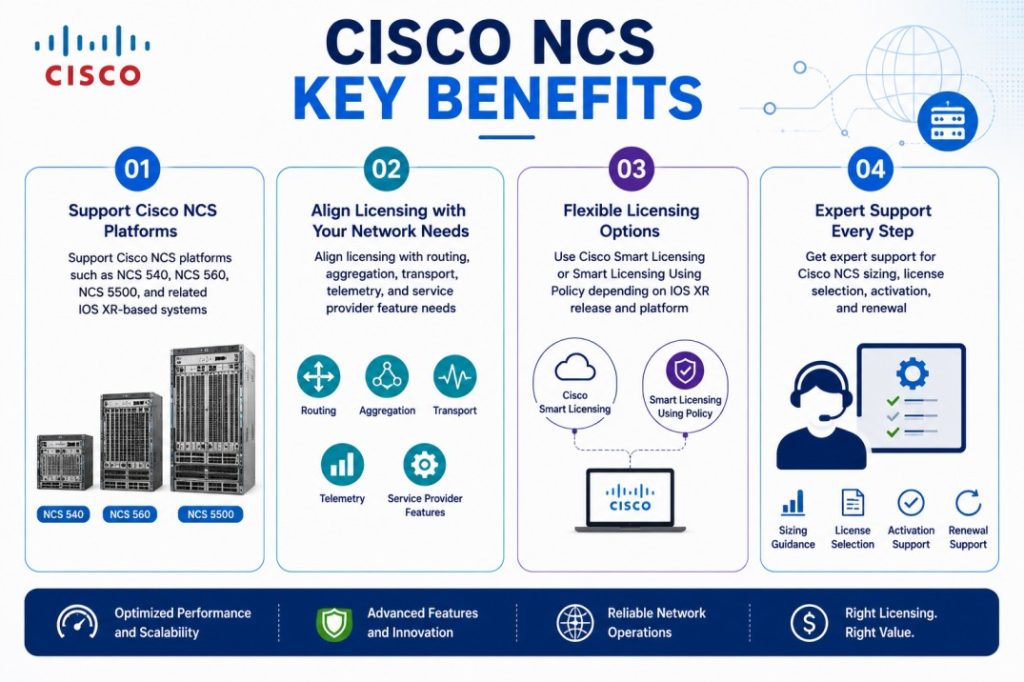
- Support Cisco NCS platforms such as NCS 540, NCS 560, NCS 5500, and related IOS XR-based systems
- Align licensing with routing, aggregation, transport, telemetry, and service provider feature needs
- Use Cisco Smart Licensing or Smart Licensing Using Policy depending on IOS XR release and platform
- Get expert support for Cisco NCS sizing, license selection, activation, and renewal
Cisco NCS License At a glance
What it does : Cisco NCS licensing enables software features and entitlement management for Cisco Network Convergence System platforms used in routing, packet transport, service provider edge, aggregation, optical networking, and high-scale network infrastructure.
Product family : Cisco Router License
License type : Product and release dependent. Cisco IOS XR licensing supports different licensing models across IOS XR platforms, and Cisco documents Smart Licensing, Smart Licensing Using Policy, and platform-specific licensing references for NCS 540 and NCS 5500 platforms.
Typical term : Depends on platform, software model, support coverage, and ordering path. Cisco’s IOS XR perpetual licensing model can be used with Cisco NCS 540 and 560 routers, while other NCS deployments may use feature-based, subscription, or Smart Licensing-managed entitlement models depending on the platform.
Activation method : Cisco Smart Licensing or Smart Licensing Using Policy, with usage reporting through Cisco Smart Software Manager, Smart Software Manager On-Prem, Cisco Smart Licensing Utility, or supported disconnected workflows depending on platform, IOS XR release, and environment restrictions.
Who needs it : Organizations deploying Cisco NCS platforms for service provider routing, carrier Ethernet, WAN aggregation, metro networks, core routing, data center interconnect, optical transport, and high-performance network convergence.

License Overview
Cisco NCS licensing is not one fixed model across every platform. The right Cisco NCS License depends on the NCS family, IOS XR release, hardware model, deployment role, and the software capabilities required by the network.
For Cisco NCS 540 and NCS 560 routers, Cisco documents an IOS XR perpetual licensing model that allows customers to pay up front and avoid recurring renewals for that licensing model. This is relevant for organizations that prefer a long-term software entitlement model for eligible IOS XR routing platforms.
For Cisco NCS 5500 Series routers, Cisco IOS XR licensing references include Smart Licensing as a flexible cloud-based model used to manage software licenses and entitlements across an organization. Cisco also describes NCS 5500 software feature licenses as being mapped to specific network use cases and feature sets.
Because Cisco NCS environments can include access routing, aggregation routing, core routing, data center interconnect, high-density 100G/400G designs, optical transport, or service provider edge functions, licensing should be planned around the actual network role rather than only the platform name.
A properly aligned licensing model helps organizations avoid feature gaps, maintain entitlement compliance, support IOS XR software planning, and keep Cisco NCS capabilities aligned with the intended network architecture.
Product Overview
Cisco NCS platforms are commonly used in networks where scale, convergence, performance, and availability are critical. These environments may include service provider networks, large enterprise backbones, metro aggregation, data center interconnect, and transport-heavy network architectures.
In a smaller deployment, Cisco NCS may be used for access or aggregation routing. In larger environments, it may support high-density interfaces, segment routing, MPLS, telemetry, optical integration, large-scale routing tables, or carrier-grade transport functions.
The selected license determines which software capabilities, feature sets, and entitlement workflows are available for the platform. That makes license planning important before deploying new NCS routers, upgrading IOS XR software, enabling advanced features, or expanding capacity.
One of the main operational advantages is architecture-based licensing. Instead of treating every NCS platform the same, teams can plan licensing according to the role of the device in the network. For organizations using Cisco NCS within a broader Cisco Networking strategy, architecture-based licensing supports cleaner planning, better entitlement control, and more predictable lifecycle management across converged routing and transport environments.
Core technical flow
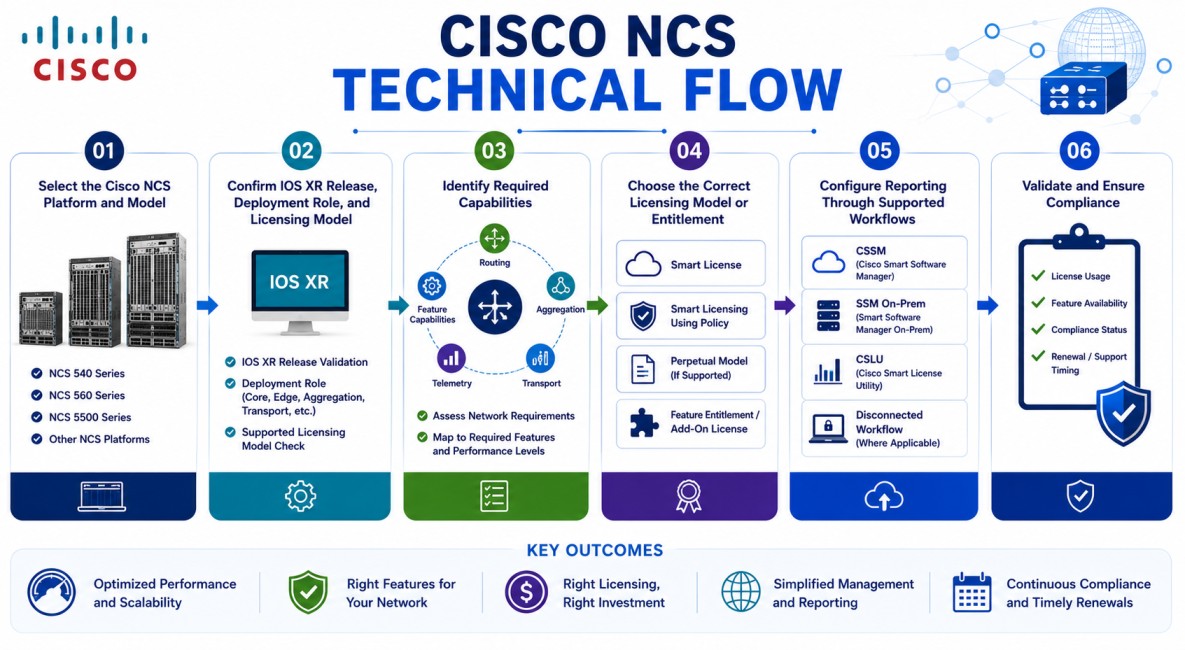
- Select the Cisco NCS platform family and hardware model
- Confirm IOS XR release, deployment role, and supported licensing model
- Identify required routing, aggregation, transport, telemetry, or feature capabilities
- Choose the correct Smart License, Smart Licensing Using Policy workflow, perpetual model, or feature entitlement
- Configure reporting through CSSM, SSM On-Prem, CSLU, or a supported disconnected workflow
- Validate license usage, feature availability, compliance status, and renewal or support timing
Options & Tiers
| Licensing Model | Best for | Typical Scope | What affects pricing |
|---|---|---|---|
| IOS XR perpetual licensing | Eligible NCS 540 / 560 deployments | Long-term software entitlement model | Platform and feature scope |
| Smart Licensing | IOS XR entitlement management | Cloud-managed license visibility and usage tracking | Platform and license type |
| Smart Licensing Using Policy | Modern IOS XR deployments | Usage reporting and compliance workflow | IOS XR release and reporting model |
| Feature-based licensing | Specific NCS capabilities | Platform or use-case-specific feature enablement | Required feature set |
| SLR / disconnected workflow | Restricted environments | Controlled or air-gapped licensing process | Security and connectivity model |
| Support and renewal coverage | Operational continuity | Software access, support, and lifecycle planning | Term and support level |
Features & Benefits
As service provider and enterprise backbone networks grow, licensing becomes important for keeping software capabilities aligned with real infrastructure requirements.
A well-planned Cisco NCS License helps organizations enable the correct routing, transport, telemetry, aggregation, and service-edge capabilities for each platform role.
One major benefit is operational scalability. Cisco NCS platforms are often deployed in high-scale environments, so licensing should support both current feature needs and future network expansion.
Another benefit is clearer license governance. Cisco Smart Licensing and Smart Licensing Using Policy provide structured ways to report usage, manage entitlements, and keep license visibility aligned with Cisco Smart Software Manager workflows. Cisco’s IOS XR Smart Licensing Using Policy documentation notes that SLP is enabled by default on new IOS XR devices and that existing Smart Licensing devices can use it after upgrading to supported IOS XR releases.
Over time, this helps organizations reduce licensing uncertainty, simplify IOS XR lifecycle planning, and maintain better control over Cisco NCS deployments.
System Requirements
Common environments
- Cisco NCS 540 and NCS 560 routing environments
- Cisco NCS 5500 / 5700 aggregation and core deployments
- Service provider edge, metro, and aggregation networks
- Data center interconnect and high-capacity WAN networks
- Optical and packet transport environments using NCS platforms
Technical requirements
- Supported Cisco NCS hardware model
- Compatible Cisco IOS XR software release
- Correct feature, software, or platform entitlement
- Cisco Smart Account and Virtual Account access where applicable
- CSSM, SSM On-Prem, CSLU, or disconnected reporting workflow depending on environment
How activation works
Activating Cisco NCS licensing usually starts with confirming the NCS platform, IOS XR version, supported licensing model, and Cisco Smart Account where the entitlement is available.
For many IOS XR deployments, Cisco Smart Licensing or Smart Licensing Using Policy is used to manage license reporting and entitlement compliance. Cisco’s IOS XR licensing collection provides licensing guidance for IOS XR products, while platform-specific NCS licensing references explain how licensing is handled for NCS families such as NCS 540 and NCS 5500.
In connected environments, license usage can be reported through Cisco Smart Software Manager. In controlled environments, organizations may use Cisco Smart Licensing Utility or Smart Software Manager On-Prem. For restricted or classified environments, Cisco NCS 540 documentation identifies Specific License Reservation as a solution designed for environments that do not allow electronic communication in or out.
For newer IOS XR releases, activation planning should also consider transport changes. Cisco’s IOS XR Smart Licensing Using Policy documentation states that starting with IOS XR Release 25.3.1, Call Home transport mode is no longer supported, and CSLU or Smart Transport should be configured for licensing operation.
After activation or reporting configuration, administrators should validate license usage, entitlement status, feature availability, platform compliance, and support or renewal timing.
Pricing factors + quote process
Pricing for Cisco NCS licensing usually depends on the NCS model, IOS XR software model, required feature set, port speed, bandwidth requirements, deployment role, support coverage, and activation method.
A Cisco NCS 540 access or aggregation deployment may have a different licensing scope than an NCS 5500 or 5700 core and aggregation environment. Optical NCS platforms, packet transport systems, and high-capacity service provider deployments may also require more detailed software and feature planning.
Additional considerations such as Smart Licensing method, perpetual licensing eligibility, disconnected workflow requirements, service provider feature needs, telemetry, line card capabilities, renewal timing, and Cisco support coverage can also influence the final quote.
During the quote process, NCS inventory, IOS XR release, architecture role, feature requirements, and activation model are reviewed first so the licensing approach can match the organization’s routing and convergence strategy more accurately.
After you request a quote
- We review your Cisco NCS model and deployment architecture
- Identify the correct IOS XR, feature, perpetual, or Smart Licensing scope
- Provide official pricing and delivery details
- Share activation, reporting, and renewal guidance
Cisco NCS pricing depends on your router series, license type, deployment model and support requirements.